Is Nitrogen Reflow Worth the Investment? A Buyer’s Cost Model
Evaluate nitrogen reflow using your process evidence, measured gas demand and incremental ownership cost.
5 min read
Nitrogen reflow is worth evaluating when it addresses a defined process requirement or produces a measured economic benefit. It is not automatically the right upgrade for every lead-free assembly, and a low oxygen figure alone does not establish a return on investment.
For procurement, separate two questions. First, does the assembly need the proposed atmosphere to meet its agreed quality requirements? Second, what does maintaining that atmosphere cost at your factory’s actual workload? Answering both gives you a stronger purchase decision than comparing oven prices or repeating a generic yield-improvement claim.
Define the reason before choosing an oxygen target
Write down the problem you want to solve. That may be a customer-specified process condition, an observed soldering issue or a material combination that needs application trials. Include the paste, board finish, component terminations and existing thermal profile in the review.
Nitrogen reduces oxygen exposure, but its effect on your assembly must be validated. It should not be presented as a universal cure for voiding, bridges, poor printing or placement errors. Nor should every observed improvement be attributed to nitrogen if other process settings changed at the same time.
Work with your process and quality teams and relevant material suppliers to define acceptable results. If a customer mandates an atmosphere condition, document exactly what must be measured and recorded. A compliance-driven requirement may justify the investment even when direct rework savings alone would not.
Do not buy the lowest ppm number by default
Oxygen concentration is commonly expressed in parts per million, or ppm. The useful target is the condition your validated process requires—not necessarily the lowest number a supplier can demonstrate in an empty oven.
A Heller technical paper on reflow costs and nitrogen control explains the relationship between oxygen targets, changing board loads and nitrogen control. It describes why lower oxygen targets can demand more nitrogen and why application-specific control matters. It is technical background, not a current gas-price source or a FAROAD performance guarantee.
Ask suppliers to identify the measurement location, instrument, calibration method and production conditions behind a quoted oxygen result. A stable measurement at one location does not by itself describe every point along the board’s path.
Specify the atmosphere package, not just the oven family
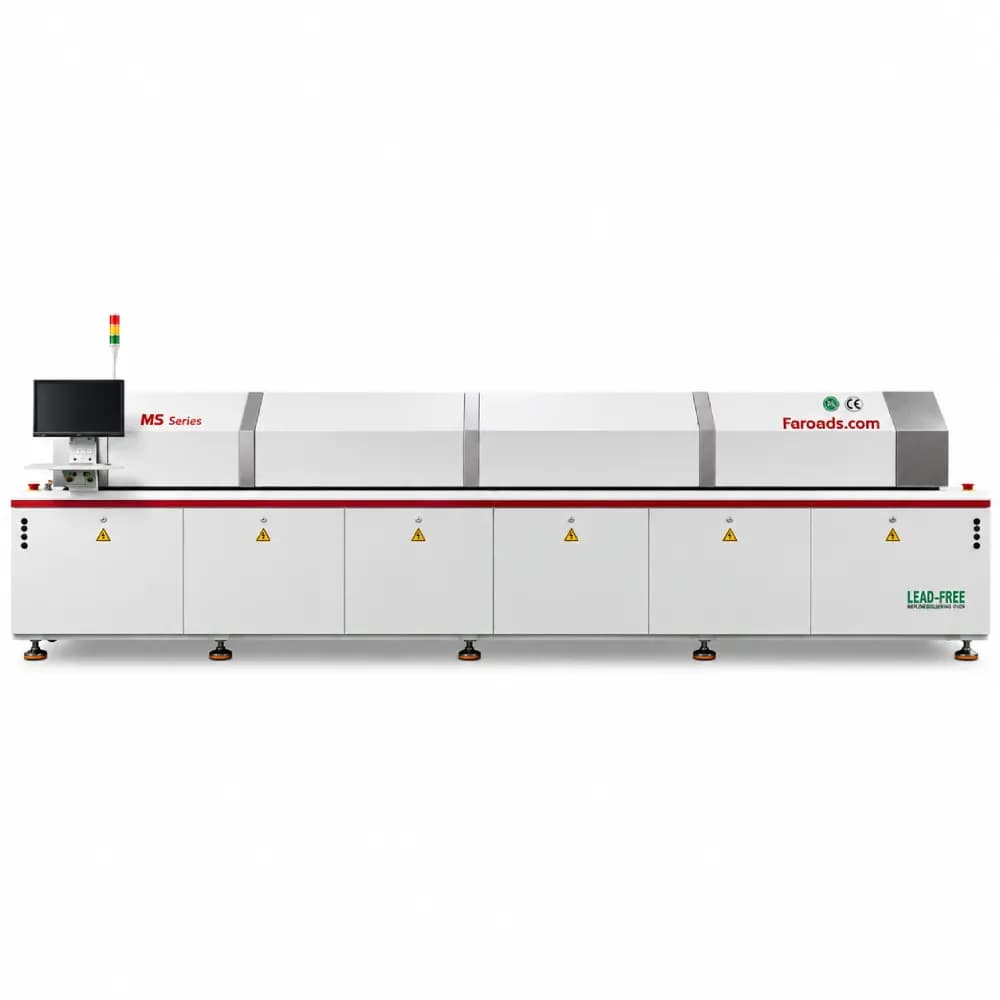
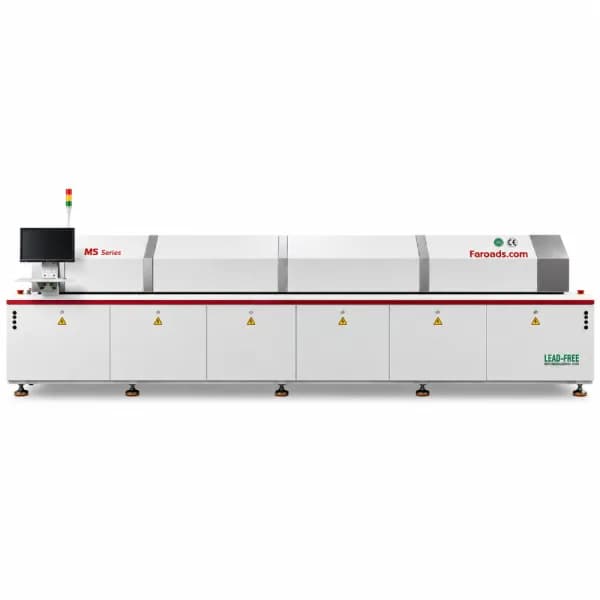
The FAROAD MS-10 page distinguishes the standard air MS-10 from the MS-10N with a nitrogen protection device. It lists an oxygen analyzer, nitrogen flow meter and external water cooler for the nitrogen configuration.
Use those items as the starting point for a written scope. Confirm what is supplied, what the facility must provide, and which installation connections and controls are included. Ask how oxygen is monitored, whether gas flow is automatically regulated and how alarms and production records work in the quoted version.
Do not infer a guaranteed oxygen level, gas-saving percentage or specific consumption from a feature name. Request a measured operating proposal for your target atmosphere, panel mix, conveyor settings and loading pattern. Compare nitrogen configurations within the FAROAD reflow range
Evaluate each option on that same measured basis.
Measure more than steady-state consumption
Gas demand during continuous production may differ from startup, idle and recovery. A factory with short lots and long gaps needs a different cost model from a line running a stable product all day.
Request consumption information for four defined states:
Consumption state: Initial purge and warm-up under the proposed start procedure.
Consumption state: Normal loaded production at the agreed oxygen target.
Consumption state: Planned idle periods with the proposed operating settings.
Consumption state: Recovery after a normal interruption or product change.
Record the time spent in each state during a representative shift. Also agree gas pressure, purity, flow units and the reference conditions for those units. Do not combine standard cubic feet, normal cubic meters and actual-volume measurements without a consistent conversion basis.
Build the incremental annual cost
Compare the nitrogen proposal with the alternative you would actually buy or continue operating. The incremental investment may include the atmosphere package, gas infrastructure, monitoring, cooling, commissioning and validation work. It is not always the entire oven price.
For annual operation, use measured or quoted flow for each state multiplied by its annual hours and the applicable delivered gas price. Add startup purge consumption separately if it is not already included. Include rental or supply charges, maintenance and any incremental utilities.
If nitrogen generation is being considered, obtain a separate facilities proposal. Compressor demand, gas quality, backup supply, maintenance and capacity at the required purity belong in that comparison. A generator’s headline output is not automatically the usable supply available at the oven connection.
For sites in the United States, Canada or Mexico, use the local facility’s written supply quote and agreed billing currency. National averages are a poor substitute for a delivered price with the actual supply terms.
Use a transparent break-even example
The following numbers are illustrative only. They are not FAROAD quotations, gas-consumption specifications or market-price estimates.
Assume incremental installed investment of $30,000. Suppose production consumes 18 normal cubic meters per hour for 3,000 hours annually, while idle operation consumes 6 normal cubic meters per hour for another 1,000 hours. Annual consumption in those two states is 60,000 normal cubic meters.
At an assumed delivered gas rate of $0.25 per normal cubic meter, annual gas cost is $15,000. Add an assumed $3,000 for other incremental annual costs and the modeled operating increase is $18,000. Startup purge is excluded here and must be added if material to the actual proposal.
If your required simple payback is three years, the project needs annual benefits of $28,000: $18,000 to cover the extra operating cost and $10,000 toward recovering the $30,000 investment. Financing, tax and discounting are excluded from this simple screening model.
Suppose documented avoidable rework costs $14 per affected panel. If rework reduction is the only credited benefit, the project would need to avoid 2,000 such events annually to reach that $28,000 threshold. Your real trial must establish whether that benefit is plausible; the example does not predict a yield change.
Validate the benefit without double-counting it
Compare representative assemblies using controlled materials and documented settings. Record the defect types that nitrogen is intended to address, accepted output, rework effort and any remaining quality limitations. Define sample size and confidence requirements with the quality team.
Separate observed savings from opportunities. Recovered capacity becomes revenue only if there is demand and the rest of the factory can deliver it. Reduced operator effort becomes a cash saving only when the expense is actually avoided or the time has a separately justified use. Do not count one recovered panel as both avoided scrap and additional sales without reconciling the baseline.
Include a sensitivity case for higher gas cost, fewer operating hours and a smaller process improvement. A proposal that only works at the most optimistic assumptions deserves another review.
Request an atmosphere-specific proposal
Send the assembly information, paste requirements, oxygen requirement if already defined, product loading schedule, utility details and gas-supply basis. Ask for trial evidence and a configuration-specific consumption estimate, with startup and idle behavior clearly identified.
Request a FAROAD nitrogen reflow quotation with those conditions attached. The buying goal is not the smallest ppm number. It is the required assembly result at an ownership cost your factory can defend.