Faster SMT Changeovers: When Do Extra Feeders and Carts Pay Back?
Compare feeder duplication, offline preparation and shared setups before investing in more placement speed.
5 min read
For a high-mix factory, another set of feeders or a better preparation workflow can sometimes be more valuable than a faster placement head. The reason is practical: a machine does not place components while the next job is being made ready.
That does not mean every factory should buy more carts or duplicate every feeder. The right investment depends on the product schedule, material overlap and work that actually stops the line. This guide helps buyers decide whether a setup package deserves its place in an SMT equipment quote.
Measure a changeover that matters to the business
Use a consistent boundary: the last accepted panel of product A to the first accepted panel of product B, measured at the same agreed output point. That captures production readiness rather than just the moment a new program appears on the screen.
Break the interval into activities: line clearance, material verification, feeder and nozzle work, board support, program selection, printing setup, oven readiness and first-article approval. Record which tasks happen simultaneously and which wait for another task to finish.
Keep upstream stop time and downstream flow effects visible. If boards from the old product are still in the oven, a simple stopwatch at the mounter may misrepresent the line-level result. Use the same measurement method before and after an improvement.
Find the actual critical path before buying hardware
If feeder preparation takes 25 minutes but can happen while the current job runs, it may not need to be line-stop time. If first-article approval takes another 20 minutes after mechanical setup, a faster cart exchange will not remove that approval delay.
Observe several real changes rather than timing one carefully rehearsed demonstration. Include a difficult transition with different tape widths, tray components or underside support. Also include a repeat job to see whether stored programs and established setups actually reduce the work.
Ask the production team what prevents offline preparation today. The constraint could be too few spare feeders, missing verification tools, incomplete kits, restricted floor space or unavailable staff. Different causes need different purchases—or sometimes no new machine option at all.
Compare three ways to reduce setup loss
Duplicate preparation capacity. Extra feeders and compatible carts may allow the next job to be prepared while the current one runs. Include the preparation station, verification method, storage and feeder maintenance workload in the scope.
Shared setups. Product families using many common parts may keep a common feeder arrangement across several jobs. That can reduce physical changes, but may affect placement travel and cycle time. Compare the complete schedule, not only the saved setup minutes.
Software-assisted setup. Program preparation, component-library management and material verification may reduce repeated work or errors when configured appropriately. Identify the exact function, inputs, licenses and operator actions. “Quick changeover” is not a measurable specification by itself.
Yamaha concepts such as common setups and coordinated product changes are useful for a buyer’s comparison, but Yamaha’s implementation Yamaha’s automatic setup discussionan.d reported results should not be treated as FAROAD capabilities or expected savings. Reference:
Match the FAROAD options to the proposed workflow
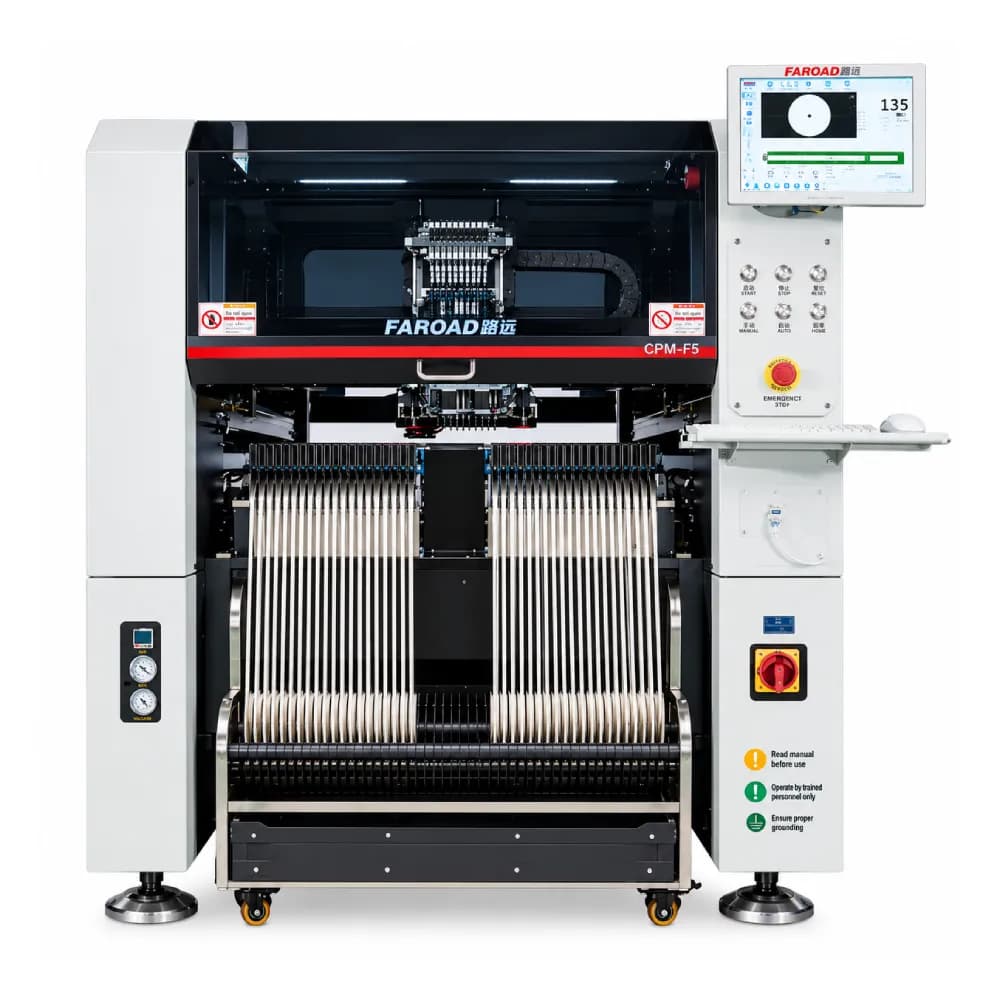
The FAROAD CPM-F6 page lists a dock cart, nozzle station, tray cabinet and QR-code-based quick model switching among its options. It also describes coordinate import and component-database synchronization.
Ask what each selected option changes in the actual preparation sequence. Can the next job be built and verified offline? Which items must still be changed at the machine? How are program, material and nozzle readiness confirmed? Obtain those answers for the quoted software and hardware configuration.
The page expresses feeder capacity in 8 mm slot terms. Build the proposed setup from actual tape widths, tray needs and the component list. A count of available slots is not the same as the number of mixed-width feeders that fit your next job.
Use the high-mix / low-volume solution as a project starting point, then ask for an itemized setup package rather than assuming that every option is standard.
Put a value on recovered line time
Consider an illustrative factory with four product transitions per shift. Suppose the measured average production gap is 30 minutes and a demonstrated setup package reduces it to 15 minutes. That recovers 60 minutes per shift. At an assumed accepted running rate of 80 panels per hour, the recovered time represents capacity for up to 80 additional accepted panels per shift—only if materials, downstream operations and customer demand permit it. This is planning arithmetic, not a machine-output promise.
Alternatively, the value may be avoided overtime or better on-time delivery. Choose the benefit that matches the factory’s constraint. Do not count hypothetical extra sales, avoided overtime and saved operator time as though all necessarily occur together.
Measure offline labor separately. Moving 30 minutes of preparation away from the stopped line is valuable, but it does not make those 30 minutes of work disappear. The economic benefit is often more productive use of the expensive line, not fewer total labor minutes.
Compare the complete investment with a conservative payback
An illustrative setup package might require $24,000 of incremental investment. If the factory can substantiate $12,000 per year in avoidable overtime after accounting for extra preparation labor, software and maintenance, simple payback is two years.
That is a sample decision model, not a current equipment price or FAROAD savings claim. Replace every assumption with quoted costs and demonstrated time changes. Include extra feeders, carts, setup tools, licenses, training, storage and any recurring support or verification costs.
Run a lower-frequency scenario. If customer schedules change and transitions fall by half, does the package still make sense? Also consider whether existing staff can reliably complete the next setup before the current job ends. More hardware alone will not fix incomplete material kits.
For United States, Canadian and Mexican plants, use the receiving site’s actual staffing pattern and cost basis. Keep supplier quotes and local costs in a consistent currency. Do not assume a labor-rate saving that the site cannot actually realize.
Test the workflow, including the first accepted panel
Use a transition between two of your own representative products. Agree what can be prepared in advance and give both proposals the same preparation opportunity. Time the operator work and line stop separately.
A useful demonstration checks the following items:
Demo check: Completeness and verification of the next material kit.
Demo check: Feeder, nozzle, support and program changes actually required.
Demo check: Safe movement, docking and storage of the proposed carts.
Demo check: Detection and resolution of a deliberately selected setup mismatch under an agreed procedure.
Demo check: Time to the first accepted panel and readiness to sustain the next lot.
Record remaining manual tasks and exceptions. A rapid cart exchange is only one event inside the larger changeover. If printing setup or first-article review remains the limiting task, address that dependency in the project plan instead of promising the feeder package will eliminate it.
Request a setup proposal around the real schedule
Send several consecutive jobs, BOMs, tape and tray formats, lot sizes, current changeover observations and available preparation staffing. Identify shared components and products that require different supports or nozzles.
Request a FAROAD high-mix configuration review asking for a base machine proposal and a separately priced setup package. Compare both against the same schedule and acceptance trial. That turns a vague promise of flexibility into a practical purchasing decision: how much productive time the package can recover, at what cost, and with what work still required.