SMT Line Capacity Planning Before You Request Quotes
Plan an SMT line around good-board output, product mix, bottlenecks and acceptance criteria. Build a scope that makes equipment quotes comparable.
4 min read
Buying a complete SMT line is an integration decision. A group of individually capable machines can still miss the production target if the printer, placement system, oven and inspection station operate at incompatible rates or require different board handling.
The most useful starting point is not a preferred machine brand or maximum CPH. It is a written capacity brief that defines the products, the required good output and the time available to make them. Use the process below to turn a broad project into a quote-ready specification.
Define exactly what output means
State whether the target is panels per hour, individual PCBs per shift or accepted assemblies per day. Define both sides of a double-sided product. A two-sided board may need two printing, placement and reflow passes; the routing must be included in the capacity model.
An illustrative factory target of 1,200 accepted panels in eight hours is an average of 150 good panels per hour. If planned activities leave six hours of actual production time, the running requirement becomes 200 good panels per hour. The running takt is then 18 seconds per good panel, before any additional allowance for rejected panels.
These figures are planning examples. Use your own production calendar, maintenance plan and measured quality performance. Avoid counting the same downtime allowance twice in separate utilization assumptions.
Model a product mix, not a single ideal board
Create a routing sheet for each important product family:
Panel size, thickness and weight — Mechanical transport and support.
Placements and component types — Head configuration, feeders and placement time.
Stencil and paste process — Printing time, cleaning and inspection.
Thermal constraints — Oven profile, conveyor speed and cooling.
Lot size and frequency — Setup losses and offline preparation.
Quality requirements — Inspection coverage, review and traceability.
Include anticipated products within the planning horizon. Buying for every theoretical future possibility can waste capital, but ignoring a likely larger panel or additional product family can create an early upgrade requirement.
Find the limiting operation
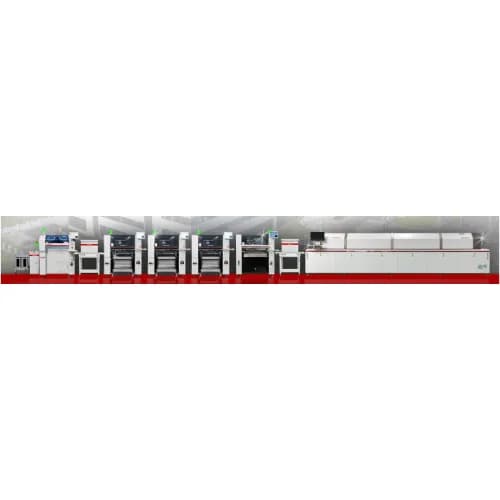
A typical FAROAD SMT line includes loading, printing, SPI, placement, reflow, AOI and unloading. Each step has a different capacity driver.
Printing must include alignment, printing, separation and the effect of periodic cleaning. Placement needs a board-specific cycle estimate. Inspection depends on the selected program and coverage, not only camera speed. Handling needs enough capacity to prevent blocked transfers and unmanaged rejects.
The oven is different again: several boards can be in it simultaneously. Its profile duration is not the interval between completed boards. Board pitch and belt speed establish conveyor throughput, while heated length must support the necessary process time.
Ask each supplier to present a station-by-station capacity table using the same panel definition. The bottleneck is the lowest effective rate under the proposed operating conditions.
Separate machine running time from factory output
Peak equipment capability is not an eight-hour production forecast. Manufacturers may publish placement speed under optimum conditions; the YSM40R specification makes that qualification explicit.
Build an operating model that also includes material replenishment, program changes, maintenance, first-article checks and fault recovery. Decide which activities happen during production and which can be moved offline.
Buffers can reduce the effect of short interruptions, but they do not correct a sustained capacity deficit. If one station is permanently slower than demand, extra work-in-progress simply accumulates before it.
Define where the supplied line starts and ends
An SMT quote may not include all the activities needed to ship a product. Depending on the assembly, the wider process may require depaneling, through-hole insertion, additional soldering, cleaning, programming, electrical test or coating.
Document which operations are inside this project and which remain outside it. This is particularly important when a proposal uses the word “turnkey.” The contract should identify equipment, tooling, software, documentation and responsibility—not rely on a broad label.
Check the layout as an operating space
Machine footprints alone do not establish whether a line fits. Include access for feeder carts, maintenance, materials, operator movement, reject handling and delivery or rigging.
Confirm board direction, fixed rail, transfer height and mechanical compatibility at every interface. List electrical supply, compressed air, exhaust and any atmosphere or cooling needs. Have qualified facility personnel review those requirements for the actual site.
For data integration, specify the required functions: board identity, recipe selection, event reporting or traceability. A general “MES-ready” statement is not evidence that every requested function is included or compatible.
Request a phased commercial proposal
Ask suppliers to separate required equipment, productivity options and potential expansion items. A phased proposal can show what the initial line supports and what changes would be needed at higher volume.
Compare landed project scope rather than base machine prices. Include feeders, nozzles, stencils, fixtures, software, commissioning, training and agreed spares. Get warranty and support terms for the destination in writing.
Make acceptance about the agreed product mix
Define the representative assemblies, material readiness, staffing assumptions, run duration, acceptable quality and reporting method. Include a changeover if changing products is central to the business case.
A convincing result is repeatable accepted output under documented conditions. A brief run of the simplest board does not establish capacity for a mixed production schedule.
Prepare your line-planning brief
Send board drawings, BOMs, placement data, routing, hourly and daily targets, lot sizes, shifts, inspection requirements, factory layout and details of retained equipment. Mark uncertain assumptions so they can be resolved before the configuration is fixed.
Use the complete SMT line page as a starting point, then request a line proposal. Ask for a balanced station-capacity model and an explicit scope. That gives you a purchase decision tied to output rather than a collection of impressive specifications.