PCB Loaders and Unloaders: A Buyer’s Compatibility Checklist
Choose board handling equipment around magazines, assembly clearance and refill workload—not just maximum PCB size.
5 min read
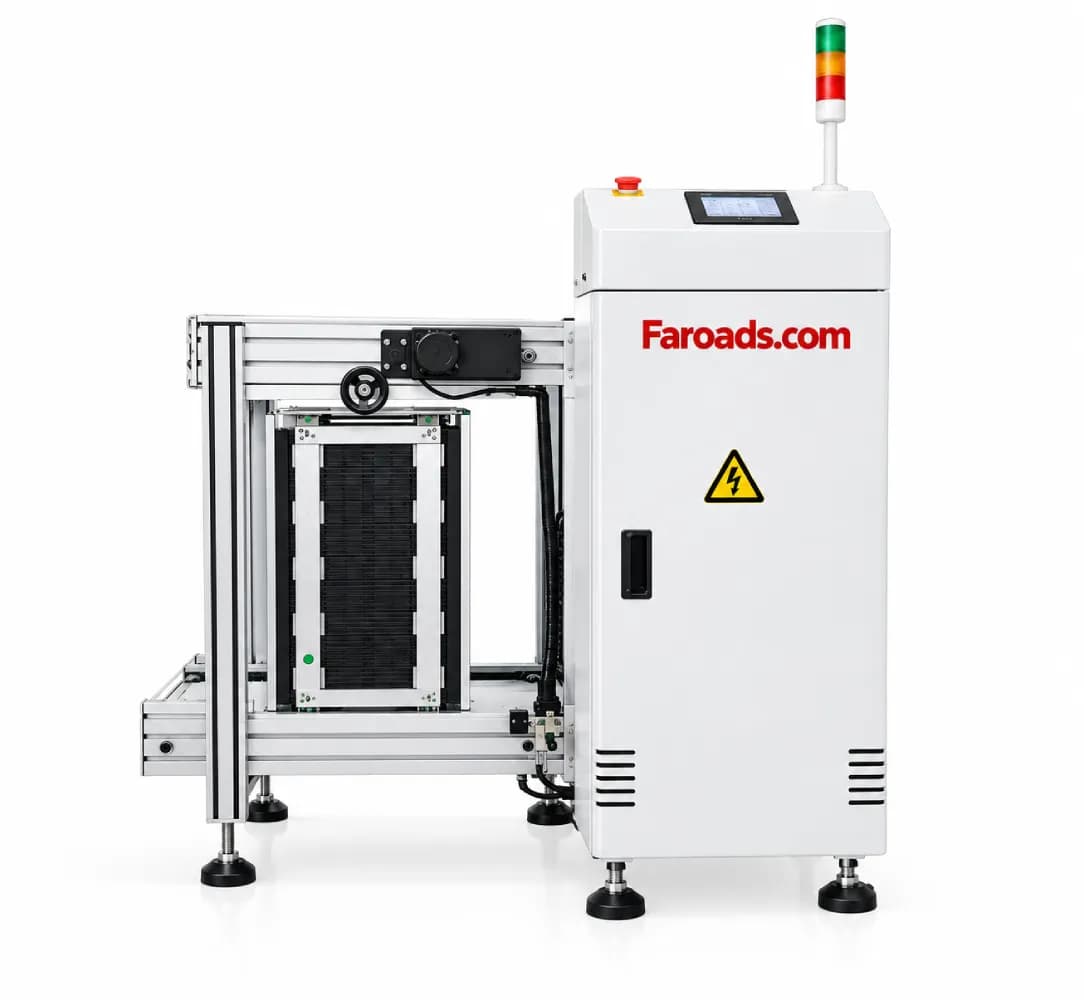
A PCB loader can save operators from feeding individual boards, while an unloader collects assemblies into magazines. But buying both does not automatically create unattended production. The magazines, board clearances, transfer settings and replenishment routine must work together.
For a factory adding automation or replacing manual handling, the best starting question is simple: how will boards enter and leave the line during a normal shift? Use that operating picture to compare equipment, rather than choosing the cheapest machine that accepts the largest board.
Decide what arrives at each end
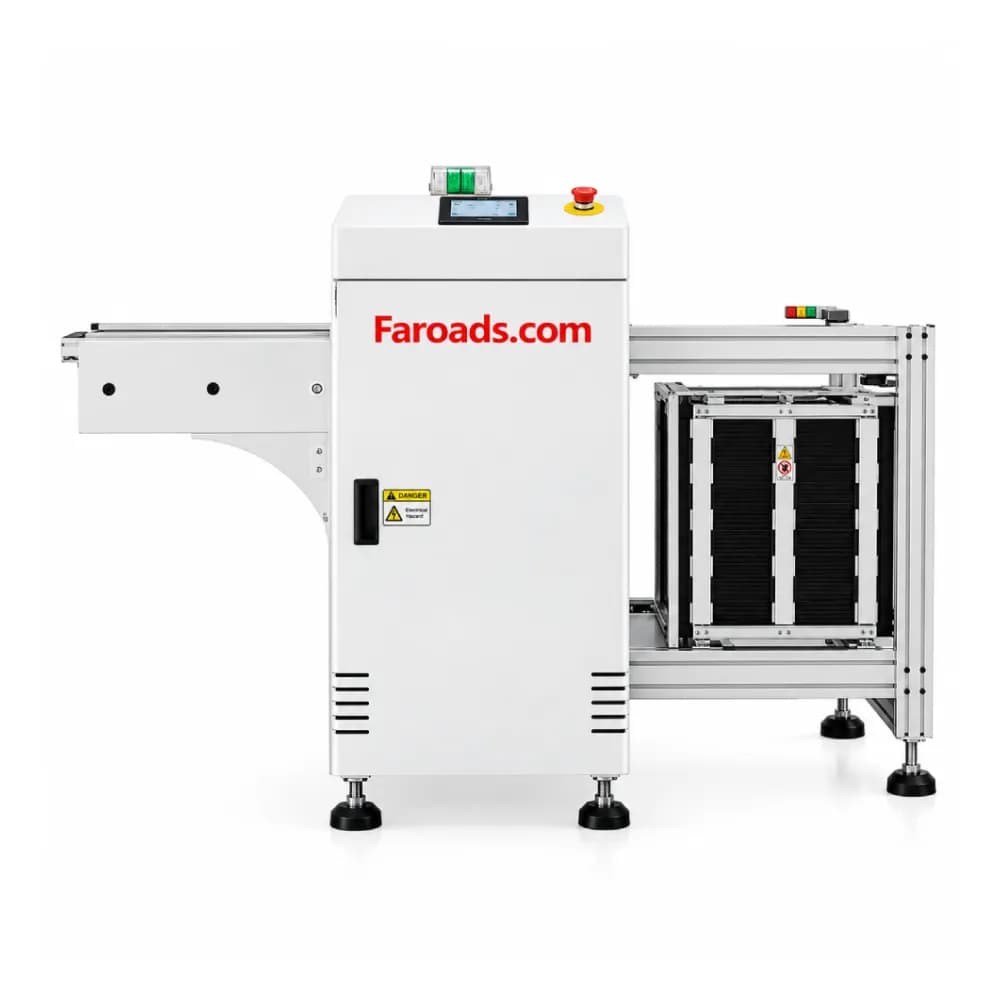
At the entrance, specify whether the line receives bare panels in magazines, stacked boards or assemblies returning for their second side. Those are different handling jobs. Give suppliers photographs or samples of the incoming presentation, not only the PCB drawing.
At the exit, identify the condition of the assembly. A populated panel may need substantially more vertical space than a bare board. It may also be warm after reflow, or require inspection and segregation before storage. Confirm the receiving magazine’s suitability for the actual handling temperature and assembly geometry.
Keep the route explicit: an unloader placed after AOI has a different relationship with inspection and reject handling than one receiving directly from the oven. Ask who defines that logic and how accepted, rejected and unreviewed boards remain identifiable.
Treat the magazine as part of the machine purchase
“Standard magazine” is not a complete specification. Record external dimensions, usable board width, slot geometry, indexing pitch, condition and loading orientation.
If you plan to reuse existing magazines, send their drawing and a representative sample for compatibility confirmation.
Check the usable capacity with your assembly, not just the number of physical slots. Tall components may require skipping slots. Rails, protruding connectors or fixtures may alter how far a board can enter. Confirm the pusher contact area so force is applied where the board design permits it.
Ask suppliers to explain how magazines are located and secured, how the first usable slot is established and what prevents indexing into an occupied or unsuitable position. Include partially filled magazines in the discussion if they occur in your production flow.
A useful quotation identifies the magazine type and quantity supplied. Buying machines without enough working magazines can merely move the handling bottleneck to the material-staging area.
Use the FAROAD models as a concrete starting point
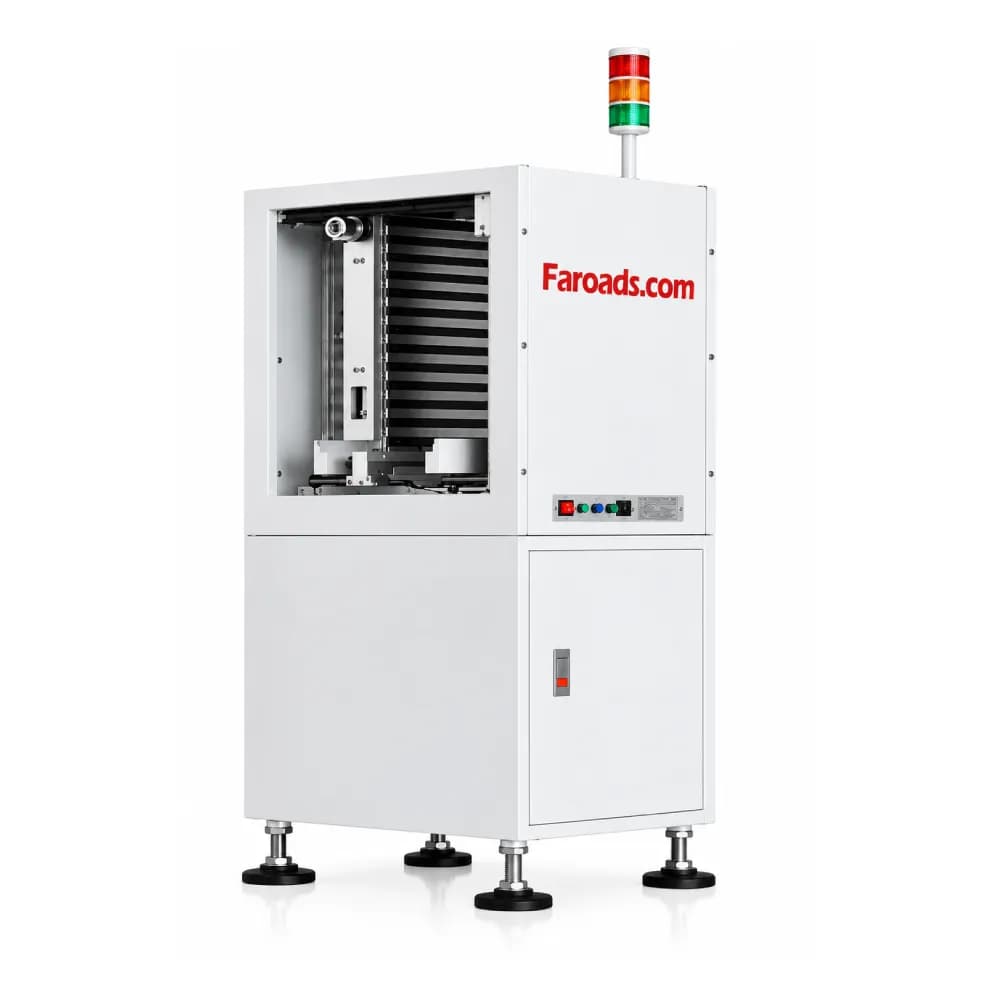
The FAROAD L400 magazine loader lists a PCB range of 50 × 50 mm to 400 × 330 mm and magazine dimensions of 460 × 400 × 563 mm. Its published approximate loading and magazine-change times are six seconds and 25 seconds respectively.
The UL400 magazine unloader lists the same board and magazine dimensions. These give buyers an initial screening envelope, not proof that every populated board inside that rectangle can be handled. Ask for assembly-clearance, slot-pitch and weight confirmation for the ordered configuration.
FAROAD also lists a compact ML400 in its PCB handling range. A compact machine may suit a tight installation, but compare its actual loading method, working capacity and operator-access needs with the magazine-based alternatives. Do not treat footprint alone as equivalent functionality.
Translate feed time into the real operating requirement
A machine’s individual board-transfer time is only part of the handling cycle. Magazine exchanges, sensor checks, operator replenishment and upstream or downstream waiting also matter.
Consider this illustrative planning case, not a FAROAD performance claim. A line needs one panel every 15 seconds, or 240 panels per hour. If the usable magazine capacity is 40 panels, a magazine represents ten minutes of production. If component clearance reduces usable capacity to 20 panels, that falls to five minutes.
That difference changes the operator’s route even though the board size and machine feed speed have not changed. It also changes the number of magazines needed to stage an hour of work: six in the first case and twelve in the second.
Now consider an assumed 25-second magazine exchange. At a 15-second line interval, the line would consume about two panels during that gap. Ask how the proposed configuration handles the interruption: continued supply from its magazine arrangement, a defined buffer, or an accepted pause. Do not assume any of those functions is included.
Separate attendance reduction from staffing reduction
Removing repeated hand-feeding can free useful operator time without eliminating an entire role. The operator may still replenish magazines, clear alarms, review inspection calls and move completed assemblies.
Measure the current task before building the business case. Record touches per panel, minutes spent feeding and collecting, walking distance, frequency of interruptions and any documented handling damage. Use your own labor rates and observed losses.
Then ask what changes with the proposed equipment. An automated unloader that needs frequent magazine attention may still improve consistency, but its economics differ from an arrangement that supports a longer interval between visits. Credit only time that can actually be reassigned, and avoid counting the same recovered minutes as both labor savings and extra production revenue.
Check the interfaces and the operating space
Confirm board travel direction, fixed rail, transfer height, edge clearance and conveyor width with adjacent equipment. Include both the smallest panel and the heaviest or most difficult assembly.
For communication, ask for the exact transfer interface and required cables or adapters. Test downstream-not-ready behavior and recovery after a stopped transfer using the supplier’s safe procedure. A statement that machines can connect is less useful than a witnessed handoff between the proposed configurations.
In the layout, reserve magazine insertion and removal space, maintenance access and a safe material route. A machine can fit on the drawing while making magazine replenishment awkward. Have the receiving site’s qualified team review electrical, air and safety requirements for the installation in the United States, Canada or Mexico; requirements depend on the actual facility and jurisdiction.
Make the handling trial resemble production
Agree the sample boards and magazines before purchase. A useful trial includes:
Trial item: The smallest and largest production panels, plus a populated second-side assembly when applicable.
Trial item: A complete magazine sequence, including exchange and replenishment.
Trial item: A downstream stop followed by controlled recovery.
Trial item: Checks for board-edge damage, component contact and incorrect magazine indexing.
Trial item: A timed observation of how often an operator must attend the equipment.
Record the configuration, slot usage, settings and exceptions. A few empty boards moving successfully do not establish suitability for a populated production mix. Use the agreed trial results to settle open configuration questions before shipment.
Request a complete handling quotation
Send panel drawings, assembly heights above and below the board, weights, magazine details, line interval, required attendance interval and neighboring-machine information. Ask for the machines, magazines, interface items, installation responsibilities and acceptance demonstration as separate quote lines.
Request a FAROAD handling proposal based on that operating brief. The right purchase is a repeatable board-flow arrangement with a manageable replenishment routine—not simply a loader and unloader with matching model names.