LED Solder Paste Printer: When Do Long Boards Need a Dedicated Printer?
Long LED light bars and strip panels can outgrow a standard stencil printer. Here is how to tell when you need an LED printer and what to check in the specification.
5 min read
LED lighting boards look simple to print. The pads are repetitive, the components are often large by SMT standards, and the paste deposits are generous. The difficulty is the format. Light bars, linear modules and strip panels can be well over a meter long and only a few centimeters wide, and many are built on aluminum-backed substrates. A standard stencil printer may simply not have room for them.
This guide helps LED manufacturers decide whether a standard automatic printer is enough or whether a dedicated long-board LED printer belongs in the line, and what to check before buying either.
What makes LED boards different at the printer
Length. The first limit is the printable area. A board, or a panel of strips, that is longer than the printer's maximum print size cannot be printed in one pass, whatever the accuracy figures say.
Stencil size. Long boards need long stencils, and long stencils need large frames. The printer must clamp and position a frame that size, and the frame must stay flat and properly tensioned across its length.
Board support. A long, narrow board supported only at the edges can sag or flex under squeegee pressure. That gives uneven paste height from one end to the other.
Substrate. Metal-core boards are stiffer and heavier than FR-4. Your heaviest metal-core panel must sit inside the printer's stated thickness and weight range.
Print volume per board. LED boards often carry hundreds of identical pads. Consistent deposits from end to end matter more than ultra-fine pitch capability.
When a standard printer is still enough
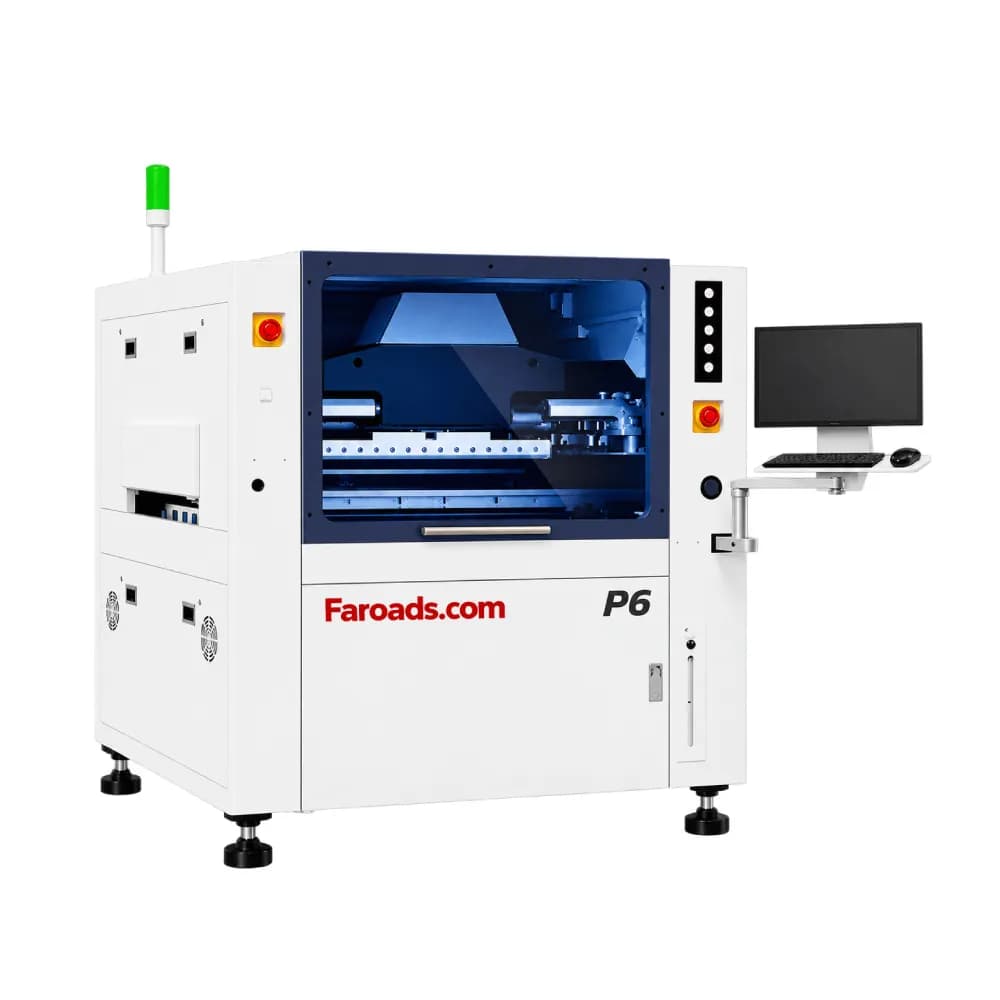
If your LED products are compact modules, downlight boards, short linear segments or panels that fit a standard print area, a general-purpose automatic printer is usually the better choice. It handles other products too, and it is typically faster per cycle on small boards.
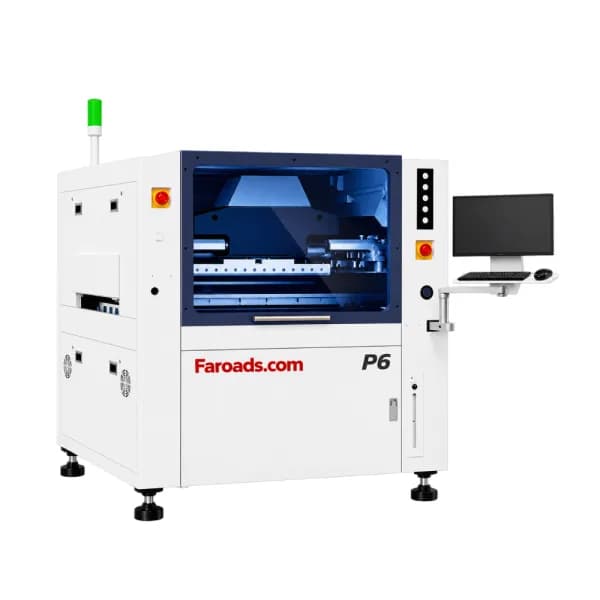
FAROAD's current standard printers illustrate the envelope. On its product page, the P5 prints boards as large as 510 510 mm with a 7-second cycle. The larger P6 accepts boards up to 650 × 610 mm (750 × 610 mm with the expansion) and lists a 10-second cycle. If every LED board you build fits within those limits with margin, a dedicated LED printer may not be necessary.
When a long-board LED printer earns its place
A dedicated LED printer makes sense when one or more of these apply:
- Your boards or strip panels are longer than a standard printer's maximum print size.
- You want to print full-length light bars instead of shorter segments that are joined later.
- You plan to pair the printer with a long-board LED mounter and LED reflow oven as a dedicated LED line.
- LED products make up most of your volume, so specialization does not leave the printer idle.
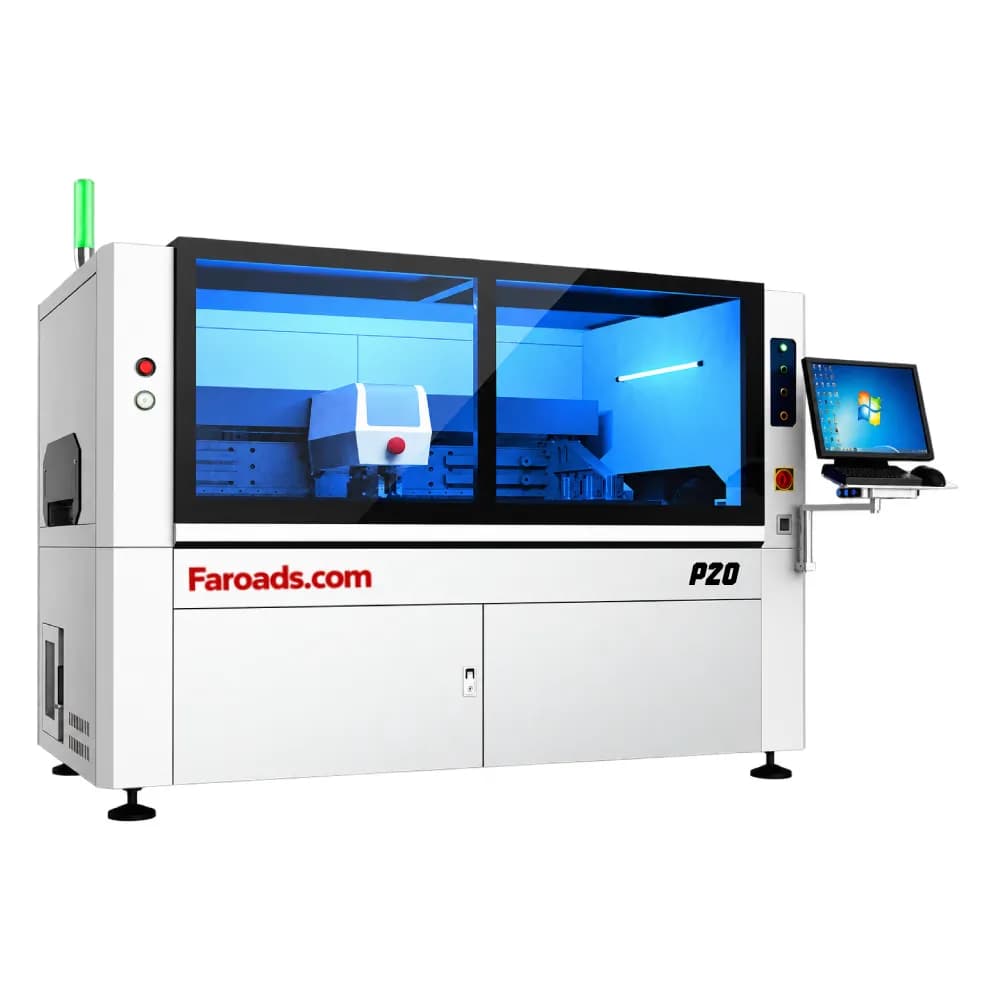
FAROAD's LED solder paste printer P20 lists a standard print size from 50 × 50 mm up to 1,500 × 350 mm, stencil frames from 737 300 mm to 1,800 × 650 mm, board thickness from 0.4 to 6 mm and board weight up to 4 kg. Its listed printing accuracy is ±30 m at 6 with Cpk of at least 2.0, and its cycle time is 15 seconds.
Match the printer to the rest of the LED line
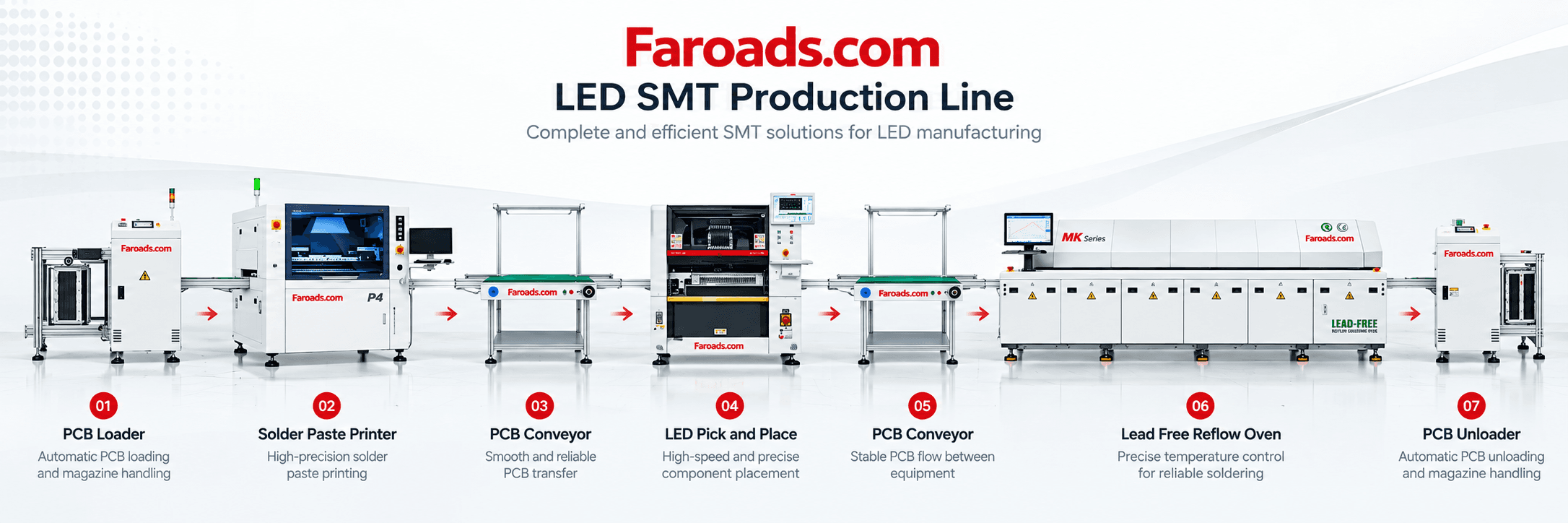
The whole line can only build what its tightest station accepts. Before ordering a long-board printer, line up the board envelope of every machine.
- Placement. FAROAD's CPM-L3-1200 LED mounter lists boards up to 1,200 × 400 mm. The CPM-L3F lists 600 400 mm in single-segment mounting and 1,200 400 mm in two-segment mounting.
- Printer width. The P20's print size is up to 350 mm wide, so a board that is wider than that will be limited by the printer even if the mounter accepts 400 mm.
- Reflow. LED-specific ovens with mesh belts, such as FAROAD's MK-MAX models, carry long boards without relying on edge rails alone. Our guide to rail versus mesh-belt reflow explains the choice.
- Inspection and handling. Check SPI, AOI, loaders and conveyors too. For example, FAROAD's listed 3D SPI accepts boards up to 450 × 500 mm, so very long boards need a different inspection approach that should be agreed in the proposal.
For a wider view of long-board lines, see our guide to LED SMT production line selection.
Compare output in boards and LEDs, not cycle seconds
A long-board printer usually has a longer cycle than a standard printer, but each cycle prints more product. Compare output in finished light bars or LEDs per hour.
Illustrative calculation only: suppose a 1,200 mm light bar is currently built as two 600 mm boards on a standard printer at roughly 10 seconds each, or about 20 seconds of printing per finished bar. A long-board printer at 15 seconds per cycle prints the full bar in one pass. Printing time per bar drops, and there is no joint between two segments to assemble later. Your own numbers will depend on panel design, cleaning frequency and how fast the downstream mounter runs.
What to check in the specification and trial
- Maximum print size and stencil frame range, with margin around your longest board.
- Board support along the full length, including how support pins or blocks are placed under long, narrow boards.
- Printing accuracy and repeatability, read as stated conditions, not as guarantees for every board.
- Stencil cleaning on a long stencil, including cleaning paper use and how long a cleaning cycle takes.
- Board thickness and weight limits for metal-core panels.
- Transport speed and direction options so the printer fits your line layout.
Run the trial with your longest, heaviest panel and your real paste. Measure deposits at both ends and the middle of the board.
Frequently asked questions
Can I print long LED boards on a standard printer?
Only if the full board and stencil fit within its print area and frame range. Otherwise the board must be redesigned into shorter panels.
Is an LED printer less accurate than a standard printer?
Published accuracy figures can differ, but LED pads are usually large enough that consistency along the length matters more than the finest accuracy figure. Test with your boards.
Do I need SPI on an LED line?
It depends on your defect risk and board size. Confirm whether an inspection system can accept your longest boards before planning it inline.
Can one printer serve both LED and standard boards?
A long-board printer can print shorter boards, but it is usually slower per cycle and has a larger footprint. Plants with mixed work often keep a standard printer as well.
Request an LED printing proposal
Send FAROAD your longest panel drawing, stencil size, substrate type and target output. We will recommend a printer and line envelope that fit. Request a quote to get started.