Rail or Mesh-Belt Reflow? How to Choose the Conveyor for Your Boards
Edge-rail and mesh-belt reflow conveyors suit different boards. Learn how board format, double-sided assembly, LED panels and line flow decide the right choice.
5 min read
Most reflow oven comparisons focus on zones, heated length and temperature control. The conveyor gets less attention, yet it decides which boards the oven can carry, how they are supported while hot and how smoothly they move to the next machine. Choosing the wrong transport type can force you into carriers, extra handling or a second oven later.
This guide explains the practical difference between edge-rail and mesh-belt conveyors and how to match the choice to the boards you actually build.
Two ways to carry boards through the oven
An edge-rail conveyor holds the board by its two long edges. Chains or pins on each rail move the board through the tunnel, and the rail width is adjusted to the board. Both the top and bottom of the board are free, apart from the narrow edge band that rests on the rails.
A mesh-belt conveyor is a continuous metal mesh that runs the full width of the oven. Boards, panels or fixtures simply rest on top of it. Width adjustment is not needed, because anything that fits on the belt can travel.
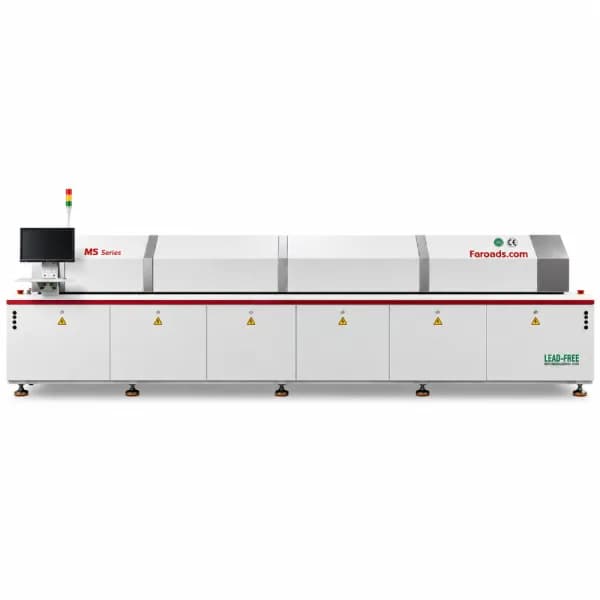
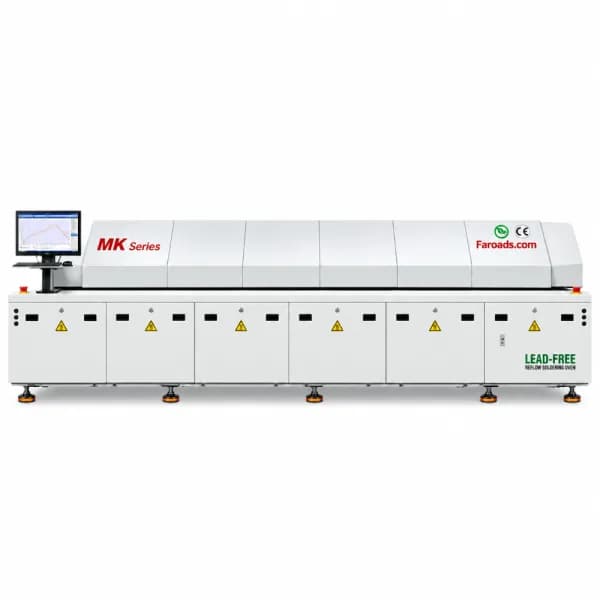
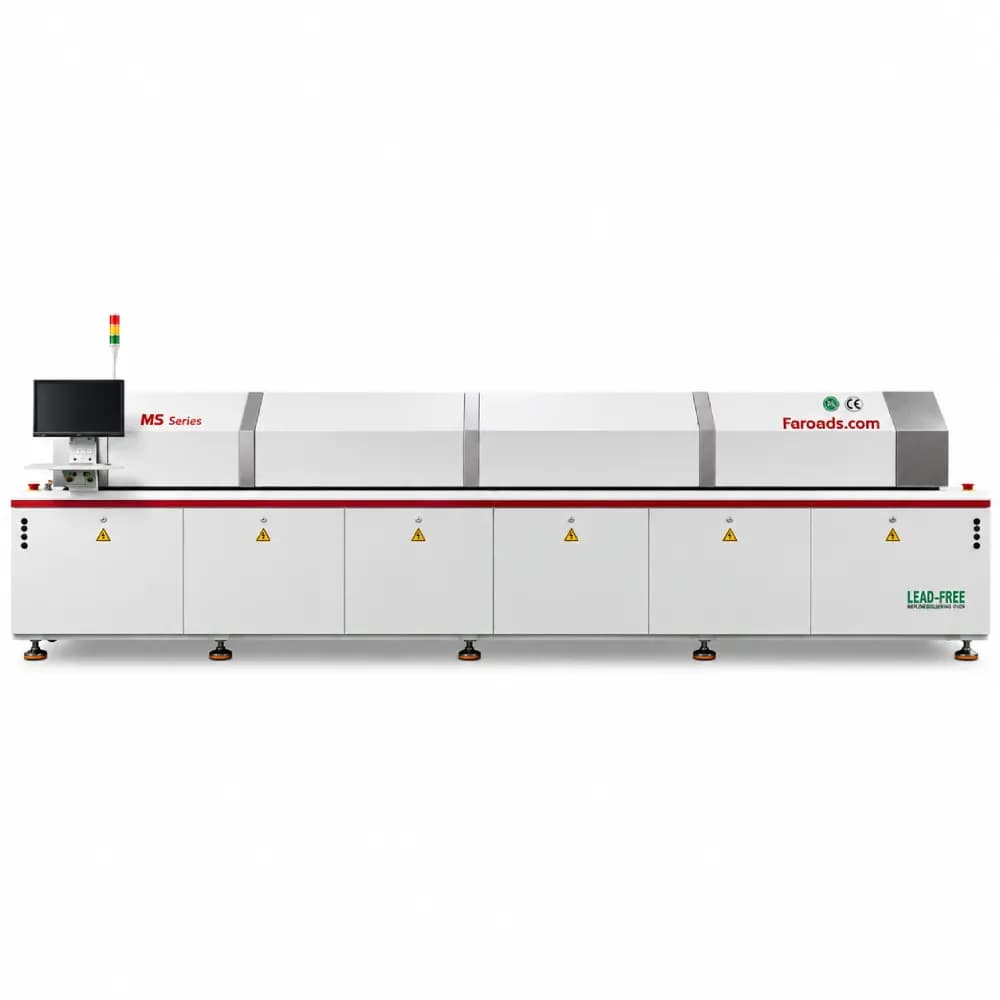
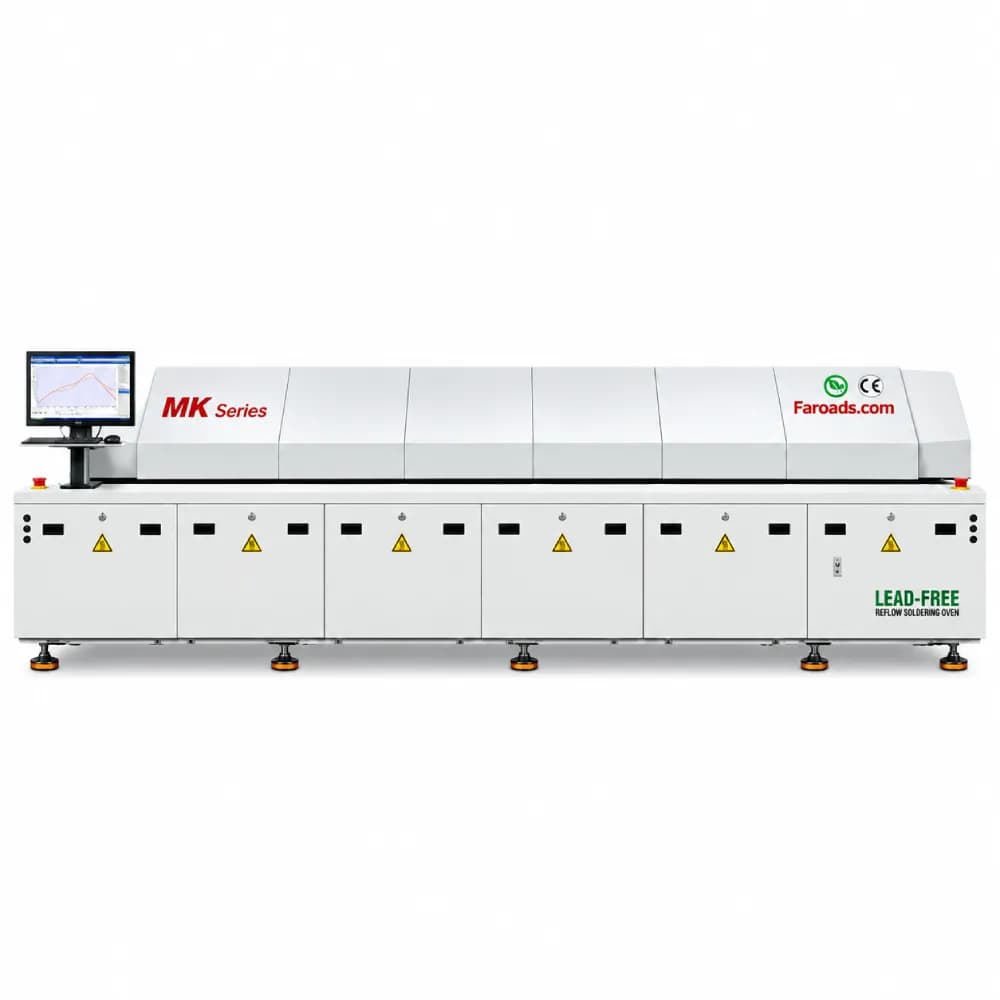
Some ovens combine both. FAROAD MS and MK specification tables, for example, describe the transport as chain drive plus mesh drive with a single-row chain. If you see a combined system on a quotation, ask how each part supports your specific boards.
When an edge-rail conveyor is the better fit
Edge rails are the standard choice for most production SMT lines, for good reasons:
- Double-sided assembly. When the second side is reflowed, components already soldered on the underside must not rest on a belt. Edge support keeps them clear.
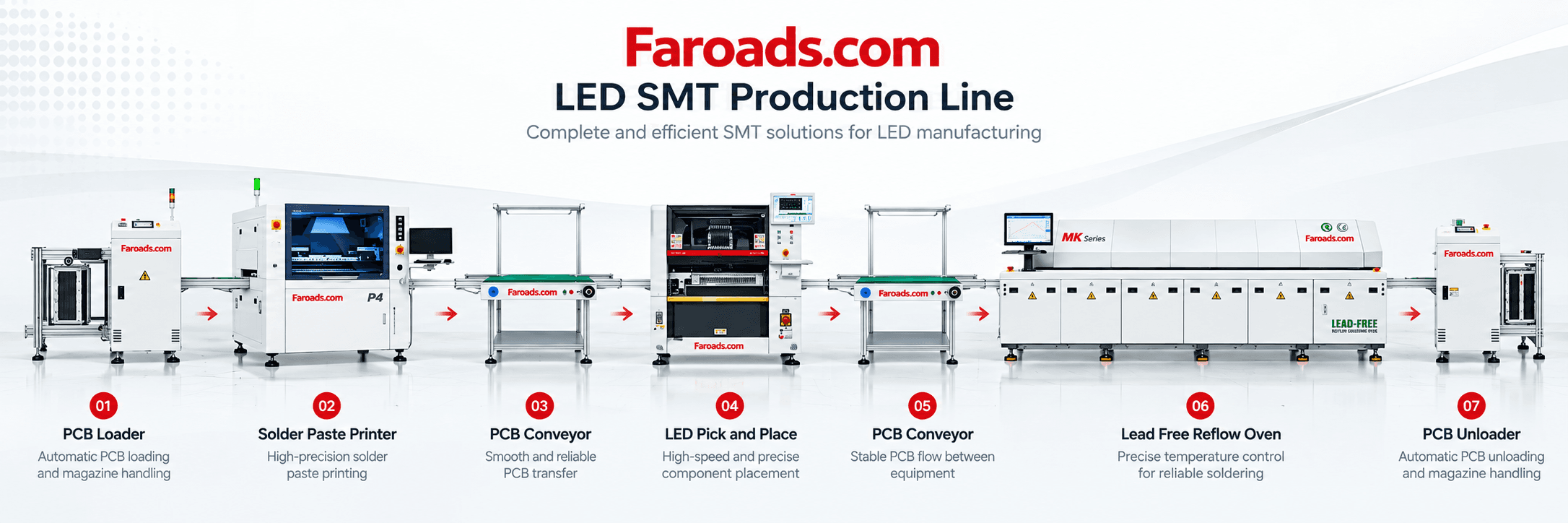
- Line flow. Rail conveyors align naturally with printers, placement machines and inspection equipment that also handle boards by their edges.
- Dual-track production. Rail ovens can offer two independent lanes. FAROAD's MS and MK dual-track versions list two adjustable lanes of 50 to 275 mm each.
- Bottom-side heating. With nothing under the board, lower heaters and airflow reach it more evenly.
The main requirement is a clear edge band. If your panel design leaves components near the edges, or the board is thin enough to sag between the rails, discuss center support or panel changes before choosing.
When a mesh belt earns its place
A mesh belt solves problems that rails cannot:
- Boards without usable edges, such as irregular shapes, very small boards or products in fixtures.
- Long, narrow LED panels that are awkward to clamp at the edges and benefit from continuous support along their length.
- Single-sided products where nothing on the underside needs protection.
- Mixed formats where constant rail adjustment would slow changeovers.
The trade-offs are worth understanding. Boards resting on the mesh cannot carry soldered bottom-side components in a way that would be pressed against the belt. The belt also connects less directly with rail-based equipment upstream and downstream, so transfer points need attention. Finally, the mesh can collect flux residue over time, so cleaning belongs in the maintenance plan.
Questions about your boards that decide the choice
Before requesting quotations, answer these questions for every product the oven will serve:
- Is any product double-sided, now or in the next few years?
- Do panels have a clear edge band on both long sides?
- What are the maximum width, length and thickness?
- How tall are components above and below the board?
- Are boards run in carriers or fixtures?
- How often will the line change between board widths?
If most answers point to standard rectangular panels and double-sided work, rails are usually the safer choice. If the mix is dominated by long single-sided LED boards or edgeless formats, a mesh belt deserves serious consideration. Our guide to specifying a line for long LED boards covers how the oven fits into the wider equipment envelope.
How FAROAD's published oven specs compare
The following figures are taken from current FAROAD product pages. Confirm them against your quotation.
Rail-style production ovens (MS and MK series). Single-track transport width of 50 to 490 mm, adjustable. Dual-track versions provide two lanes of 50 to 275 mm each. The MK-8 lists component clearances of 30 mm above and 25 mm below the board; MS pages list 30 mm above and 20 mm below.
Mesh-belt LED ovens (MK-MAX series). The MK-8MAX lists a mesh belt drive with a 700 mm belt width and 30 mm more upper clearance than the rail ovens, at 60 mm. Its page also describes an inlet and outlet air extraction system intended to prevent oil dripping or leakage, which is a common concern in LED lighting production. The range comes in 8, 10 and 12 heating-zone versions within FAROAD's LED-specific reflow ovens.
Use these numbers as a screening step. A trial with your own boards remains the best evidence.
Line integration and changeover
Think about the machines on either side of the oven. A rail oven usually connects directly to placement and inspection equipment that handle boards the same way. A mesh-belt oven may need a transfer arrangement so boards move from edge-conveyor equipment onto the belt without being disturbed.
Changeover works differently, too. Rail width must be adjusted for each board size, manually or automatically. A mesh belt needs no adjustment, which can save time in lines that switch formats often. Zone count, profile capability and atmosphere are separate decisions; see our reflow oven buying guide for those.
Frequently asked questions
Can a mesh-belt oven handle double-sided boards? It is not the usual choice for second-side reflow, because soldered underside components would rest on the belt. Rail conveyors are generally preferred for double-sided work.
Are mesh-belt ovens only for LED products? No, but LED lighting is a common application because long, single-sided panels benefit from continuous support.
Can one oven run both standard boards and LED panels? Sometimes. It depends on board formats, the conveyor design and changeover frequency. Share the full product list so the supplier can assess it.
Does conveyor type affect energy use? It can, because the belt itself is heated and carries some of that heat out of the tunnel. Profile requirements, insulation and oven design usually matter more.
Choose the conveyor with your oven quote
Send FAROAD your board drawings, panel sizes, component heights and whether any products are double-sided, and request a quotation. Ask for the recommended conveyor type alongside the oven configuration so both decisions are made from the same product data.