How Many Reflow Oven Zones Do You Need? 8, 10, 12 or 14 Compared
Zone count is really a decision about heated length, line speed and how much control your hardest board needs. Here is how to choose between 8, 10, 12 and 14 zones.
5 min read
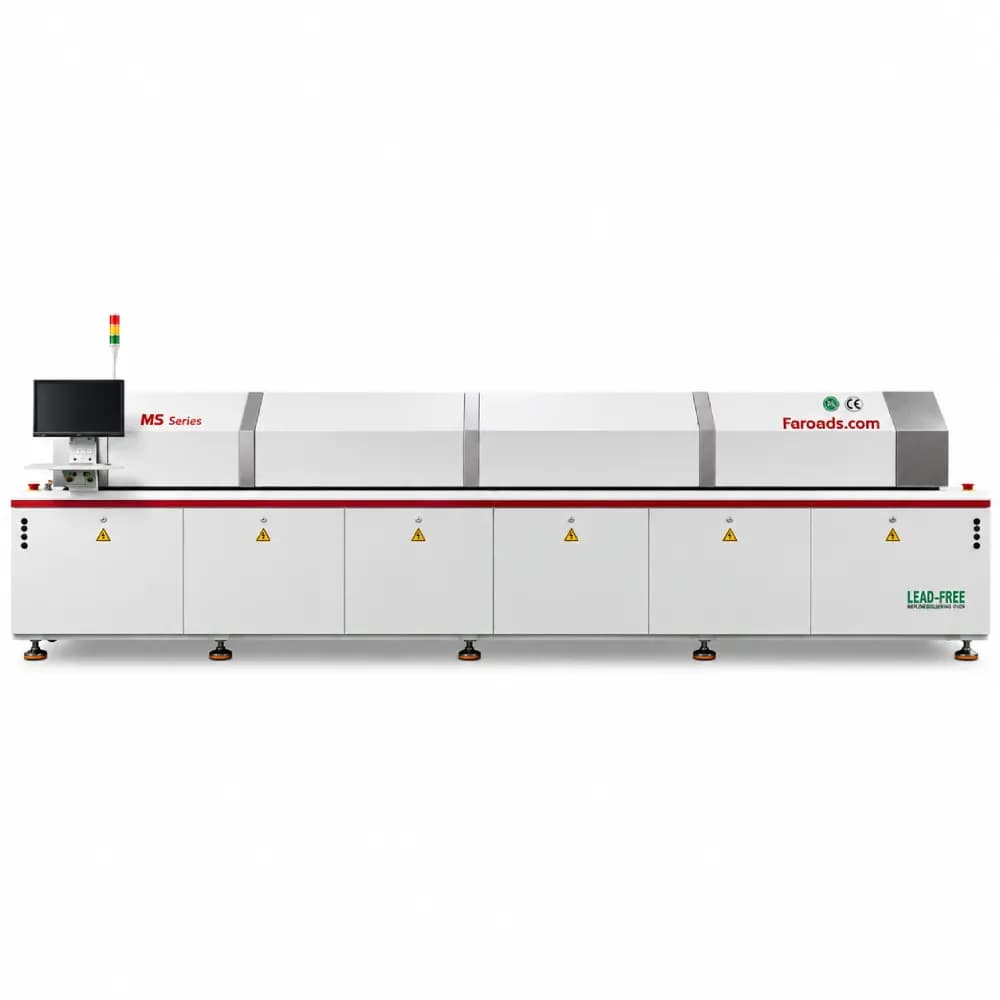
Zone count is usually the first number on a reflow oven quotation, and it is tempting to read it as a quality ranking. In practice, it stands in for two other things: heated length, which decides how fast the conveyor can run while every board still gets the full profile, and the number of places where you can adjust temperature along the tunnel.
This guide explains how to turn those two ideas into a zone count for your line. For the wider oven decision, including board handling and total cost of ownership, see our reflow oven buying guide.
What an extra zone actually buys
Each convection zone has its own heaters, fans and controller. Adding zones gives you two separate benefits.
More heated length. Zones in a given oven family are built to a similar pitch, so more zones generally means a longer tunnel. A longer tunnel lets the conveyor move faster while each board still spends the time your solder paste profile requires above each temperature. This is a throughput benefit.
Finer control of the profile shape. With more zones, the oven can split preheat, soak and the approach to peak into smaller steps. That helps when a board has very different thermal masses, or when the paste or component makers specify a narrow window. This is a process benefit.
If your problem is output, the first benefit matters. If it is yield on difficult boards, the second does.
Start from line speed, not the brochure
Work backward from the rest of the line. Find the cycle time your printer and mounters can sustain on your busiest product, then check which oven length can match it. Required conveyor speed equals heated length divided by the time your profile needs in the heated tunnel; boards per minute equals conveyor speed divided by board length plus gap. Use heated length, not overall machine length, and take the profile time from your own paste datasheet.
An illustrative comparison across four oven lengths
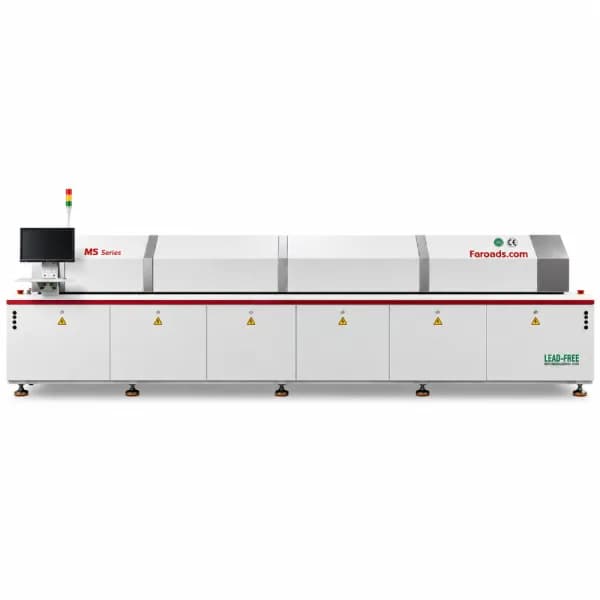
The figures below are an illustrative calculation, not measured FAROAD throughput. They assume a profile that needs about 270 seconds in the heated tunnel and boards 250 mm long with a 50 mm gap, so each board uses 300 mm of conveyor. Heated lengths come from FAROAD's current MS series product pages.
- 8 zones, MS-8 (3,142 mm heated length): about 700 mm/min conveyor speed, roughly 2.3 boards per minute, or one board about every 26 seconds.
- 10 zones, MS-10 (3,890 mm): about 860 mm/min, roughly 2.9 boards per minute, about every 21 seconds.
- 12 zones, MS-12 (4,640 mm): about 1,030 mm/min, roughly 3.4 boards per minute, about every 17–18 seconds.
- 14 zones, MS-14 (5,836 mm): about 1,300 mm/min, roughly 4.3 boards per minute, about every 14 seconds.
All four speeds sit inside the 300–2,000 mm/min conveyor range listed for the series. The pattern is the point: if your mounters release a board every 30 seconds, an 8-zone oven is not your constraint, and paying for 12 zones buys capacity the line cannot use. If they release a board every 15 seconds, the shorter ovens become the bottleneck no matter how good their control is.
When the board, not the line, sets the zone count
Throughput is only half the decision. Some products need more zones even when line speed does.
- Heavy or uneven boards. Thick copper, large ground planes, metal-backed boards and big connectors heat slowly while small chips nearby heat quickly. More zones in preheat and soak give the whole board time to even out before peak.
- Narrow process windows. Some lead-free pastes, temperature-sensitive parts and large BGAs leave little room between too cold and too hot. Extra zones give the profile engineer more places to make small corrections.
- Many products on one oven. If the oven must serve very different boards, a longer tunnel makes it easier to find one profile that suits several of them, which reduces changeover between recipes.
- Planned atmosphere changes. If you may add nitrogen later, confirm that the oven length you choose is available in a nitrogen version rather than assuming it can be retrofitted.
Light boards with standard passives and small ICs rarely need this extra control; an 8-zone oven with a sensible profile often handles them well.
The cost of zones you do not use
Every additional zone has a price beyond the quotation. FAROAD's MS pages show the trade-offs clearly. The MS-8 lists a 30 kW starting power and 7 kW normal operating power in a body about 5.25 m long. The MS-14 lists 39 kW and 12 kW in a body about 7.8 m long, and the heat-up time rises from approximately 15 to approximately 20 minutes.
That is more floor space, a larger electrical supply, higher running cost and a longer warm-up every morning: good reasons not to buy length you will not fill. Our guide to energy-efficient reflow ovens covers running cost in more detail.
Do not forget cooling
Zone counts on quotations sometimes mix heating and cooling. Ask for both numbers separately. Within FAROAD's MS series, the MS-8 lists 2 cooling zones, while the MS-10, MS-12 and MS-14 list 3, with a fourth optional on the MS-12. Cooling capacity matters more as conveyor speed rises, because boards leave the heated section with less time to cool before they reach the unloader or AOI. If your boards are heavy or your downstream station is temperature-sensitive, make exit temperature part of the trial.
How the FAROAD range maps to zone count
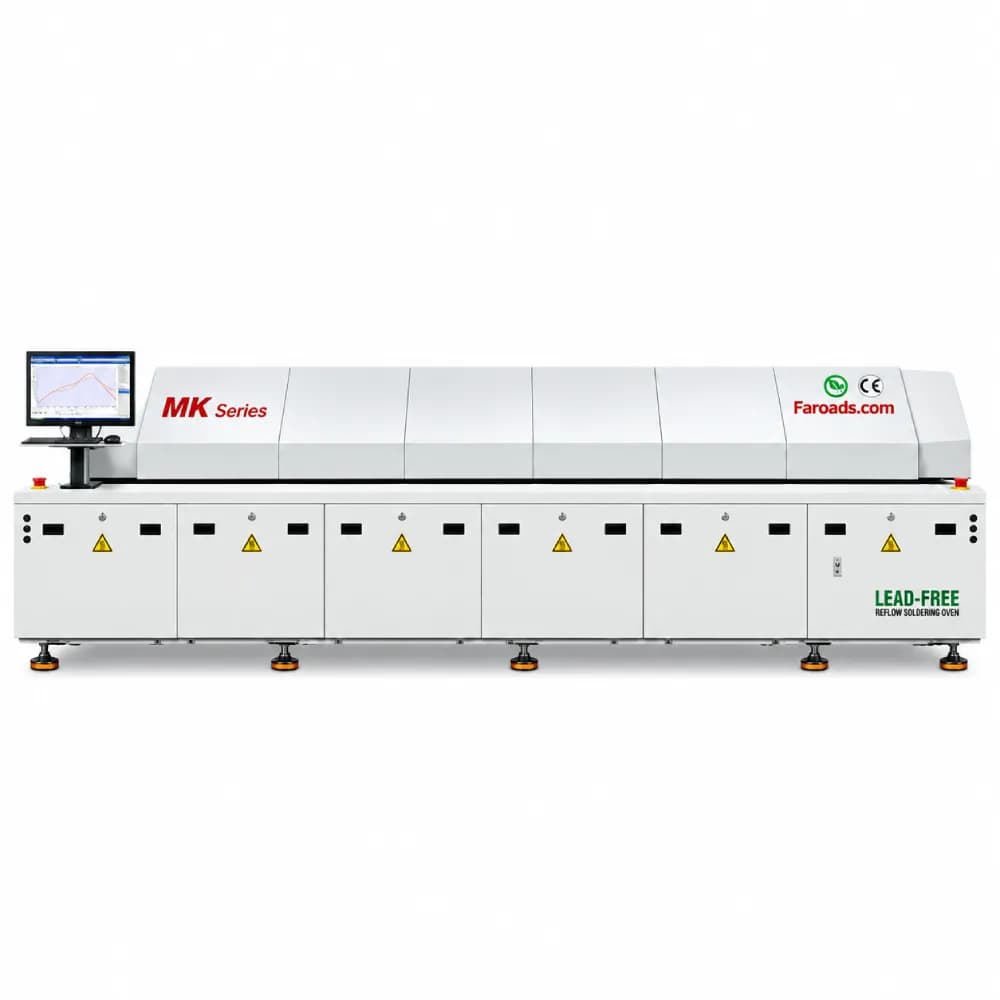
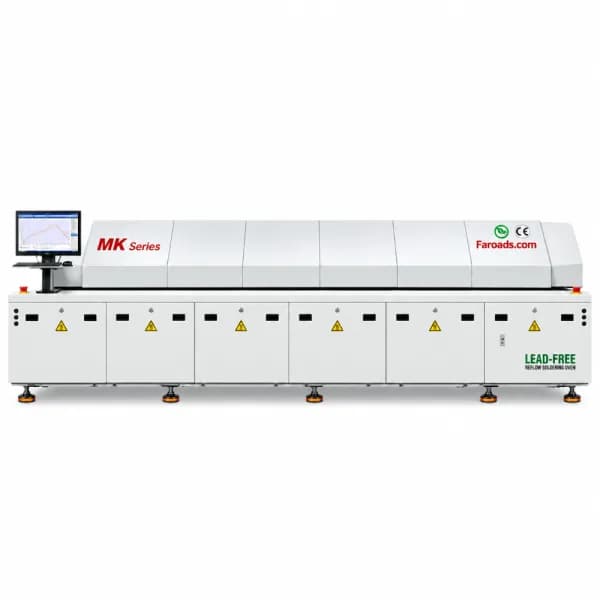
FAROAD offers two inline oven families with matching zone steps. The MS series covers 8, 10, 12 and 14 zones, each with a dual-track D version and a nitrogen N version. The MK energy-saving series lists 8, 10 and 12 zones in single- and dual-track configurations, with heated lengths of 3,142, 3,670 and 4,150 mm. For LED lighting boards, the MK-MAX models use a mesh belt and offer 8, 10 and 12 zones as well.
Choose the length your line and boards need first, then the series by atmosphere, energy and board-handling requirements.
Frequently asked questions
Is a 10-zone oven always better than an 8-zone oven? No. It is longer and gives more adjustment points, but if your line cannot feed it faster and your boards are simple, the extra zones add cost without adding output or yield.
Can I run a slower conveyor on a long oven for small batches? Yes, but you still pay for its space, power and warm-up time. Size for the volume you expect over the next few years.
How do I know if my boards need more zones? Run a thermocouple profile on your heaviest board, measuring both the biggest and the smallest components. If the temperature spread at peak is hard to control, more preheat and soak zones are likely to help.
Do dual-track ovens change the zone choice? The heated length still sets conveyor speed for each lane. Two lanes can raise output for the same length if both lanes stay busy.
Request a zone recommendation
Send FAROAD your line cycle time, largest board size and weight, paste datasheet and heaviest components. We will recommend the zone count and oven series that match your line. Request a quote to start the comparison.