SMT Equipment for Power Electronics: What to Specify Before You Buy
Power supplies, inverters, chargers and motor drives push an SMT line with large parts, heavy boards and high thermal mass. Here is what to specify at each station.
4 min read
Power electronics boards look different from the phones and controllers most SMT lines are designed around. A power supply, inverter, charger or motor drive may carry large inductors, transformers, tall capacitors, heavy connectors and thick copper, often on a thick board that takes a long time to heat. A line specified for small consumer boards can struggle with all of these at once.
This guide covers what changes when power boards are your main product. It focuses on the specification questions, and links to our general placement and reflow guides rather than repeating them.
What makes power boards different on an SMT line
Three characteristics drive most of the decisions.
Size and height. Power components are large and tall. They need a placement head and camera that can handle them, and clearance at every downstream station.
Weight. Heavy parts and thick boards add mass. Conveyors, board support and clamping must hold them steady, and placement heads must pick and seat them reliably.
Thermal mass. Thick copper planes and large components absorb heat. The reflow oven must bring the heaviest joint to soldering temperature without overheating small parts elsewhere on the board.
Build a size, height and weight chain for every station
The most useful early exercise is a simple table of limits, written as a list for each station: maximum board size, board thickness, board weight, component height above the board and clearance below it. Then compare your largest power board against every line.
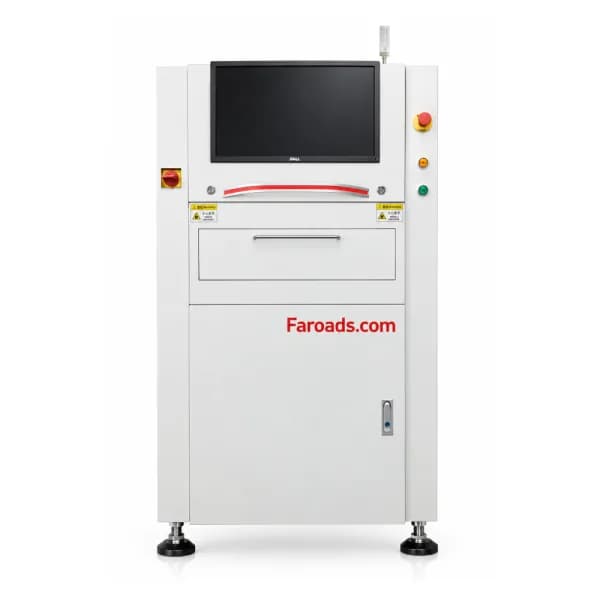
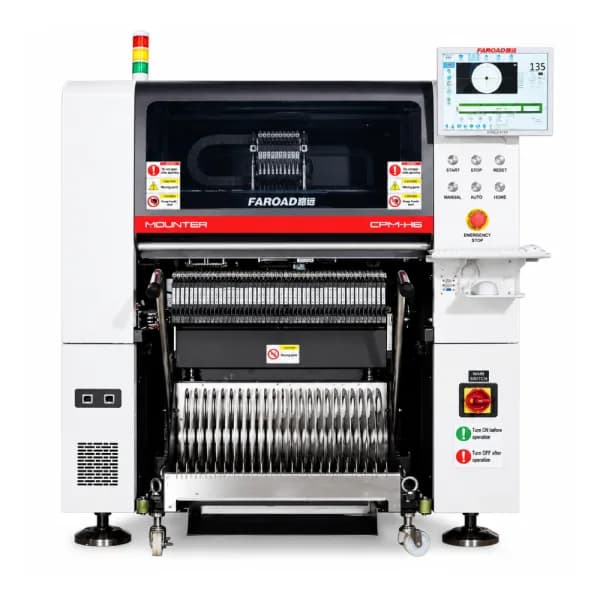
FAROAD's published figures show why the whole chain matters. The CPM-H6 and CPM-F6 multifunctional heads list a maximum component size of 55 × 55 mm with a height of 25 mm, and board thickness from 0.5 to 9.0 mm. The MS-8 reflow oven lists upper and lower board clearances of 30 mm and 20 mm. The Inpex S510 AOI lists a standard top clearance of 30 mm, adjustable to 50 mm, and a maximum board weight of 5 kg, while the Inpex M400 lists 7 kg.
A board that fits the mounter can still be stopped by an oven or inspection limit. Where a figure is not published, such as maximum board weight on a conveyor, ask the supplier for it in writing.
Placement: large parts, heavy parts and how they are picked
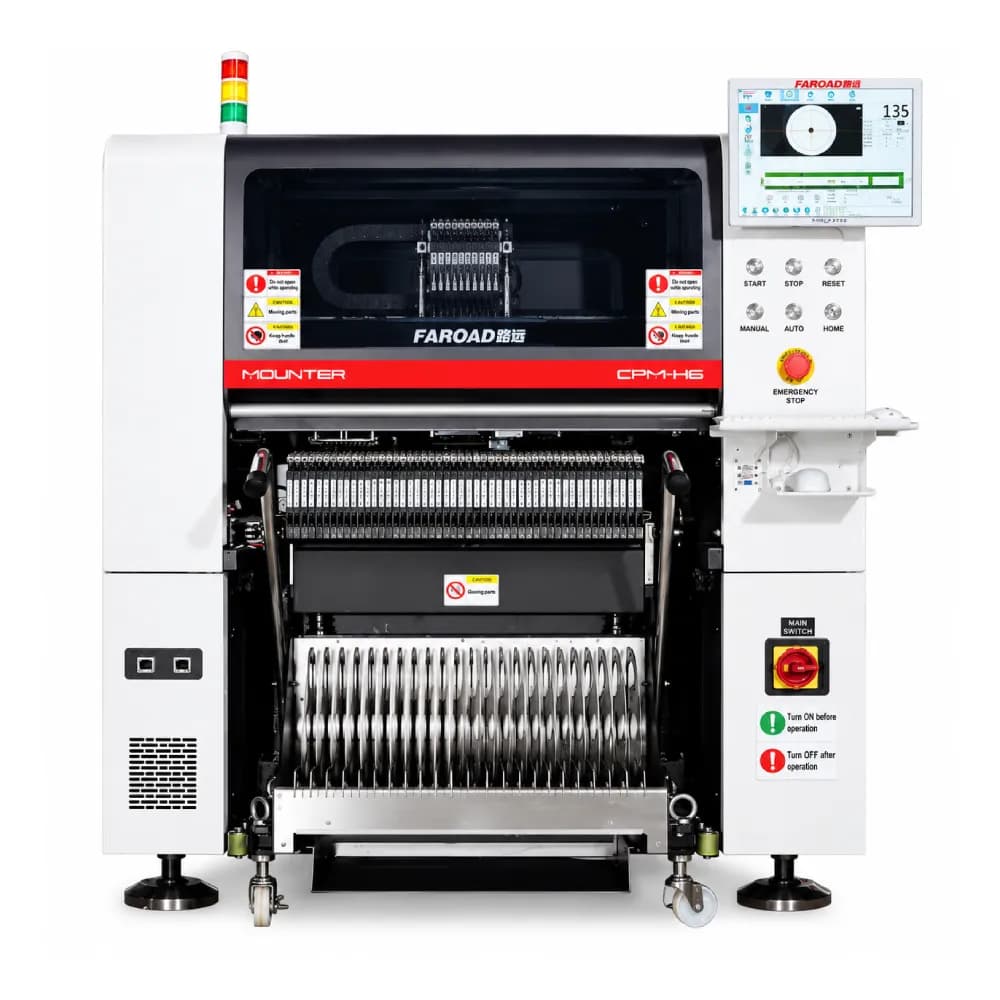
For power boards, component range and handling matter more than peak placement speed. Check every large and heavy part on your BOM against the multifunctional head range, and confirm how each part is supplied: wide tape, tube or tray.
The FAROAD CPM-H6 lists tape feeders up to 88 mm on its multifunctional head, tube feeders, an optional tray system and real-time vacuum monitoring. The CPM-F6 lists force control management as an option. Ask how the machine confirms a heavy part has been picked and seated correctly, and which nozzles are needed for your largest bodies.
Parts beyond any machine's range, such as very tall transformers or press-fit connectors, may be fitted by hand or in a separate through-hole process. Identify them early so the line plan includes them.
Printing for large pads and thick boards
Power boards often combine large thermal pads with fine-pitch control circuits. Stencil design will do most of the work, but the printer must hold a thick, heavy board flat and supported.
Check the printer's board thickness and weight limits against your heaviest panel. The FAROAD P5 page lists board thickness up to 6 mm and a 4 kg board weight in its process parameters. If you assemble both sides, check the clearance for components already on the underside. Our solder paste printer selection guide covers support and alignment in more detail.
Reflow: thermal mass, not zone count
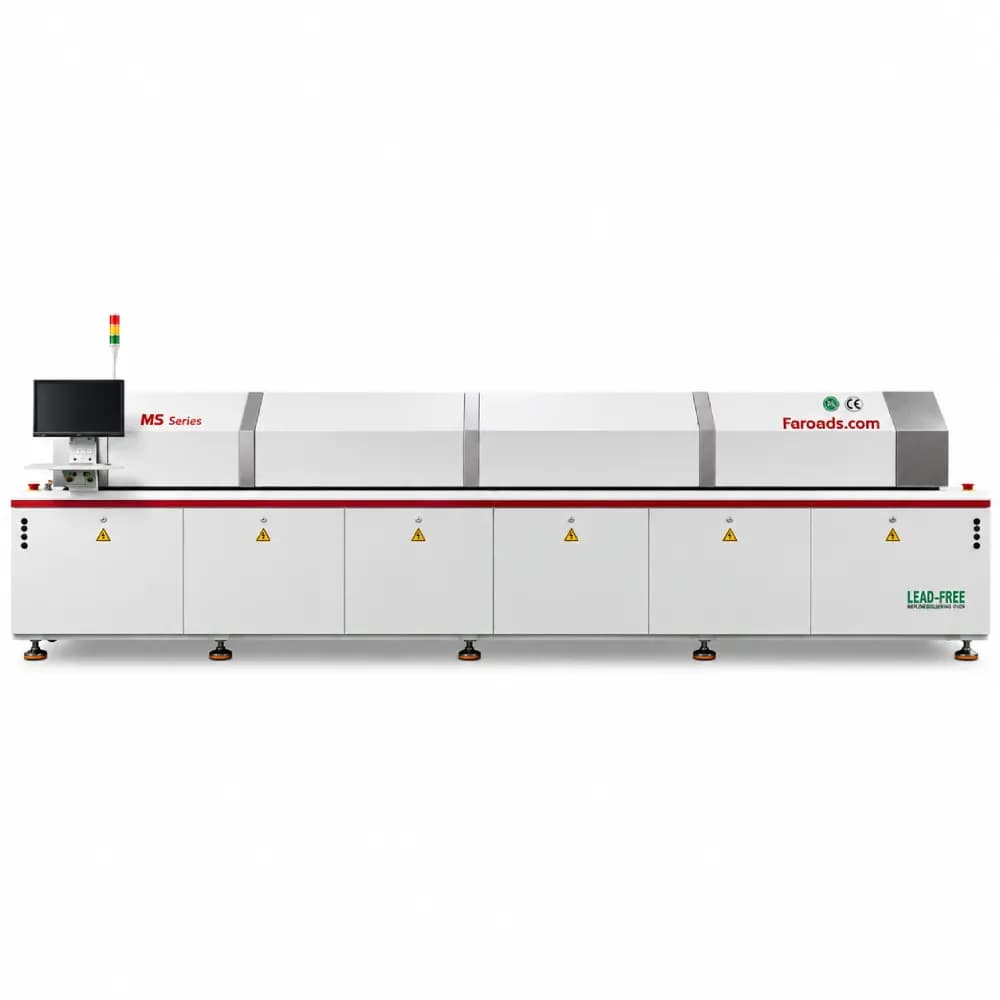
The reflow challenge on a power board is uneven heating. A large copper plane under a heavy inductor heats slowly; a small resistor nearby heats quickly. The profile must bring both within the paste supplier's window.
Ask for a profile trial on your heaviest board with thermocouples on the largest components and on the smallest parts. Heated length and conveyor speed determine how long the board spends in each zone. The FAROAD MS series of lead-free ovens is offered with 8, 10, 12 and 14 heating zones; the MS-8 lists a 3,142 mm heated length and a conveyor speed range of 300 to 2,000 mm/min. Nitrogen versions are available if your process requires them. For capacity sizing, see our reflow oven buying guide.
Inspection around tall parts
Tall components cast shadows and can hide neighboring joints from a top-down camera. Ask the AOI supplier to inspect your actual board and show which joints can and cannot be judged.
Check clearance and weight limits as part of the chain above. If some joints cannot be seen optically, decide how they will be verified, for example by electrical test or by inspecting before a tall part is fitted.
Plan the through-hole steps
Most power products mix surface-mount and through-hole components. Decide where through-hole parts will be soldered, by hand, by selective soldering or by wave, and where that step sits relative to the SMT line. Board flow, handling and inspection all depend on the answer.
Frequently asked questions
Do power boards need a slower placement machine? Not slower, but one whose multifunctional head and feeders handle your largest parts. Speed matters less than range and pick reliability.
How many oven zones do we need? It depends on board mass and output. A profile trial on your heaviest board is a better guide than zone count alone.
Can one line handle both power and control boards? Often, if the line's limits cover the power boards. Control boards are rarely the constraint.
Does FAROAD supply wave or selective soldering? FAROAD's equipment catalog currently lists wave and selective soldering as coming soon, so plan the through-hole step separately for now.
Send a power-board brief
Share your heaviest board, tallest component list and target output with FAROAD, and we will check them against the full line. Request a quote with a BOM and board drawing to start.