Buying an SMT Production Line? Eight Costly Mistakes to Avoid
Eight avoidable mistakes that make SMT line projects slower, costlier or less productive than planned, with practical fixes and links to deeper FAROAD guides.
4 min read
Most SMT line projects that disappoint do not fail because of a bad machine. They struggle because of decisions made early, often with good intentions, that look small at the time and expensive later. The same patterns appear again and again, whether the buyer is a first-time OEM or an experienced contract manufacturer adding capacity.
This guide lists eight common mistakes in the order they tend to happen during a project, with a short fix for each. Where a topic needs more depth, we point to a detailed guide.
Mistake 1: Choosing machines before writing a product brief
It is tempting to start with a machine you have seen at a trade show or a model a colleague recommends. The problem is that the line must fit your boards, not the other way round.
The fix: before contacting suppliers, write a one-page brief. Describe each board family by size and thickness, which parts it carries and how many, whether both sides are assembled, how many boards you expect to build, how many shifts will run and how often products change. Every supplier should quote against the same brief.
Mistake 2: Sizing the line only for today's boards
A line is a long-term asset. If it is sized tightly around current products, the next generation of wider panels, taller components or finer-pitch parts may not fit.
The fix: add a short "next three years" section to your brief. Include the largest board you expect, any new component types and likely volume growth. Then check that the printer, placement machines, oven and inspection stations all cover that envelope, not just the mounter. Our SMT line capacity planning guide shows how to model a realistic product mix.
Mistake 3: Taking brochure placement speed at face value
Placement machine speeds are usually stated under ideal conditions with specific components and head configurations. Your boards will have a different mix, more nozzle changes and travel between feeders.
The fix: ask each supplier to estimate cycle time for your representative boards and to explain the assumptions. Compare those estimates, not the headline figure. Our pick-and-place machine selection guide explains what to ask behind the speed claim.
Mistake 4: Comparing quotations with different scopes
One proposal includes feeders, inspection, board handling and commissioning. Another covers only the main machines. The second looks cheaper until the missing items are added.
The fix: list every item and service you need, and ask suppliers to price against that list. Mark anything excluded. Our guide to building an SMT line budget provides a structure that makes gaps visible.
Mistake 5: Planning to "add inspection later" without a plan

Deferring SPI or AOI can be a reasonable budget decision. The mistake is deferring without reserving space, conveyor positions and data connections for the stations you expect to add.
The fix: decide now which inspection stations are needed on day one and which are phased. Reserve floor space and confirm that the line can accept the later stations without moving other machines.
Mistake 6: Forgetting the building
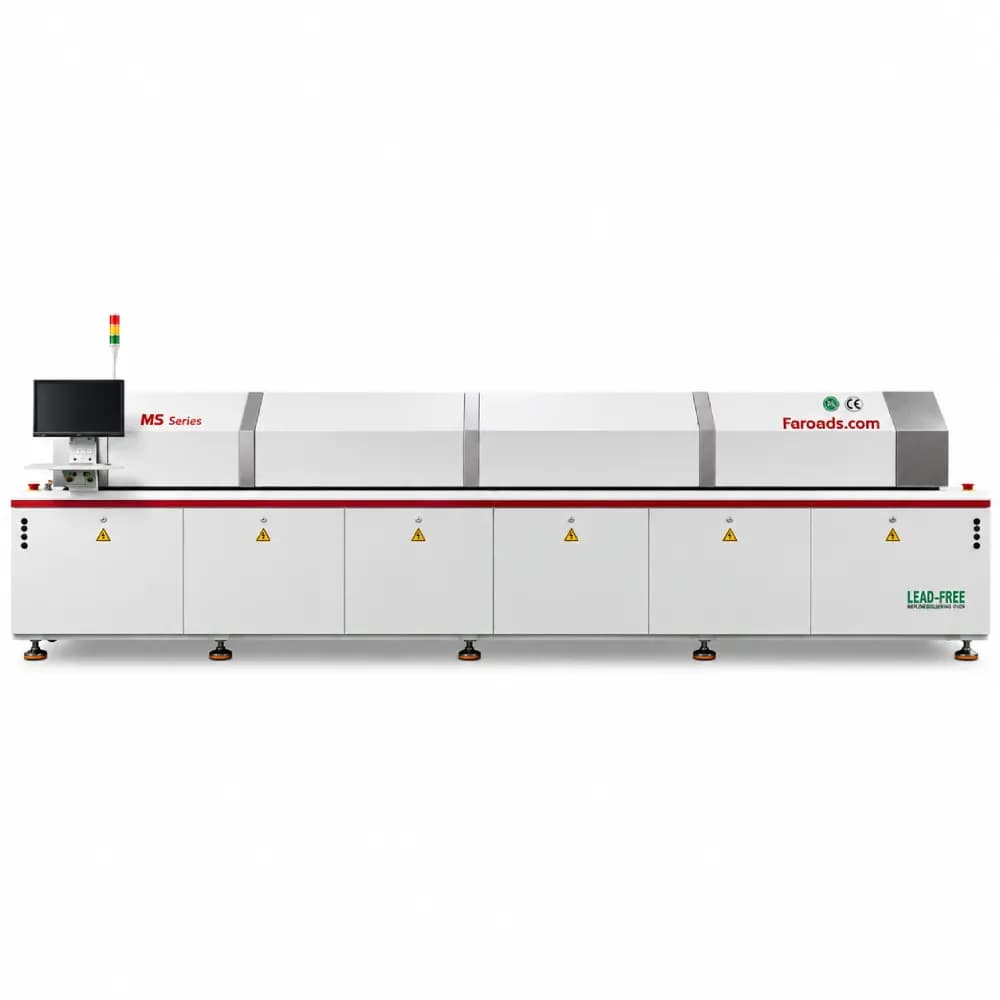
Production equipment needs power, compressed air, exhaust and floor space, and it must be delivered into the building. As an example, the FAROAD MS-8 reflow oven is listed at approximately 2,600 kg with a 380V three-phase supply, and FAROAD placement machines specify a compressed-air supply alongside their power rating. Facilities in North America often need electrical work to match.
The fix: share published utility data with your electrician and facilities team as soon as the configuration is proposed. Confirm voltage, phase, air supply, exhaust routing, floor loading and the delivery route before ordering.
Mistake 7: Leaving acceptance undefined until delivery
If acceptance criteria are not agreed in advance, there is no clear point at which the line is "finished." Disputes about performance then happen after payment terms have already moved forward.
The fix: agree the boards, run length, output and quality measures for acceptance before you sign. Include both factory testing and on-site testing where relevant. Our line integration and acceptance guide shows how to set them up.
Mistake 8: Underestimating the people side
A new line needs operators, programmers and someone who owns the process. Training that covers only machine buttons leaves your team unable to create programs, adjust profiles or diagnose defects.
The fix: list the roles you will need and the training each requires. Ask suppliers to state training content, duration, location and language in the proposal, and plan for a ramp-up period with lower output while skills develop. Keep a basic set of recommended spare parts on site from the first day of production so a minor failure does not stop a line your team is still learning.
A quick pre-purchase review
Before approving the purchase, confirm that you can answer yes to each of these:
- Every supplier quoted against the same written product brief.
- The brief covers expected products for the next few years.
- Cycle time estimates are based on your boards.
- Quotations have been compared on equal scope.
- Inspection stations and space are planned, even if phased.
- Facilities have confirmed power, air, exhaust and access.
- Acceptance criteria are written into the contract.
- Training, ramp-up and initial spare parts are planned.
Frequently asked questions
What is the most expensive mistake in an SMT line project? It varies, but undersizing the line for future products is often costly because it can force early replacement of major equipment.
How detailed should the product brief be? Detailed enough that two suppliers would quote the same configuration from it. Include board data, components, volumes and shifts as a minimum.
Should we buy the cheapest quotation if it meets the brief? Price matters, but compare scope, support, training and acceptance terms as well. The lowest price on an incomplete scope is rarely the lowest cost.
Can these mistakes be fixed after installation? Some can, at extra cost and downtime. Most are far cheaper to avoid during specification.
Get a configuration built on your brief
FAROAD configures complete SMT lines around PCB size, components, volume, shifts, factory space and existing equipment. Share your product brief and site information, then request a quotation that itemizes each machine, option and service.