High-Speed vs Modular Pick-and-Place: Which Machine Class Fits Your Line?
How to choose between FAROAD's high-speed and modular precision pick-and-place classes: component range, board size, dual-track width, and when a mixed line is the better buy.
6 min read
This article is about choosing a pick-and-place machine class: a high-speed dual-track machine built for volume, a modular precision machine built for a wider part mix, or a combination of the two. It does not retell how to read a headline CPH figure, and it does not decide when a second machine pays off. Read CPH claims in pick-and-place selection beyond headline CPH. The payback question for a second mounter is in when to add a second pick-and-place machine.
Start with the component mix, not the brochure speed
The class decision starts with what you actually place. List the smallest, largest and tallest parts, and whether they arrive on tape, trays or tubes. Then list the board-size window and placements per panel. A high optimum CPH is the wrong buy if your largest package sits outside the camera and head range, or if the panel is wider than the track you intend to run.
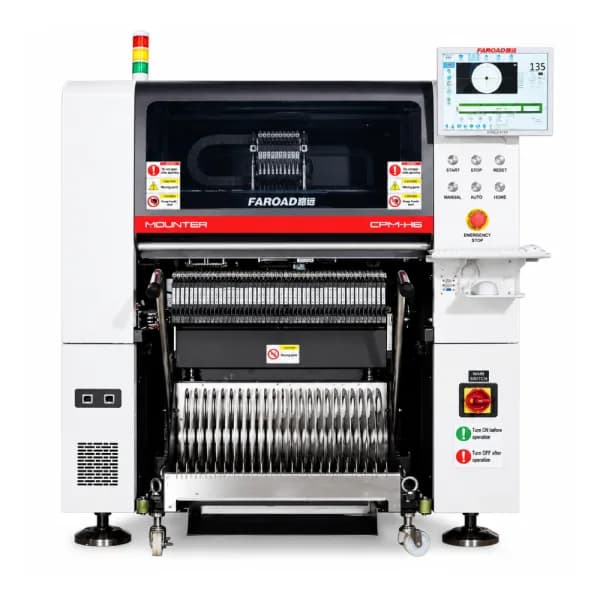
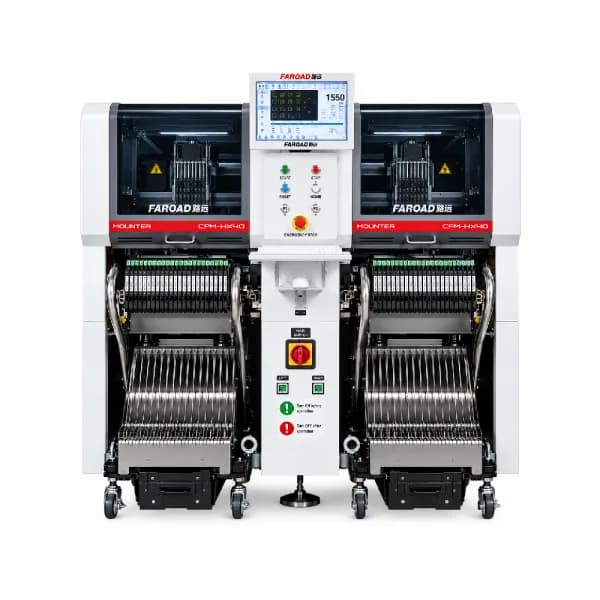
FAROAD groups general-purpose placement into three listed classes: high-speed pick-and-place (CPM-H6 and CPM-S5), high-speed modular placement (CPM-HX40), and modular precision placement (CPM-F5 and CPM-F6). Listed optimum speeds run from 42,000 CPH on the modular precision machines to 90,000 CPH on the H6 high-speed head. Use the selection article to test those claims; use this article to decide which class belongs on the quotation.
What the high-speed class is built to do
The CPM-H6 and CPM-S5 are listed as dual-arm, dual-track machines. The H6 lists 90,000 CPH for the high-speed head and 38,000 CPH for the multifunctional head. The S5 lists 84,000 CPH and 38,000 CPH for the same two roles. Both list a high-speed flying-camera range from imperial 0201 up to 12 × 12 × 6.5 mm. The multifunctional fixed-camera range is wider: up to 55 × 55 × 25 mm on the H6, and up to 40 × 40 × 25 mm on the S5. Single-track board size is listed as 50 × 50 mm minimum, with a maximum of 510 × 510 mm on the H6 and 510 × 550 mm on the S5.
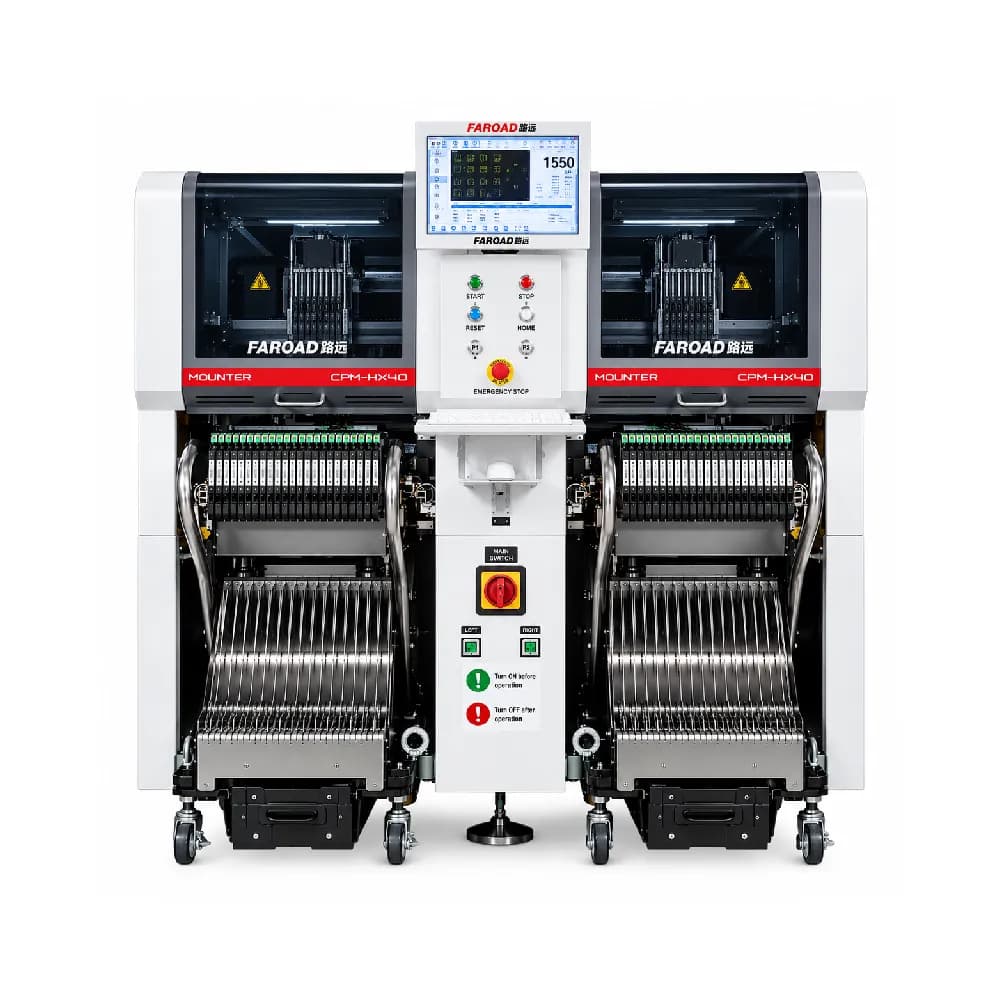
The CPM-HX40 is a different high-speed machine. It is listed at 80,000 CPH and ±0.025 mm accuracy, with 24+24 high-speed heads and a fixed camera. Its listed component range is imperial 01005 minimum, but only up to 6 × 6 × 3 mm. Its listed single-track board size tops out at 320 × 580 mm, which is a smaller window than the H6 or S5. If your mix includes large ICs, connectors or tall parts, the HX40's published component range will not cover them. If your panels are wider than 320 mm, it is the wrong class unless a different configuration is confirmed in writing.
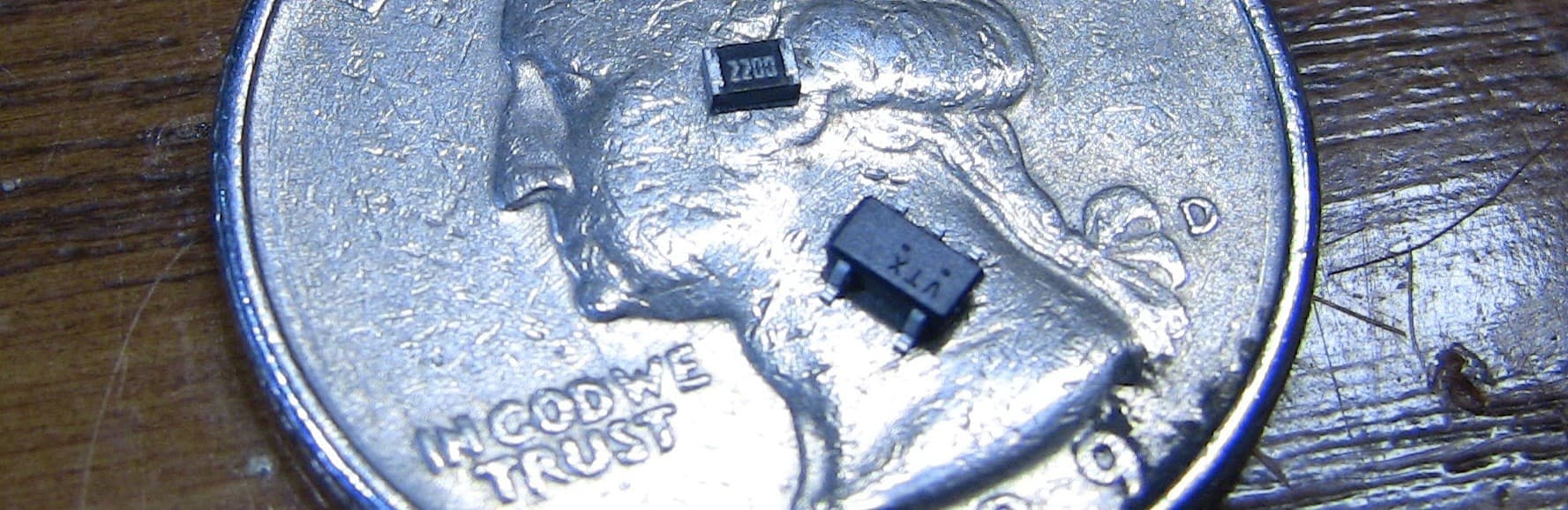
Photograph: Pete Brown. Original source on Flickr. Licensed under CC BY 2.0. Not cropped or resized; recompressed as JPEG for publication.
What modular precision machines are built to do
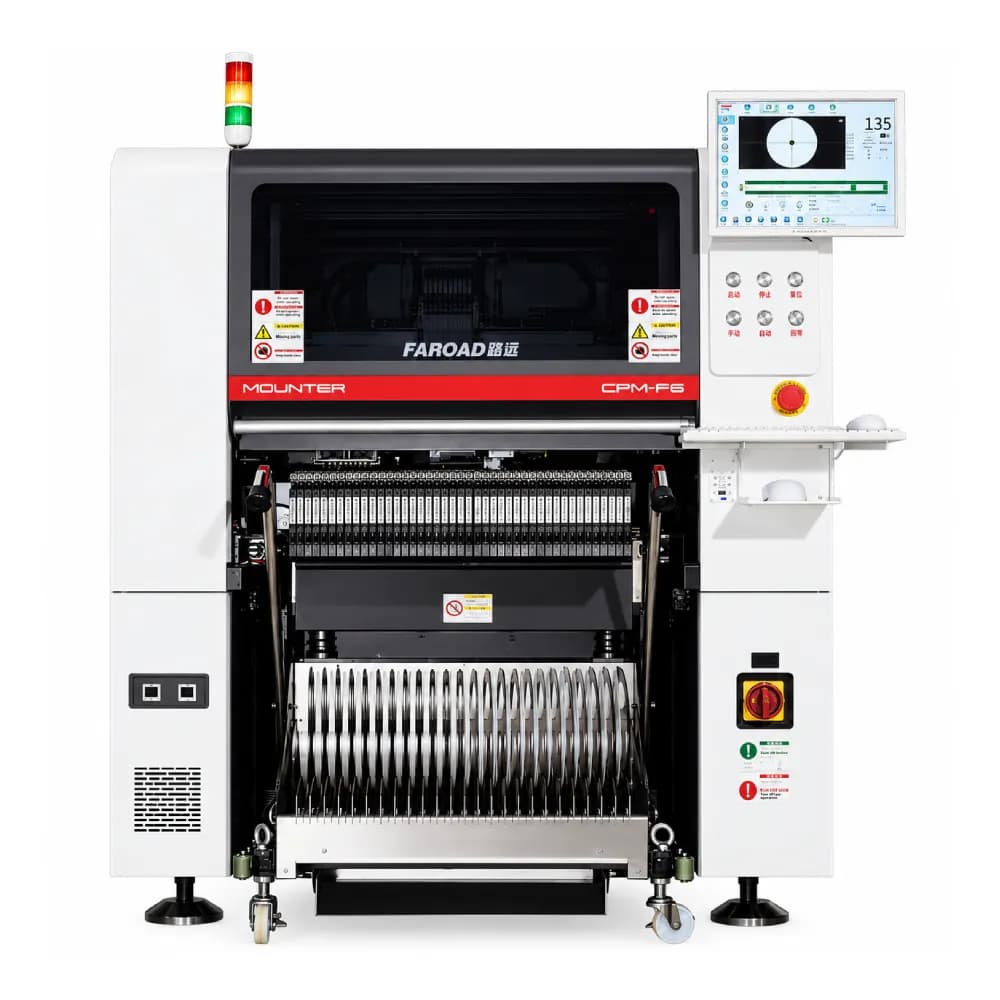
The CPM-F5 and CPM-F6 are listed as modular precision machines with a high-speed head and a multifunctional head. Both publish optimum productivity of 42,000 CPH on the high-speed head and 18,000 CPH on the multifunctional head. They are single-track machines. The F6 flying camera is listed from imperial 0201 up to 12 × 12 × 6.5 mm, and its fixed camera from the same minimum up to 55 × 55 × 25 mm. The F5 lists a multifunctional range up to 40 × 40 × 25 mm. Board size is listed as 50 × 50 mm minimum, with a maximum of 510 × 410 mm on the F5 and 510 × 570 mm on the F6.
That is the practical trade: lower listed optimum speed than the high-speed class, in exchange for a wide part range on a single modular machine, and a board window that is broader than the HX40. Feeder counts are listed as 50 slots of 8 mm on one side, with 100 slots optional on two sides for the F5 and F6. Tray cabinets and tube feeders are listed as options. For a wide mix at moderate volume, this class is often the cleaner first machine; a mostly small-chip, high-volume mix may leave placements on the table.
Dual-track is not the same as a dual-lane line
Dual-track on a placement machine is a machine feature. A dual-lane SMT line is a line-level decision, covered in dual-lane SMT lines. Do not treat a dual-track mounter as a second complete lane through the printer and oven.
On the H6, the dual-track table goes from 50 × 50 mm to 510 × 270 mm; a 1,200 mm length is mentioned only as a possible modification. The S5 dual-track table goes to 510 × 300 mm, and likewise mentions a 1,200 mm mounting modification. Treat those longer lengths as options you must order and demonstrate, not as the default table. If long boards are in the brief, put the altered envelope on the quotation and run the actual panel in that setup. In the standard dual-track window, each board is also narrower than the single-track maximum, so a 400 mm-wide panel will not automatically run two-up.
A mixed line is a valid answer
Many factories do not have to pick only one class. A high-speed head or a high-speed machine can place the chip volume, while a multifunctional head or a modular precision machine places the large and odd packages. The H6 lists mixed nozzle counts (10+6 heads) as a configuration. The F5 and F6 already combine a high-speed head and a multifunctional head in one machine.
The right answer is the configuration that places the real bill of materials inside the cycle time you need, with a feeder and tray plan that matches how the parts arrive. Accuracy still has to be read against the finest pitch, as set out in pick-and-place accuracy. An unbalanced mixed line simply moves the bottleneck from one head to the other.
Confirm the class on a timed placement trial
Ask for a timed placement of your densest production panel and of the board that contains the largest or tallest part. Set the pass criteria before the demo: every package in the bill of materials placed, the cycle time under the intended head and feeder setup, and the board size in the track configuration you will actually run. If the quotation depends on a long-board modification or a dual-track width, that configuration should be the trial, not a standard single-track demo.
Frequently asked questions
Is the CPM-HX40 the right machine for large ICs and connectors? Not on the published component range. The HX40 lists a maximum of 6 × 6 × 3 mm on its fixed camera. Large ICs, connectors and tall parts belong on a multifunctional head, such as the ranges listed for the H6, S5, F5 or F6, and should be confirmed on a trial.
Does a higher listed CPH mean I should always buy the H6 or S5? No. Optimum CPH is measured under stated conditions. If the mix needs a wide component range or a board size the high-speed configuration cannot accept, a modular precision machine or a mixed line can be the better buy.
Can I run two wide boards at once on a dual-track H6 or S5? Not at the standard listed dual-track widths. The H6 lists a 270 mm dual-track maximum and the S5 lists 300 mm, both well below their single-track maxima. Confirm any modified envelope in the quotation.
Do FAROAD machines place imperial 01005 parts? The HX40 lists imperial 01005 as the minimum on its fixed camera. The H6, S5, F5 and F6 list imperial 0201 as the minimum on the published ranges. If 01005 is required on those models, ask for a confirmed configuration and a trial; do not assume it from the HX40 table.
Request a placement-class review
Send FAROAD your board size window, the smallest and largest packages, placements per panel, and the volume you need to hold. We will propose a high-speed, modular precision or mixed configuration and a timed placement demo on your production panels. Request a quote to begin that review.