When Should You Add a Second Pick-and-Place Machine?
How to tell whether a second mounter, a faster replacement or a dual-track machine is the right way to add placement capacity, and how to avoid simply moving the bottleneck.
5 min read
Orders are growing, the mounter is running flat out, and someone suggests buying a second one. It may be the right move. It may also move the bottleneck to the oven, double the feeder bill, or solve a problem that a faster single machine would solve with less floor space.
This guide helps you decide whether a second pick-and-place machine is the right way to add capacity, and how to plan it so the whole line benefits.
Confirm placement really is the constraint
Before buying anything, check that placement is the station limiting output. Time each station on your main products over a normal week, including changeovers and stops. If the printer, oven or inspection is the slowest step, a second mounter adds little.
Also check whether the mounter is slow because of the machine or because of how it is used. Long changeovers, missing feeders, poor programs or frequent stops can make a capable machine look like a bottleneck. Our SMT line capacity planning guide explains how to find the real constraint across a product mix.
Three ways to add placement capacity
Once placement is confirmed as the constraint, there are three main paths.
Add a second machine in the same line. The work for each board is split between two mounters in series. Capacity rises, and feeder capacity roughly doubles.
Replace with a faster machine. One higher-capacity mounter replaces the existing one, which may be sold or moved to another line.
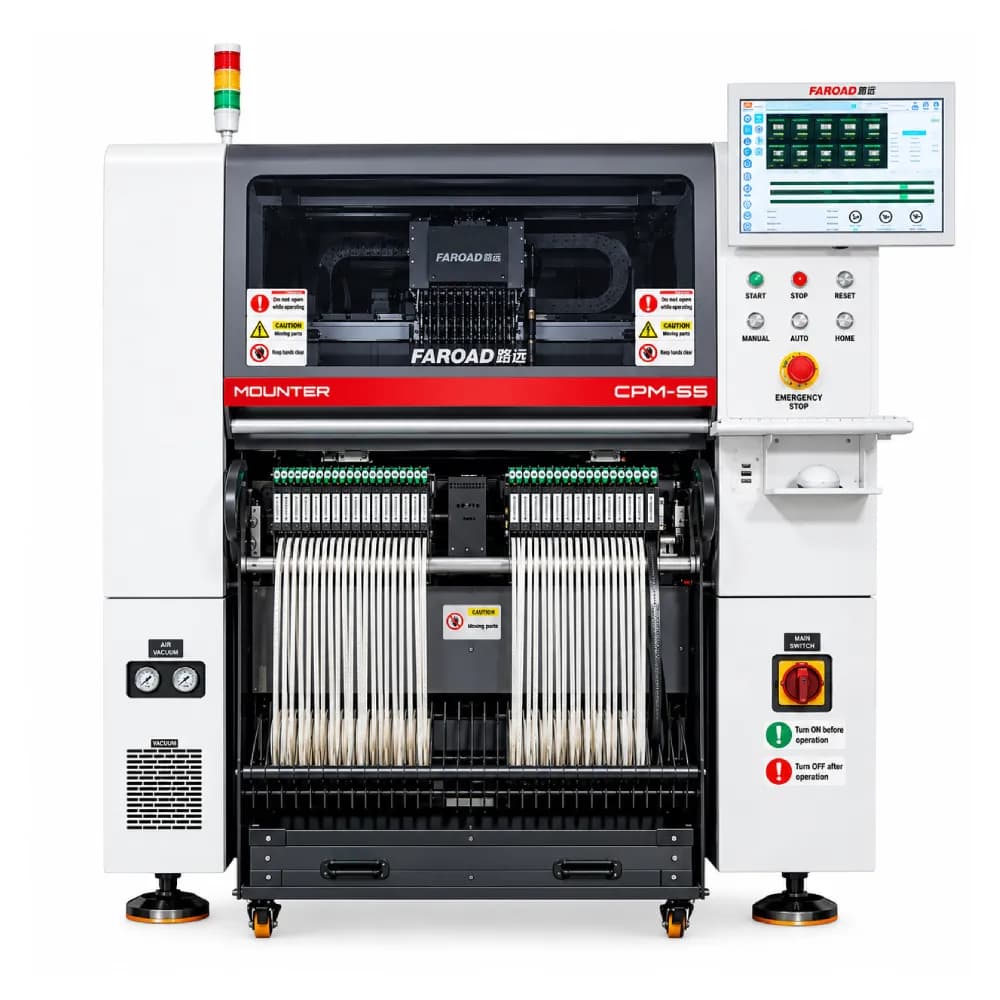
Choose a dual-track or dual-arm platform. One machine handles two boards at once or works on one board with two heads. The FAROAD CPM-S5, for example, is a dual-arm machine with a dual-track conveyor that supports independent mounting, where each track runs its own board, and alternate mounting on a single board.
When a second machine is the better answer
A second mounter tends to win when:
- Feeder slots are running out. Two machines carry roughly twice the feeders, so more products stay set up and changeovers shrink.
- The component mix is wide. One machine can be configured for small chips at high speed and the other for large or odd-form parts.
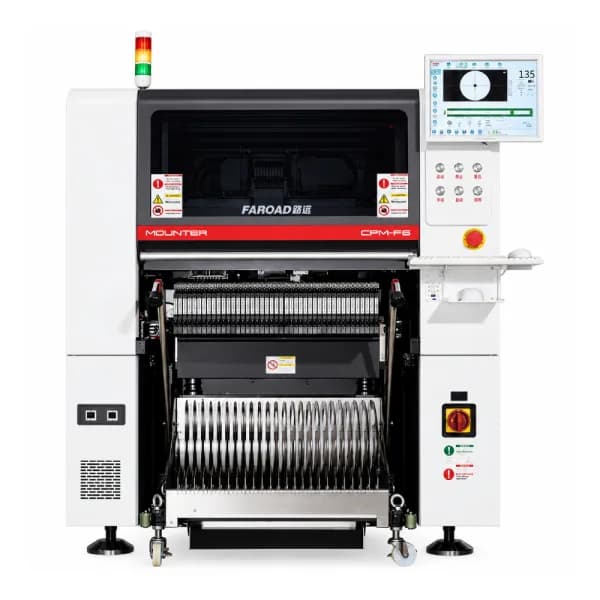
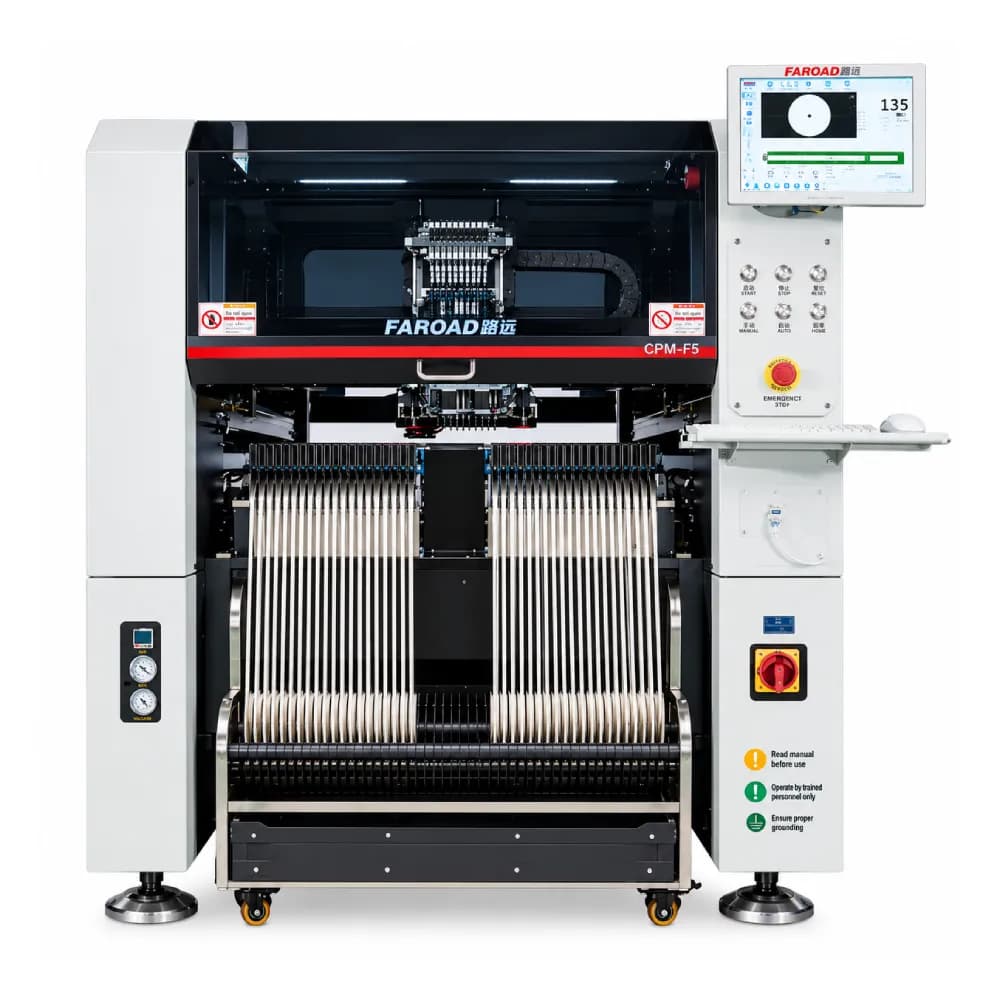
- You want a phased investment. A modular platform lets you add a matching unit later. FAROAD describes the single-arm CPM-F5 as the counterpart of the dual-arm CPM-F6 in the same modular family.
- Redundancy matters. If one machine stops, the other may keep simpler products running.
When a faster single machine is the better answer
A single faster machine tends to win when floor space is tight, when your boards are dominated by small chips that a high-speed head handles well, or when your current machine is old enough that replacement makes sense regardless. One machine also means one set of programs, fewer feeders to maintain and simpler training.
Rated speeds are measured under optimal conditions, so compare candidate machines on your actual boards rather than catalog figures.
Think about the existing machine as well. If it is reliable and well supported, keeping it alongside a new unit protects the investment you have already made. If it is near the end of its useful life, a single replacement may be cheaper than integrating new and old equipment that use different feeders, nozzles and software.
Splitting the work between two mounters
With two machines in series, the program decides how much each machine does. The goal is for both to finish each board in roughly the same time. If one machine takes much longer, the other waits and the investment is wasted.
A common approach puts small, fast-placing parts on the first machine and larger, slower parts on the second. Feeder layout, nozzle availability and component sizes all affect the split. Ask the supplier to build balanced programs for your main products before you buy, and to show the expected time on each machine. Line software helps here: the CPM-S5 page lists VConnector offline programming for intelligent optimization and balanced line design.
Check the rest of the line before you order
When placement gets faster, the next-slowest station becomes the limit. Check each one:
- Printer. Will its cycle time, including stencil cleaning, keep up?
- Reflow. Can the oven accept boards at the new rate at the conveyor speed your profile needs?
- Inspection. Can SPI and AOI inspect each board within the new cycle time?
- Handling. Do conveyors and buffers between machines have room for the extra unit?
Floor space is part of this check. The CPM-F5 page lists dimensions of 1,380 × 1,880 mm in plan, and the CPM-S5 lists 1,380 × 2,326 mm, before access space. A second machine also needs power and compressed air.
An illustrative balance check
The figures below are illustrative only.
Suppose one mounter needs 50 seconds per board, the printer 20 seconds and the oven can accept a board every 28 seconds. Placement limits output to one board every 50 seconds.
Add a second mounter and split the work so each needs about 27 seconds. The line now produces a board every 28 seconds, limited by the oven, and output rises by roughly 80 percent. If the split were poor, say 35 and 19 seconds, the line would run at 35 seconds per board and much of the gain would be lost. Balance matters as much as the purchase.
Frequently asked questions
Should the second machine be the same model? Not necessarily. A different head setup can cover a wider component range, but the same model simplifies spares and training.
Can a second machine go in a separate line? Yes. A second line adds flexibility for different products but also needs its own printer, oven and inspection. Our guide to upgrading versus buying a new line covers that choice.
Will a second machine double output? Rarely. Output is set by the slowest station after the change, and by how evenly the work is split.
How do we know the programs will be balanced? Ask the supplier to prepare and time programs for your main boards before purchase.
Request a capacity-expansion proposal
Send FAROAD your current line, station times and product mix, and we will compare a second mounter with alternative configurations. Request a quote with your BOMs and output targets to start.