Infrared vs Convection Reflow Ovens: Which Heating Method Fits Production?
How infrared and hot-air convection reflow ovens move heat into a board, why mixed assemblies behave differently in each, what the FAROAD MS and MK listings state about heating, and what to test before you order.
5 min read
Buyers who compare reflow ovens from different suppliers soon meet two labels: infrared (IR) and convection, sometimes called hot air. Both can melt solder paste. They differ in how heat reaches each joint, and that difference decides how forgiving the oven will be when a board carries small chips next to large, dark or shielded parts. This guide explains the trade-off in plain terms and shows what to check on any quotation. For the wider oven decision, start with our reflow oven buying guide.
How the two heating methods transfer heat
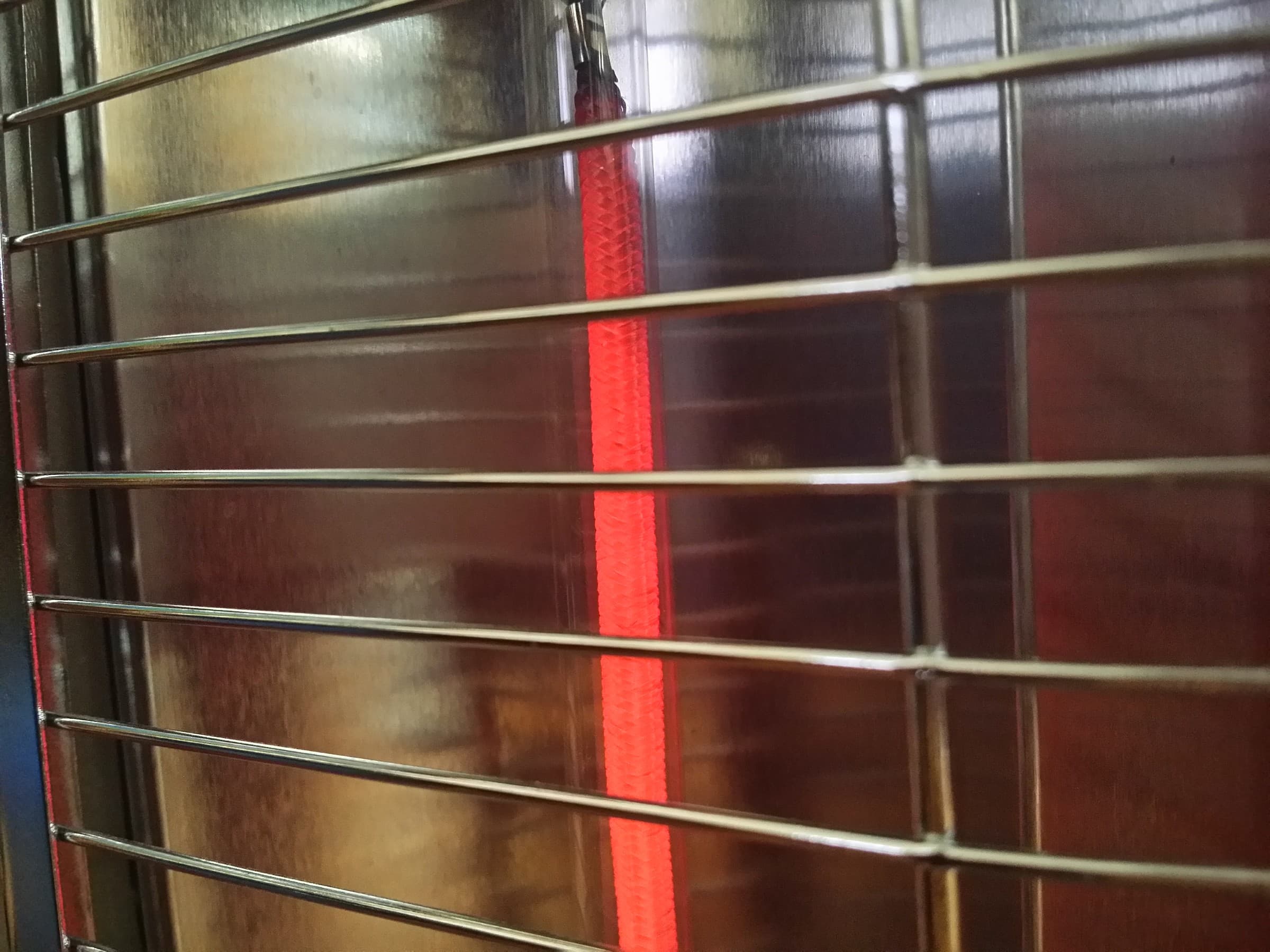
A carbon-fibre infrared heating element glowing inside its glass tube. Radiant emitters like this heat whatever they can "see". Photo: BlastarSeymour. Source on Wikimedia Commons, CC BY-SA 4.0. Resized from 4128 × 3096 px to 2400 × 1800 px and recompressed as JPEG for publication; not cropped. This file is shared under the same license.
An infrared oven uses hot panels, lamps or rods that radiate energy toward the board. Any surface in the line of sight absorbs part of that energy and warms up. How much it absorbs depends on its colour, finish and angle, which engineers call emissivity.
A convection oven heats air (or nitrogen) and blows it across the board from above and below. The moving gas carries heat to every surface it touches, whatever its colour. The gas temperature is set by the controller, so a part cannot get much hotter than the gas around it.
Many older and bench-top ovens mix the two, using IR panels with some air movement. When a supplier says "IR", ask exactly how much of the heating is radiant and how much is forced gas.
Where infrared heating struggles on mixed boards
Radiant heating works best when every surface on the board looks roughly the same to the emitter. Real production boards rarely do. Common problems include:
- Colour and finish. Black plastic bodies absorb radiant energy quickly, while shiny pads, metal shields and light-coloured parts reflect it. The same profile can overheat one part and underheat another.
- Shadowing. Tall connectors, electrolytic capacitors and shield cans block the line of sight to joints beside or beneath them.
- Thermal mass. Large ground planes and heavy parts lag behind small chips. Radiant heat does not "wait" for them in the way a gas set to a fixed temperature does.
- Profile changes. A new solder mask colour or a second-source component can shift the result, so a profile that worked last month needs rechecking.
None of this makes IR unusable. It means the process window is narrower, and more of the risk sits with the people writing and checking profiles.
Why production lines settled on forced convection
Forced convection is the usual choice for inline production because it treats different surfaces more evenly. When hot gas surrounds a board, the temperature difference between the hottest and coldest points tends to be smaller. That leaves more room in the profile for heavy parts and small chips to reach reflow without either one going outside the paste and component limits.
Convection also scales with zones. Each zone holds its own set point, so the board moves through a controlled sequence of preheat, soak, reflow and cooling. Upper and lower heaters in each zone help on double-sided assemblies and on boards with large copper areas.
The trade-offs are real but manageable. Convection ovens move a lot of air, so they need good insulation, steady fan control and a plan for flux vapour. They also take time to reach temperature from cold.
Where infrared still has a place
Radiant heating remains useful in some niches: small batch ovens, rework stations, curing tasks and simple boards made of uniform parts. A low-volume prototype shop may accept the narrower window in exchange for a compact unit. If the goal is daily production of mixed assemblies, though, judge an IR or hybrid oven by measured results on your hardest board, not by its heater type. For the other heating route some buyers consider, see our comparison of vapor phase and convection reflow.
What FAROAD's oven listings say about heating
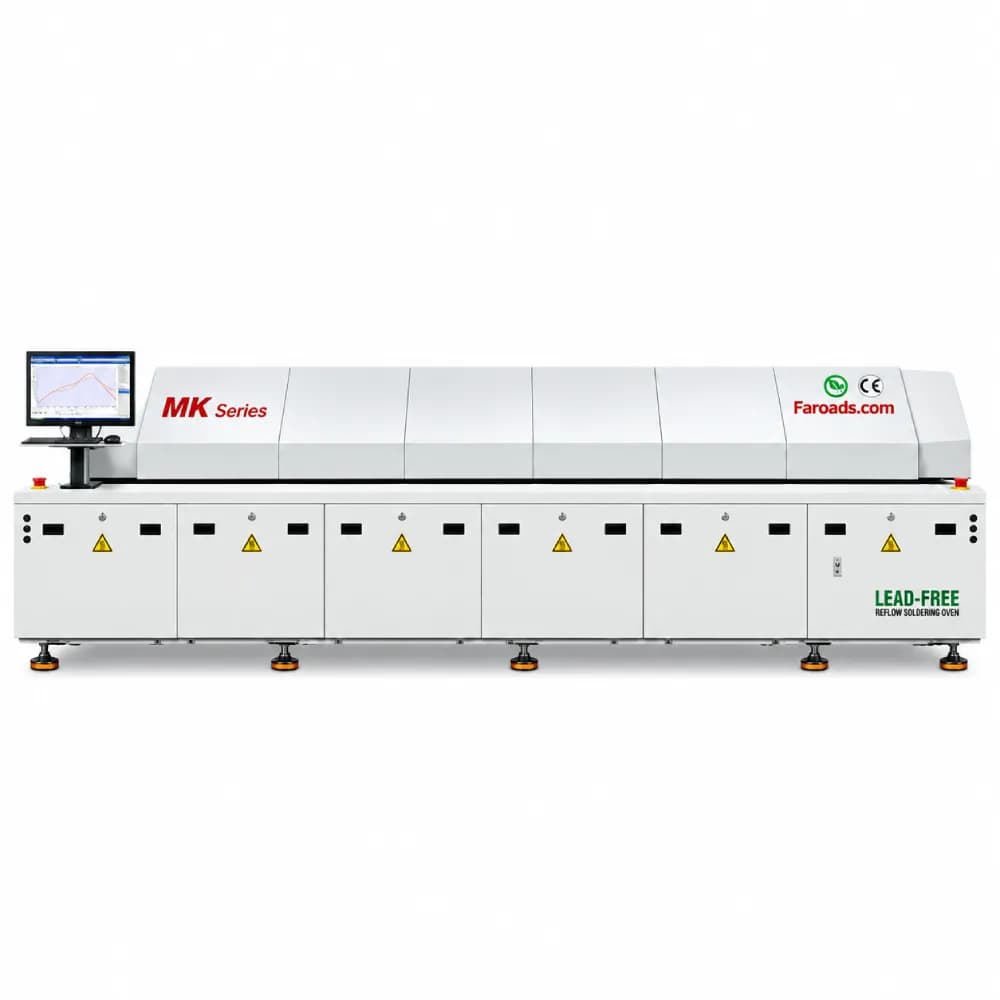
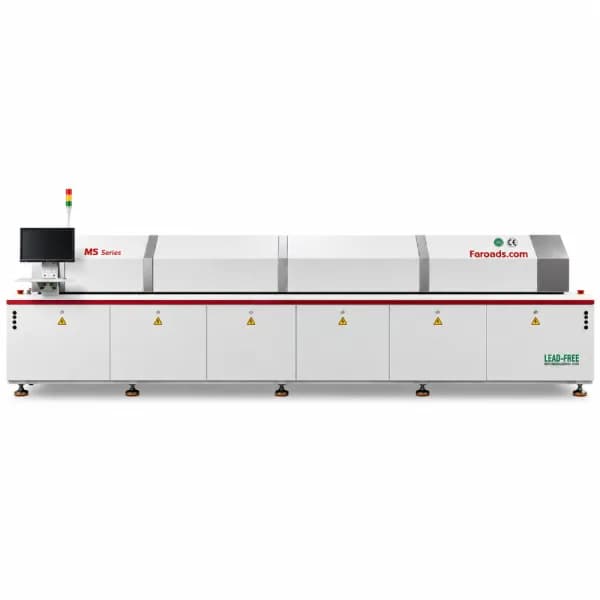
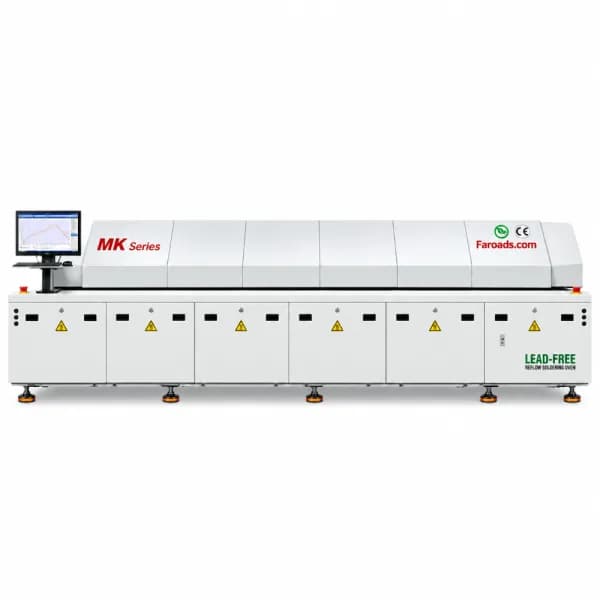
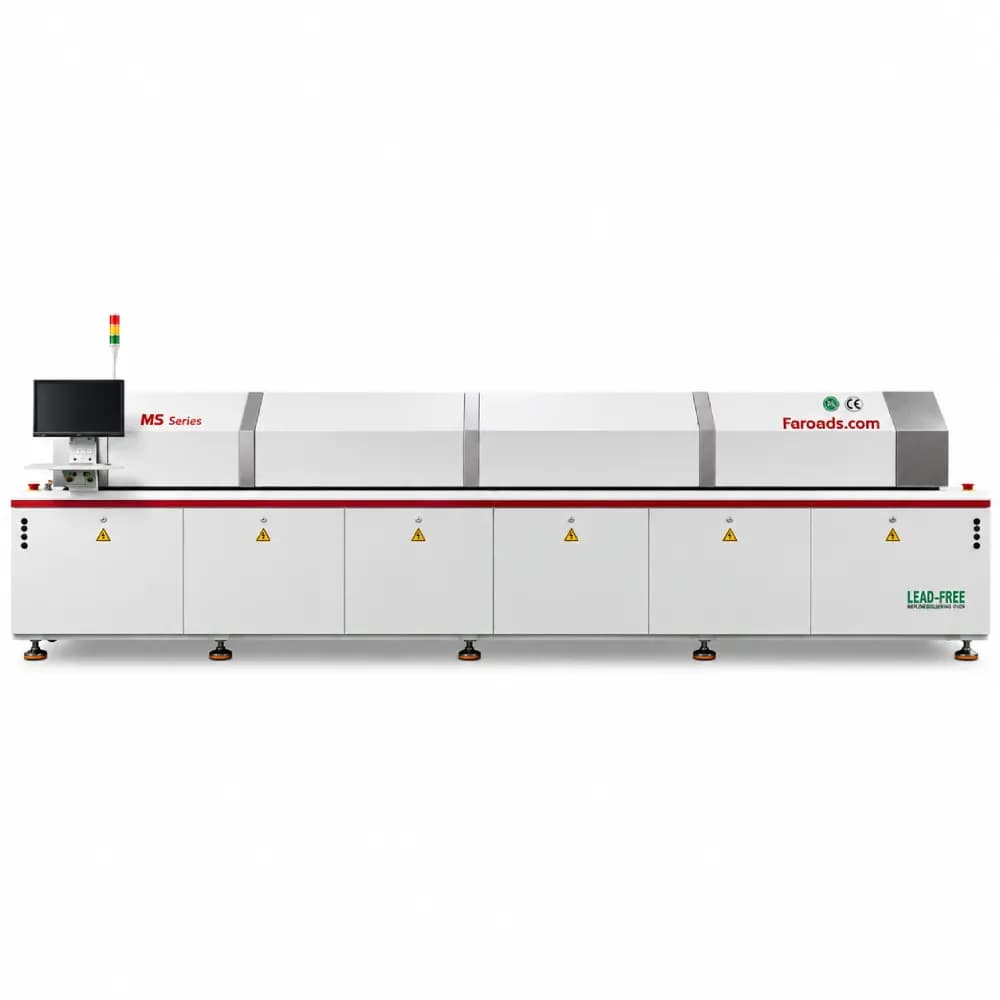
FAROAD lists hot-air reflow ovens only. All MS and MK models are described as lead-free hot air reflow machines, and FAROAD does not list an infrared or hybrid IR oven. Points worth reading on the product pages:
- The MS-10 lists 10 upper and 10 lower heating zones over 3,890 mm, an air volume of 25 m³/min, an 8 mm heat-storage aluminium plate for the air outlet rectifier and a built-in booster air drum. Its page claims no more than 1.0 °C of variation when measured along five test lines, and gives a PCB temperature distribution of ±1 °C.
- The MK-8 names its heating method as internal circulation heating, with a booster air drum, 8 upper and 8 lower zones over 3,142 mm and ±1 °C PCB temperature distribution.
- Heating-up time is listed as about 20 minutes on the MS-10 and MK-10 and about 15 minutes on the MK-8.
- Board clearance is part of the heating question: the MS-10 lists 30 mm above and 20 mm below the board, and the MK-8 lists 30 mm above and 25 mm below.
Uniformity figures on any data sheet describe a test set-up. Ask how the figure was measured and repeat a profile on your own board before acceptance.
Questions to ask before you buy any reflow oven
Whatever heating method a supplier offers, the same questions separate a suitable oven from a risky one:
- Is heating radiant, forced convection or a mix, and in what proportion per zone?
- What temperature spread across a loaded board does the supplier measure, and with how many thermocouples?
- How does the oven handle your darkest, tallest and heaviest parts on the same board?
- Are there separate upper and lower heaters, and can each be set independently?
- What happens to the profile when the line changes conveyor speed or board width?
- How long does the oven take to reach a stable profile from a cold start?
Ask for a measured profile on a board like yours, with thermocouples on the smallest chip, the largest part and a joint near a shield or connector.
Frequently asked questions
Is an infrared reflow oven cheaper to run than a convection oven? Not necessarily. Running cost depends on insulation, heated length, idle settings and how often the line runs. Compare listed operating power and warm-up time for the specific models you are quoting rather than the heating label. Can convection ovens handle boards with shield cans or large connectors? They usually handle them more evenly than radiant heating, because hot gas reaches areas the emitters cannot see. Confirm with a thermocouple near the shielded or shadowed joint. Does FAROAD sell an infrared reflow oven? No. The current FAROAD MS and MK listings are hot-air convection ovens. Infrared or hybrid ovens are not part of the catalog. What uniformity figure should I ask for? Ask for the spread measured on a loaded board similar to yours, together with the test method. A data-sheet figure from an empty oven or a test fixture is a starting point, not proof for your product.
Compare heating evidence on your own board
Send FAROAD your hardest board, solder paste and target line speed, and we will propose an MS or MK model with a profile plan to confirm temperature spread before acceptance. Request a quote to start the comparison.