Reflow Oven Cooling: How Much Cooling Does Your Line Need?
What the cooling section of a reflow oven must do, how to read cooling zones and cooling length on FAROAD MS and MK tables, and how to verify exit temperature before you buy.
5 min read
Reflow oven quotes lead with heating zones. Cooling usually gets one line in the table and little discussion, even though it decides how the joints solidify and how hot the board is when it reaches the next machine. If you are still choosing the number of heating zones, start with our reflow oven zones guide. This article covers the part after the peak.
What the cooling section has to do
The cooling section has two jobs. First, it brings the solder from liquid to solid at a rate the paste and components tolerate. Component reflow guidance based on IPC/JEDEC J-STD-020 commonly lists a maximum ramp-down rate, often 6 °C per second, and paste suppliers publish their own window. Cooling that is too slow lengthens time above liquidus and can coarsen joints; cooling that is too aggressive can stress large ceramic parts and heavy boards.
Second, it delivers the board to the next station at a manageable temperature. An inline AOI, an unloader stacking boards in magazines, or an operator taking boards by hand all care about exit temperature. A board that leaves the oven too hot can also warp after it leaves the rails.
Read the cooling line on each FAROAD table
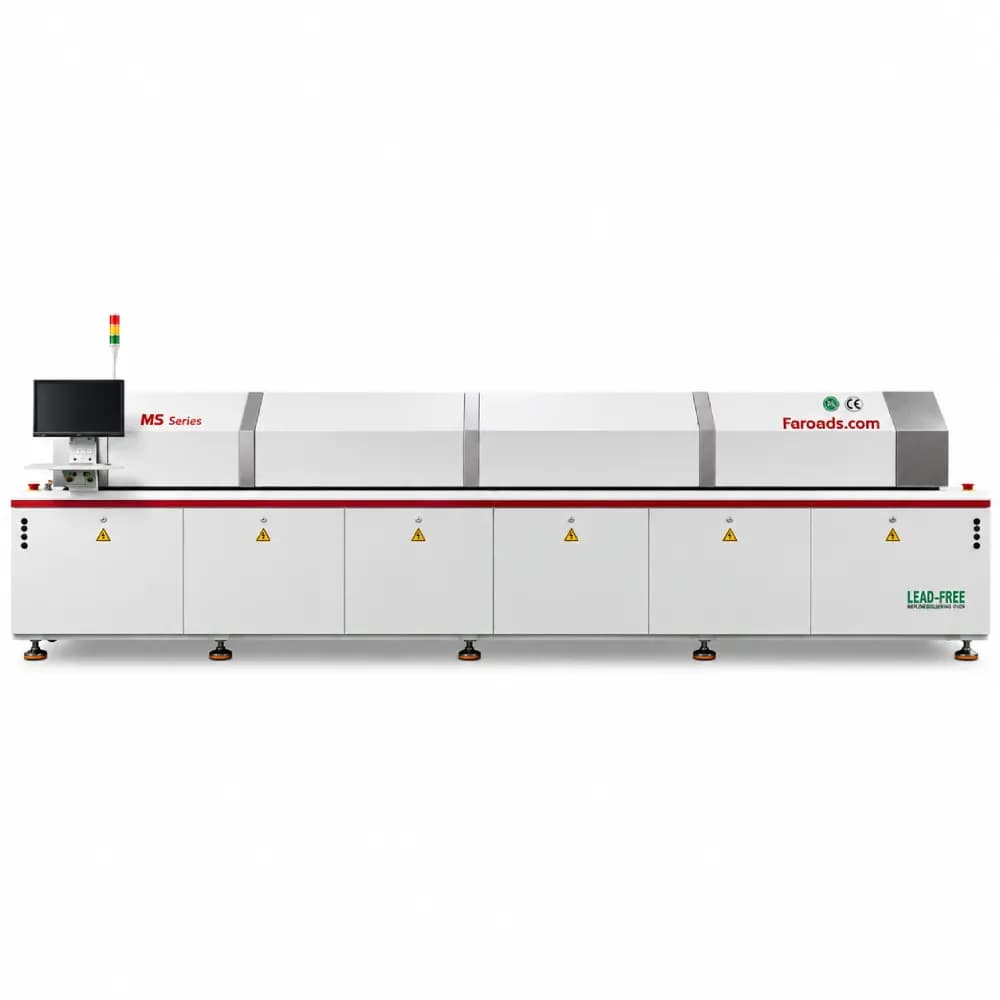
FAROAD's oven pages list cooling in different ways, so read each one rather than assuming a series value.
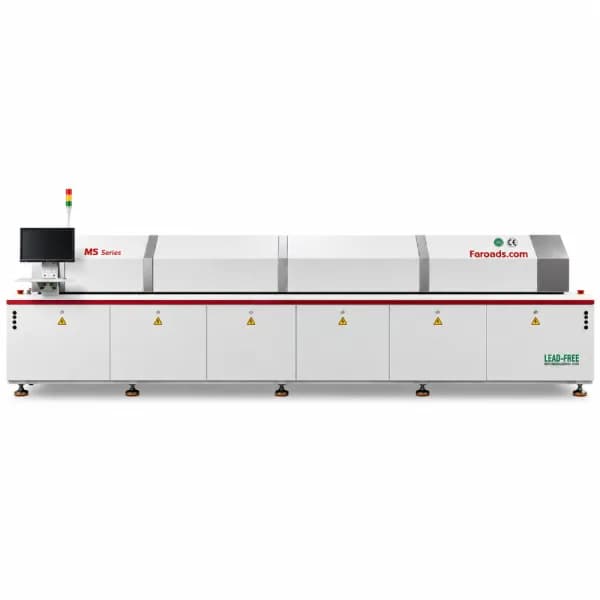
MS series. The MS-8 and MS-8D list 2 cooling zones of the cold-air internal circulation type. The MS-10, MS-10D, MS-14 and MS-14D list 3. The MS-12 and MS-12D list 3 with a fourth optional. The MS pages do not list a cooling length. The nitrogen versions (for example MS-10N) add an oxygen analyzer, nitrogen flow meter and external water cooler as part of the nitrogen protection device; do not read that as a cooling-performance figure.
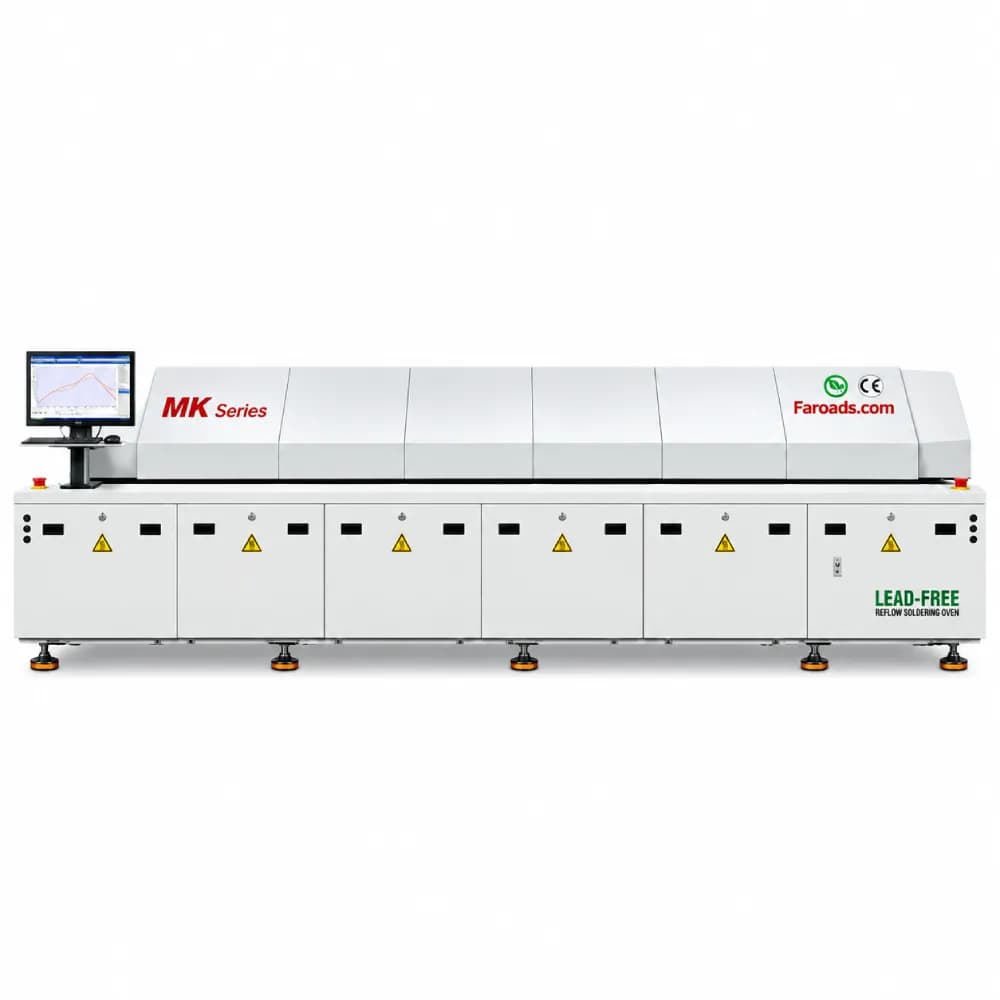
MK series. The MK-8 lists 2 cooling zones of the cold-air internal circulation type and a cooling length of 1,065 mm, while the same table names the cooling method as natural air cooling. Ask the supplier to describe the actual arrangement on the quoted machine. The MK-10 lists a 1,440 mm cooling length. The MK-12 page does not clearly list its own cooling length.
MK-MAX LED ovens. The MK-8MAX lists 3 cooling zones with three 20 m³ channels and a 1,065 mm cooling length; the MK-10MAX lists 1,440 mm.
Why conveyor speed changes the answer
Cooling length only becomes cooling time once belt speed is known. As an illustrative calculation, a board on 1,065 mm of cooling at 1,000 mm per minute spends about 64 seconds there. On 1,440 mm at the same speed it spends about 86 seconds. If the line has to run faster to keep up with the mounters, both figures shrink. FAROAD ovens list a belt speed range of 300–2,000 mm per minute, so the same oven can deliver very different cooling times depending on how it is run.
That is why cooling should be specified against the line rate you need, not the oven model alone. Our reflow profile guide explains how the full profile is set from the paste and component window.
Boards that need more cooling
Some products push cooling harder than others:
- High thermal mass. Thick boards, heavy copper, large shields, power parts and metal-core substrates hold heat and leave hotter.
- Dual-track loading. Two lanes of boards add heat load to the same cooling section.
- Long or wide boards. Lighting panels and large arrays present more mass per pitch.
- Close downstream equipment. An AOI placed right after the oven, or an unloader that stacks boards in magazines, has less time and space for natural cooling.
- Temperature-sensitive handling. Boards that go straight to programming, test or hand assembly need to be safe to touch.
If two or more of these apply, ask for the longer oven or the optional extra zone and test it, rather than relying on air cooling after the exit.
How to specify and verify cooling
Put these items in the request for quotation:
- Number of cooling zones and the cooling length for the exact model, plus the cooling method (internal circulation, fan, or an external chiller).
- The belt speed you expect to run, calculated from line takt and board pitch.
- The maximum allowed board exit temperature at the next station.
- The cooling slope required by your paste and the most sensitive component.
Then verify on a trial. Run a thermocouple profile on your heaviest board at production speed and read the cooling slope and exit temperature from the trace, not from the oven setpoints. Repeat with dual-track loading if you plan to use it. Write the agreed figures into the acceptance test. Cooling is one of several points where the two FAROAD oven families differ; see how MK and MS ovens compare for the rest.
Remember that the cooling section also has to cope with the factory around it. A hot, poorly ventilated room reduces what air cooling can achieve, so include room conditions in the trial notes.
Frequently asked questions
Do more heating zones mean more cooling? Not automatically. On the MS listings, the 10-, 12- and 14-zone models all list 3 cooling zones, while the 8-zone models list 2. Check cooling separately on every quote. Is a water chiller needed for normal SMT boards? Many lines run with internal air-circulation cooling. FAROAD lists an external water cooler as part of the MS nitrogen package. Whether your boards need chilled cooling should be decided from a measured exit temperature, not assumed. What exit temperature should I target? That depends on what happens next. Agree a figure with your inspection, handling and test teams, then measure it with a profiler at production speed. Can I improve cooling after installation? Some ovens offer optional zones or fan changes, but retrofits are harder than ordering the right section. The MS-12 lists a fourth cooling zone as an option; ask about it before ordering.
Size the cooling with your heaviest board
Tell FAROAD your heaviest board, target belt speed and the station after the oven. We will compare cooling zones and length across the MS and MK ranges and propose a profile check. Review the MS-12 specifications or request a quote.