Low-Temperature Solder: What It Changes in Your Reflow Oven Purchase
Why manufacturers are trialling tin-bismuth and other low-temperature solder pastes, what that means for reflow oven control, recipe management and cooling, and how to qualify the change.
4 min read
Most lead-free lines run SAC alloys such as SAC305, which melt around 217–220 °C and are usually reflowed with peaks in the 230–250 °C range. Low-temperature solder pastes, mostly tin-bismuth based, melt near 138 °C for the eutectic Sn42Bi58 composition and are commonly reflowed with peaks well under 200 °C. Paste makers continue to release new bismuth-based alloys aimed at better joint reliability. If your products might move in that direction, it is worth knowing what it means for the oven you are about to buy. For the standard lead-free case, see our lead-free reflow oven guide.
Why manufacturers look at low-temperature alloys
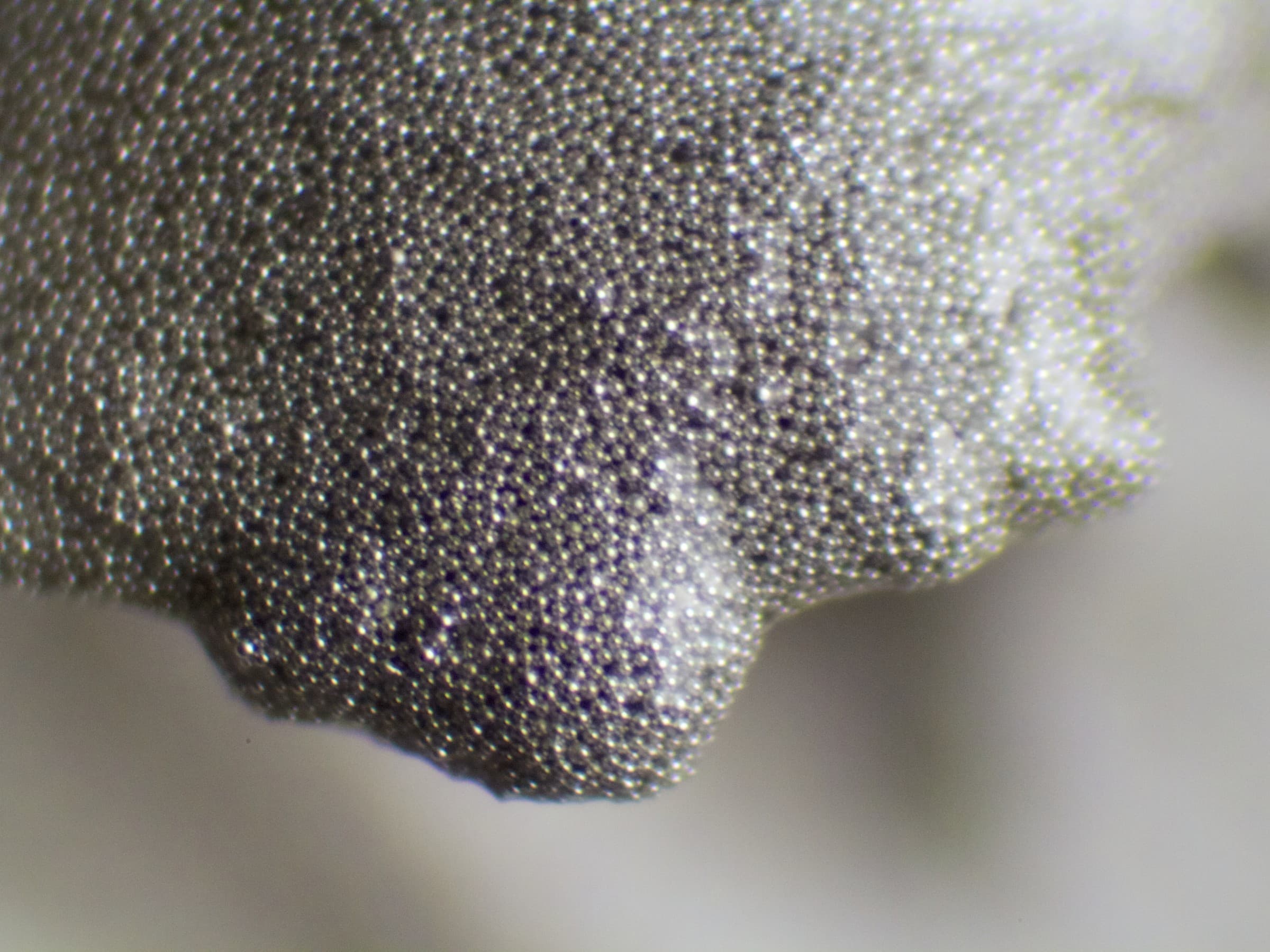
Close-up of solder paste: metal powder suspended in flux. Photograph: Windell Oskay. Original source on Flickr. Licensed under CC BY 2.0. Resized from 4607 × 3455 px to 2400 × 1799 px and recompressed as JPEG for publication; not cropped.
The reasons are practical:
- Heat-sensitive parts. Some displays, sensors, plastics and batteries are easier to protect at a lower peak.
- Warpage. Large, thin boards and big packages move less when the whole profile runs cooler.
- Step soldering. A low-temperature second pass can be made without remelting earlier SAC joints.
- Energy. Lower setpoints use less heat, although the saving depends on how the oven runs.
There are trade-offs. Bismuth-rich joints behave differently under drop and thermal cycling, and some product owners restrict them. Mixed joints, such as SAC solder balls on a BGA reflowed with low-temperature paste, need their own qualification. Low-temperature paste is a product decision first and an equipment decision second.
The oven does not need more heat. It needs control.
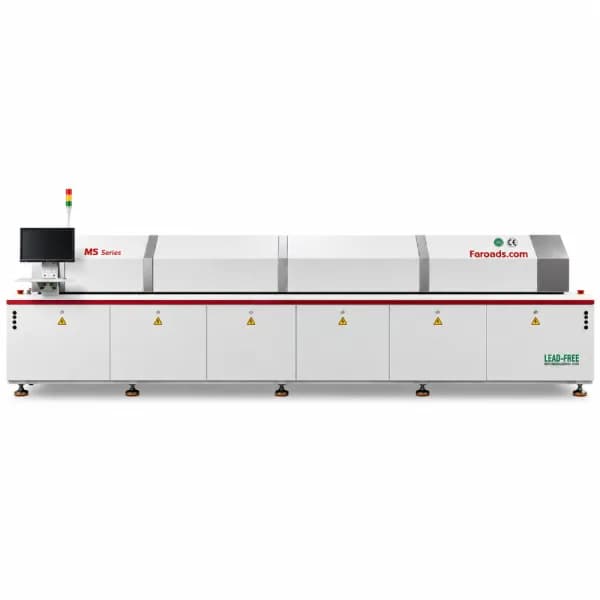
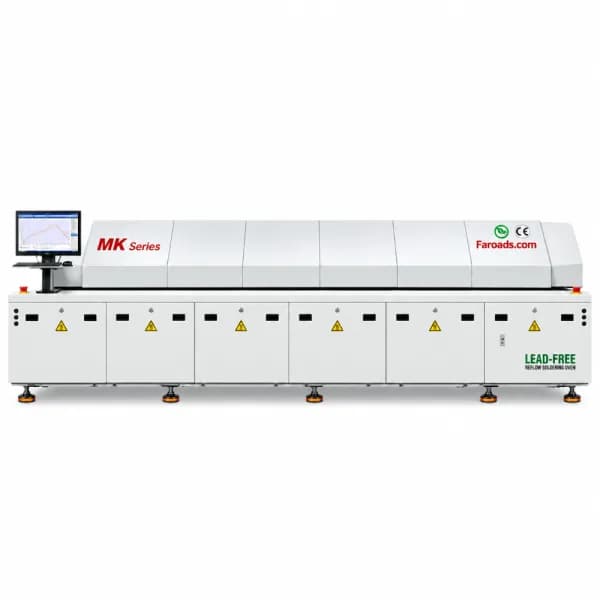
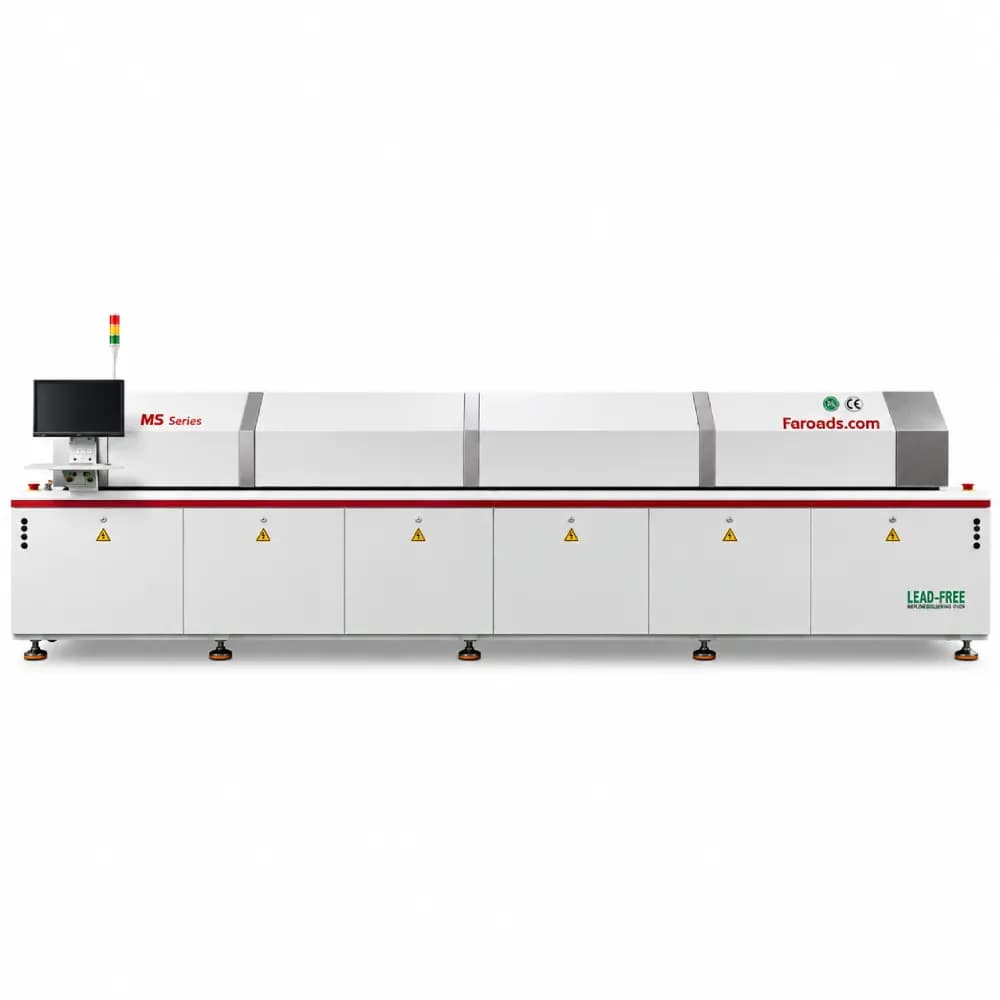
A convection oven built for lead-free SAC can usually run a low-temperature profile, because it is being asked for less heat, not more. What matters is how well it holds lower setpoints and how evenly it heats the board. Both FAROAD oven families give an upper setpoint of 350 °C, with PID loops driving solid-state relays, and quote ±1 °C for both controller precision and spread across the board. On MS models, the page adds that five test lines stay inside a 1.0 °C band.
Zone count still matters, for a different reason. A lower peak leaves less margin between the hottest and coldest part on the board, so a longer, gentler soak can help large or uneven assemblies. More zones make that shape easier to hold at production belt speed. Our reflow oven profile guide explains how the paste window sets the profile.
Running two alloys in one plant
Most factories that adopt low-temperature paste keep SAC for other products. That creates a recipe-control risk: one wrong program can underheat a SAC board or overheat a low-temperature one.
- Recipe call-up. The MS pages list MES collection over TCP/IP with QR code or barcode recognition for MES upload, which can support board-based recipe control when your MES is set up for it. The MK pages do not list MES or barcode functions, so recipe selection there depends on procedure and operator sign-off.
- Changeover time. Listed heating-up time is about 15–25 minutes from cold depending on model. Moving between alloys means changing setpoints and waiting for zones to settle; ask how long that takes on the quoted oven.
- Dual-track ovens. Both tracks pass through the same heating zones, so plan on one alloy at a time unless the supplier demonstrates otherwise.
- Upstream separation. Keep separate stencils, paste storage and labels, and make the printer program name show the alloy.
Cooling and nitrogen
A low-temperature profile spends less time far above ambient, so cooling is usually easier, but the paste datasheet still sets the cooling slope. Some low-temperature pastes are formulated for air reflow; others benefit from an inert atmosphere on difficult finishes. FAROAD sells MS ovens in nitrogen versions, which add oxygen measurement, nitrogen flow metering and an external water chiller. Whether that package pays off should be tested, as described in our nitrogen reflow cost guide.
Qualify the alloy before you size the oven
- Agree with the product owner which assemblies may use low-temperature paste and what reliability tests apply.
- Obtain the paste supplier's recommended profile window.
- Run thermocouple profiles on the real board, including the largest component and the most heat-sensitive part.
- Confirm joint quality with inspection and, where needed, cross-sections.
- Only then decide whether the planned oven length and zone count give enough margin at your belt speed.
If the low-temperature product will share an oven with SAC products, include a changeover test in acceptance.
What to put in the oven quotation
If low-temperature paste is on your roadmap, write it into the request for quotation now, even if the first products will run SAC. Ask the supplier to state:
- The lowest setpoint at which each zone holds its listed control precision.
- How quickly the oven moves from a SAC recipe to a low-temperature recipe and settles.
- How recipes are named, locked and selected, and whether barcode call-up is available on the quoted model.
- Whether the same profile can be held on both tracks of a dual-track oven.
- What profiling support and training are included at installation.
Those answers cost nothing to collect before the order and are expensive to discover after it.
Frequently asked questions
Do I need a special oven for low-temperature solder? Usually not. A lead-free convection oven with good control at lower setpoints and even heating can run it. Confirm with a loaded-board profile. Can one oven run SAC and tin-bismuth boards in the same shift? Yes, with a setpoint change and settling time between them. Reliable recipe control is the bigger issue than the oven itself. Does low-temperature paste reduce energy use? Lower setpoints use less heat, but idle time, warm-up and exhaust affect the total. Measure it rather than assuming a percentage. Is low-temperature solder as reliable as SAC? It depends on the alloy and the product's use conditions. Newer bismuth-based alloys target better reliability, but each product needs its own qualification.
Discuss a low-temperature process with FAROAD
Send your paste datasheet, board details and target belt speed. We will recommend an MS or MK configuration and a profiling plan for both alloys. See the MS-10 specifications or request a quote.