Lead-Free Reflow Ovens: What the Oven Must Handle and What to Check Before You Buy
Lead-free solder leaves a narrower gap between melting the paste and overheating the parts. Here is what that means for oven specifications, trials and quotations.
5 min read
Almost every production reflow oven sold today is described as "lead-free." The label tells you the oven can reach the temperatures lead-free solder needs. It does not tell you whether the oven can hold those temperatures evenly enough, on your heaviest board, at the speed your line runs.
This guide explains why lead-free soldering asks more of an oven, which specifications deserve attention, and how to handle the case many North American plants still face: some products on tin-lead, most on lead-free.
Why lead-free changes the oven requirement
The common lead-free alloys are tin-silver-copper (SAC) blends. SAC305, a widely used example, melts at roughly 217 to 219 degrees C according to solder suppliers, compared with about 183 degrees C for traditional eutectic tin-lead. To form good joints, the coolest joint on the board typically needs to rise well above that melting point for a defined time.
The upper limit, though, has barely moved. Many components and laminates carry peak temperature ratings in the 245 to 260 degrees C range, depending on package size and moisture-sensitivity classification. The result is a narrower gap between "hot enough to solder the heavy parts" and "too hot for the light ones."
That gap is the process window, and it is the main reason lead-free production rewards ovens with even heating and tight control.
An illustrative look at the process window
The numbers below are illustrative only, not a recommended profile. Always use your paste supplier's datasheet and component ratings.
- Tin-lead example: melting near 183 degrees C, a target peak around 210 to 225 degrees C, and component limits well above that. There is plenty of room for the heavy and light parts to differ by 15 degrees C or more.
- SAC example: melting near 217 degrees C, a target peak around 235 to 245 degrees C, and some component limits at 245 to 250 degrees C. If the heaviest part lags the smallest chip by 15 degrees C, the profile may not be able to satisfy both.
In practice, this is why a lead-free line cares so much about the temperature spread across the board at peak, not just the setpoint on the screen.
Oven specifications that matter for lead-free
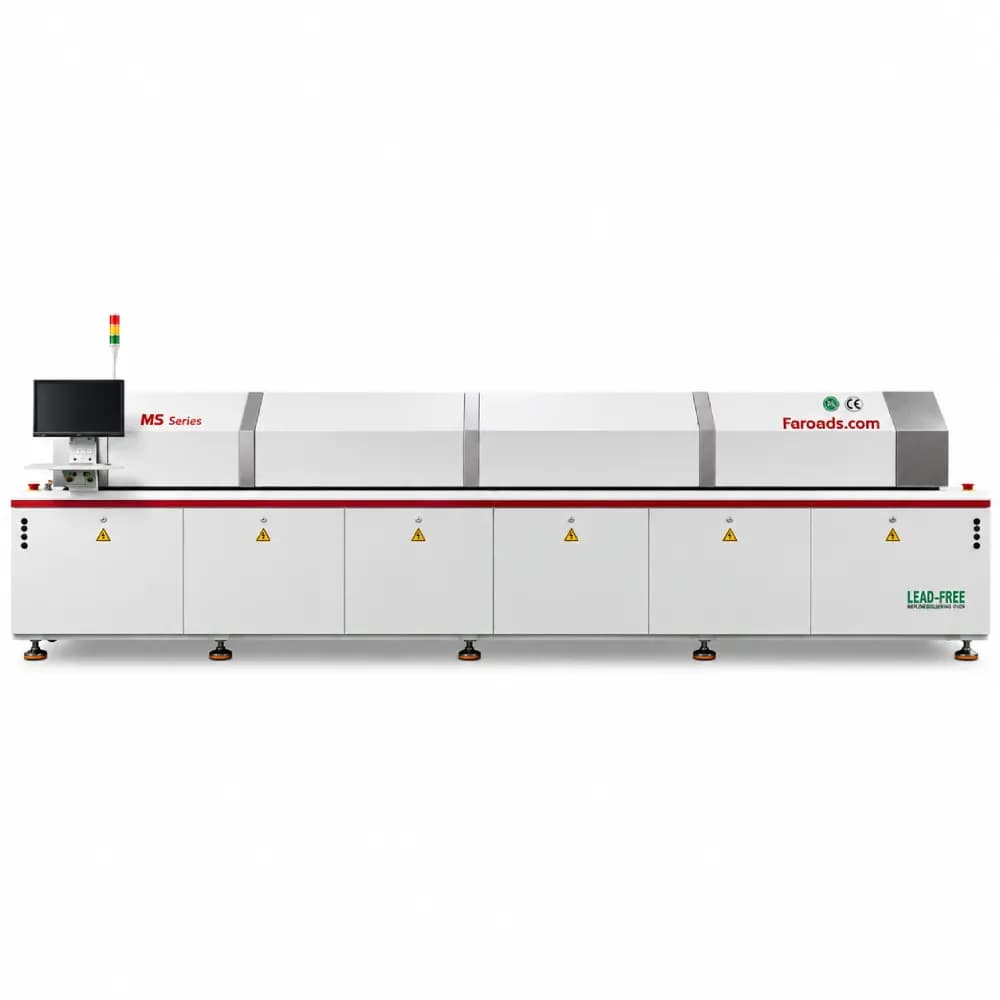
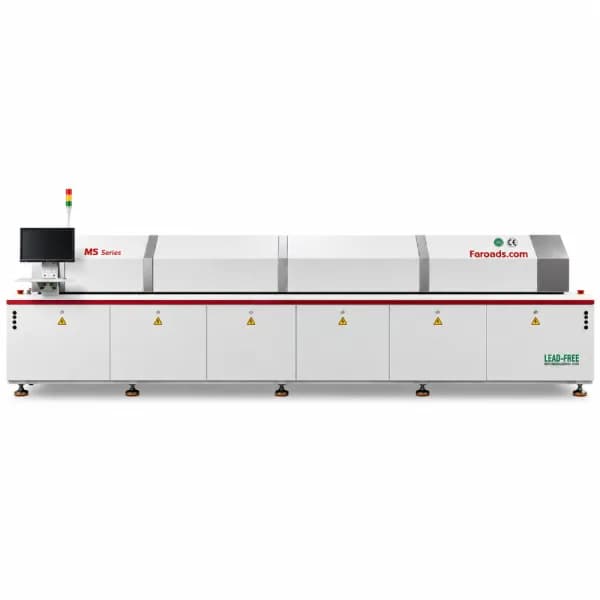
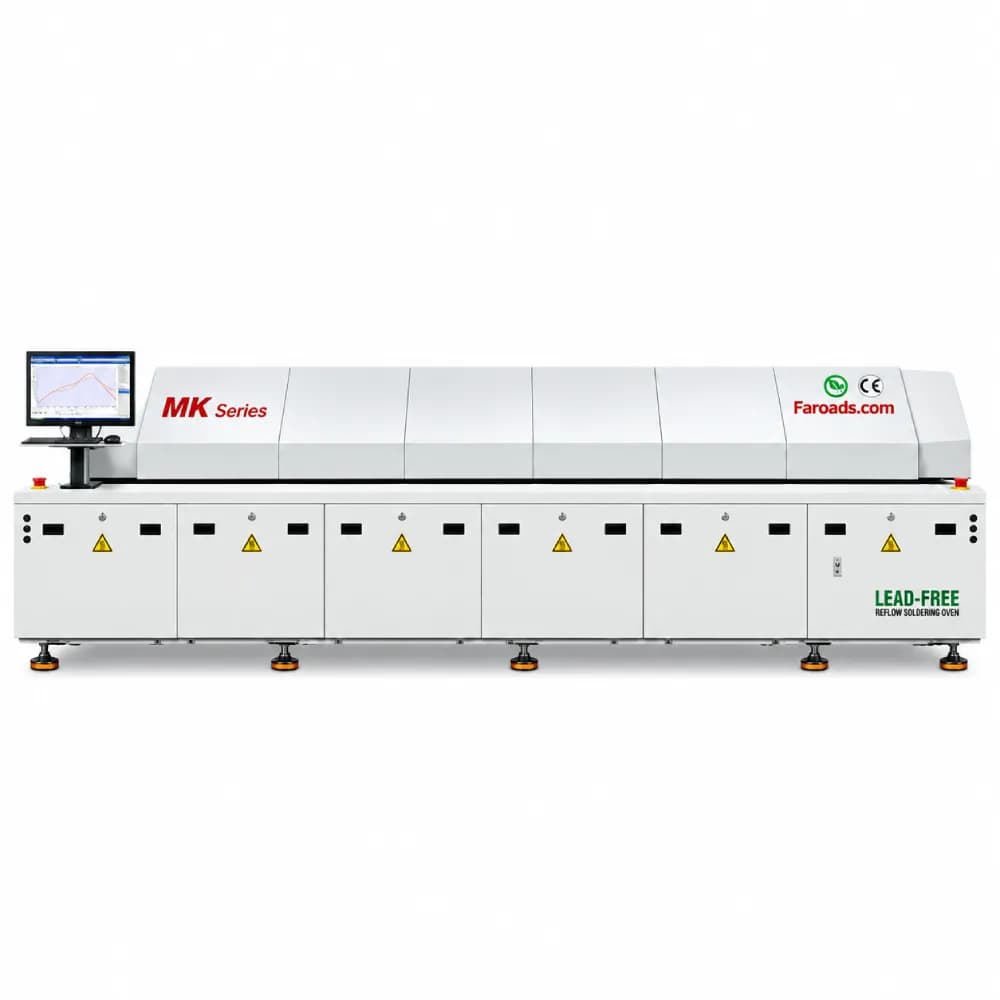
Temperature range and control. Any oven intended for lead-free work should list a control range comfortably above your peak setpoints, because zone air must run hotter than the board. FAROAD's MS series pages and the MK-8 page list a control range from room temperature to 350 degrees C with PID closed-loop control and ±1 degree C control precision.
Uniformity across the board. Request the temperature distribution figure and the method behind it. FAROAD's MS pages list a PCB temperature distribution of ±1 degree C. A supplier should be willing to show that on a profile run with your board.
Heated length and zones. More zones let the profile ramp and soak gently so heavy and light parts converge before peak. Longer heated length lets you do that without slowing the line. The method for matching tunnel length to line output is covered step by step in our reflow oven buying guide.
Cooling. Lead-free joints also need controlled cooling. Ask how many cooling zones are included and whether cooling capacity can be increased. Within FAROAD's MS range, the MS-8 lists two cooling zones and larger models list three.
Flux handling. Higher temperatures drive off more flux volatiles, which can condense in the tunnel and drip onto boards. FAROAD's MS series lists a nitrogen-saving rosin recovery system, and the MK series an upgraded flux recovery system. Ask how recovery is cleaned and how often.
Board support at temperature. Thin or large boards soften more at lead-free temperatures. Ask about center support for wide panels and whether edge rails hold flatness through the peak zones.
Air or nitrogen for lead-free?
Lead-free solder wets less readily than tin-lead, and nitrogen can help on fine-pitch parts and difficult surface finishes. Many lead-free products, however, run successfully in air. Treat nitrogen as a decision to test with your own boards rather than an automatic add-on. FAROAD's MS models each have a nitrogen version, so you can compare like for like. Our guide to nitrogen reflow investment covers the cost side.
Running tin-lead and lead-free in one plant
EU RoHS restrictions shape the requirements for many North American products sold internationally, so most commercial builds are lead-free. Some aerospace, defense and high-reliability programs still specify tin-lead. If your plant handles both, decide early how the oven will serve them.
- Separate recipes and clear labeling. Each alloy needs its own validated profile, and operators must be able to tell which product is which.
- Profile both alloys on the same oven during the trial. The tin-lead profile is easier on temperature but still needs uniformity.
- Watch mixed assemblies. Lead-free components soldered with tin-lead paste, or the reverse, need profiles agreed with your quality team.
- Consider capacity. If volumes allow, a dedicated oven per alloy simplifies scheduling and records.
Questions to put in your quotation request
- How evenly does the oven heat a loaded board, and how was that figure measured?
- How many heating and cooling zones are included, and what is the heated length?
- What is the control range and precision of each zone?
- What flux recovery is fitted, and what is the cleaning interval?
- Can the oven store separate recipes for tin-lead and lead-free products?
- Will the supplier profile your heaviest board with your paste before shipment?
Where FAROAD's lead-free ovens fit
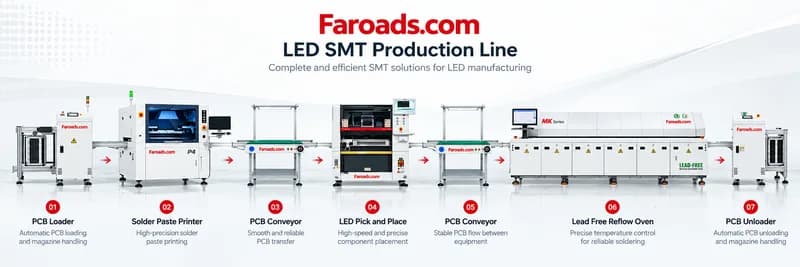
FAROAD lists two inline lead-free convection families. The MS high-end series offers 8, 10, 12 and 14 zones, dual-track versions and nitrogen versions, with the uniformity and control figures above. The MK energy-saving ovens come in 8-, 10- and 12-zone lengths with PC+PLC control, thicker heat insulation and an energy-saving design. For LED lighting boards, the MK-MAX versions carry boards on a mesh belt. Confirm the final configuration and specifications in your quotation.
Frequently asked questions
Can an older oven run lead-free?
Often it can reach the temperature, but older ovens may struggle with uniformity and throughput at lead-free settings. Profile your heaviest board before deciding.
What peak temperature should a lead-free oven reach?
The board peak is usually set from the paste datasheet and component ratings. The oven's zone air must be able to run hotter than that, so check the stated control range.
Do I need more zones for lead-free?
Not always. Light boards often run well in 8 zones. Heavy or mixed-mass boards benefit from more zones to even out temperatures before peak.
Is nitrogen required for lead-free?
No. It can improve wetting on some products, but many lead-free boards solder well in air. Test both.
Request a lead-free oven proposal
Send FAROAD your paste datasheet, heaviest board, line speed and any tin-lead products you still build. We will propose an oven length, series and atmosphere that suit your mix. Request a quote to begin.