LED Reflow Ovens: When Do You Need a Dedicated Mesh-Belt Oven?
When a dedicated mesh-belt LED reflow oven is the right buy versus a standard rail production oven, and what to confirm on width, support, extraction, length and profile under load.
5 min read
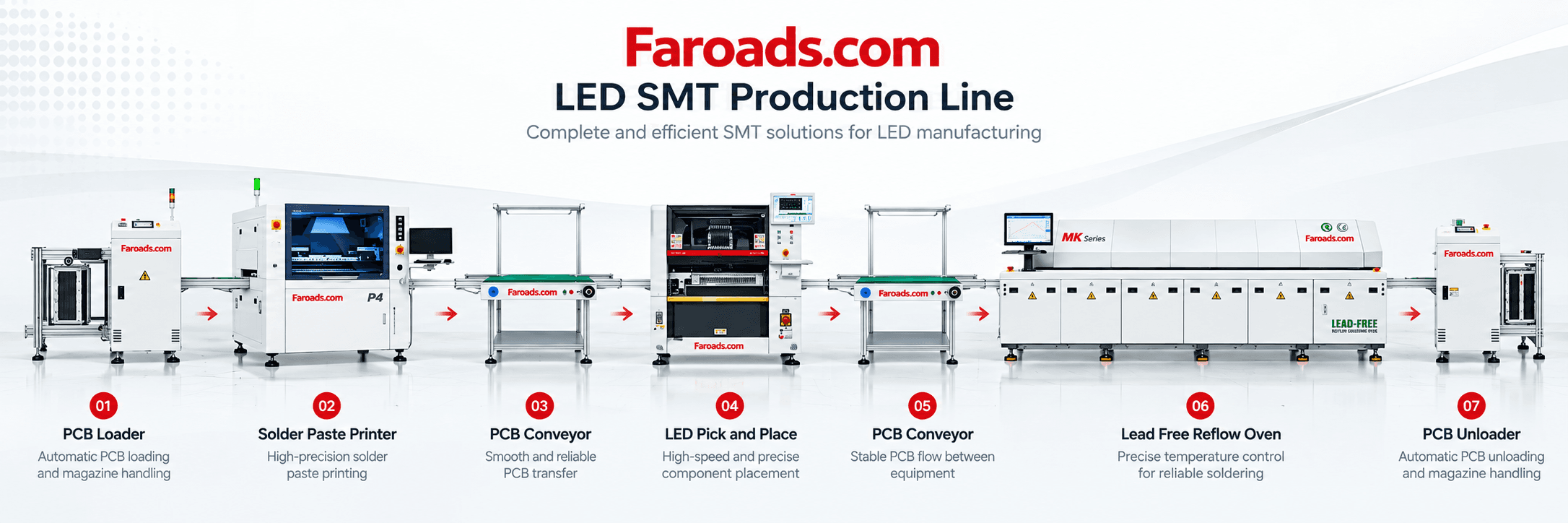
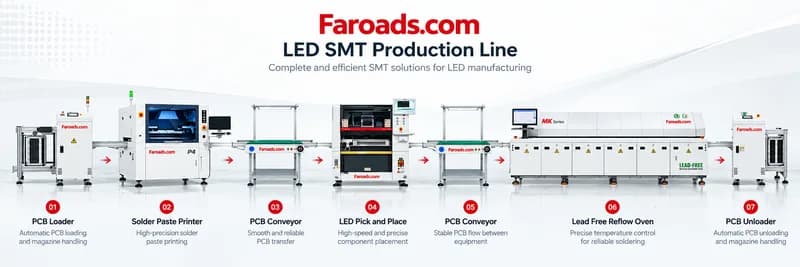
For LED lighting boards, the oven question is often not "how many zones?" It is whether a dedicated mesh-belt LED reflow oven is the right class of machine, or whether a standard rail production oven will still do the job. This article covers that class choice: belt width and support, oil-drip extraction, heated length and cooling, and whether the required profile can be held under production loading.
It does not retell the general rail-versus-mesh decision or the heated-length math. Those are covered in rail or mesh-belt reflow and in the oven sections of LED SMT line long-board selection and reflow oven profiles. Use this guide when you are deciding whether the lighting boards themselves justify a dedicated oven.
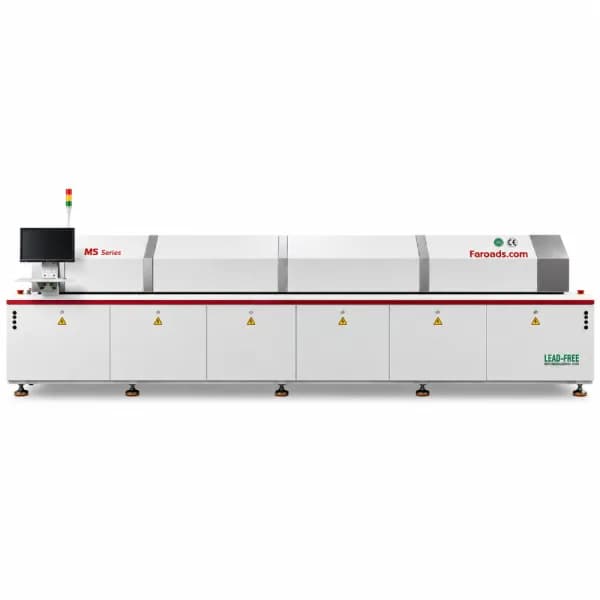
FAROAD lists three LED-specific mesh-belt ovens in the MK-MAX range: the MK-8MAX, MK-10MAX and MK-12MAX. The figures below come from those live pages, re-checked on 18 November 2026. Confirm every dimension on the quoted model. Vacuum reflow is still listed as Coming soon and is not treated here as a product FAROAD sells.
When a dedicated LED oven is the right class
A dedicated LED reflow oven earns its place when the boards are wide, long or lightly supported, when flux and oil management around lighting production is a real shop-floor problem, or when the thermal length you need is easier to get in this family than in a rail oven you already specified for other work.
It does not earn its place just because the product emits light. Short, rigid LED control boards that travel well on edge rails may belong in a standard production oven, especially if you also run conventional SMT panels in the same tunnel. Do not infer that nitrogen is required simply because the assembly is an LED product; state a process reason if you need an atmosphere option.
Width, support and the mesh-belt trade-off
The MK-8MAX page lists a mesh-belt drive, a transport belt width of 700 mm, a belt speed of 300–2000 mm/min and an upper PCB height of 60 mm. That width and the extra upper clearance are the usual reasons lighting manufacturers look at this class.
Do not copy the 700 mm belt width, or the 60 mm upper clearance, onto the MK-10MAX or MK-12MAX without checking. Those two product tables list heating-zone count, heated length, power and overall size clearly; the MK-10MAX also lists a cooling length of 1440 mm. Belt width, usable PCB width and upper clearance are not clearly listed on those models' own specification tables — the 700 mm figure appears on the MK-8MAX card. Ask for belt width and clearance on the exact model in the quotation.
A wider belt is not the same as adequate support. Long or thin lighting panels can sag, shift or heat unevenly if the belt and any tooling do not hold them as they move. Request a loaded demonstration with a representative panel, including transfer into and out of the oven.
Mesh belts also have a genuine limit: boards with components on the underside. Parts on the bottom side can interfere with the belt, or be damaged by it. If a product is double-sided, or will be, a rail oven may still be the right conveyor, even for some lighting work. The rail-versus-mesh article covers that trade-off in more detail.
Extraction, length, cooling and profile under load
LED lighting production often puts a heavy flux load on the tunnel. All three MK-MAX pages describe inlet and outlet extraction designed to stop oil from dripping or leaking, plus an upgraded flux recovery system. The pages also state that insulation thickness is "increased by 50%." Treat that wording as the manufacturer's description, not as a figure we independently measured.
Length still has to match the profile. The MK-8MAX is listed with 8+8 heating zones, a 3142 mm heated length, a 1065 mm cooling length and three cooling zones (cold-air internal circulation, 20 m³ × 3). The MK-10MAX is listed with 10+10 zones and a 3670 mm heated length. The MK-12MAX is listed with 12+12 zones and a 4150 mm heated length. Cooling length is not clearly listed on the MK-12MAX's own table — confirm it on the quoted machine rather than assuming the MK-8MAX or MK-10MAX figure.
Temperature control on the MK-8MAX page is listed as PID closed-loop, room temperature to 350°C, with control precision and board-temperature distribution both stated as ±1°C. The same page lists PC+PLC control and storage for multiple parameter sets. Ask for repeated, loaded-board profiles on your lighting panel and paste, not an empty-tunnel chart. A mesh belt full of production boards will not behave like an empty oven.
What to confirm on the quoted MK-MAX model
Put these items in the RFQ for the specific model, not for the series in general:
- Belt width, usable PCB width and upper clearance, especially on the MK-10MAX and MK-12MAX.
- Cooling length and cooling method on the MK-12MAX.
- Extraction and flux-recovery arrangement, and how oil drip will be demonstrated.
- Starting and operating power as listed on each page (MK-8MAX 28 kW / 8 kW, MK-10MAX 30 kW / 9 kW, MK-12MAX 33 kW / 10 kW) together with the utilities you must provide.
- Overall length, which is listed as 5100 mm, 6195 mm and 6900 mm respectively — these ovens are long machines.
- Loaded-board profile evidence under your paste, board material and production spacing.
When a rail production oven is still the better buy
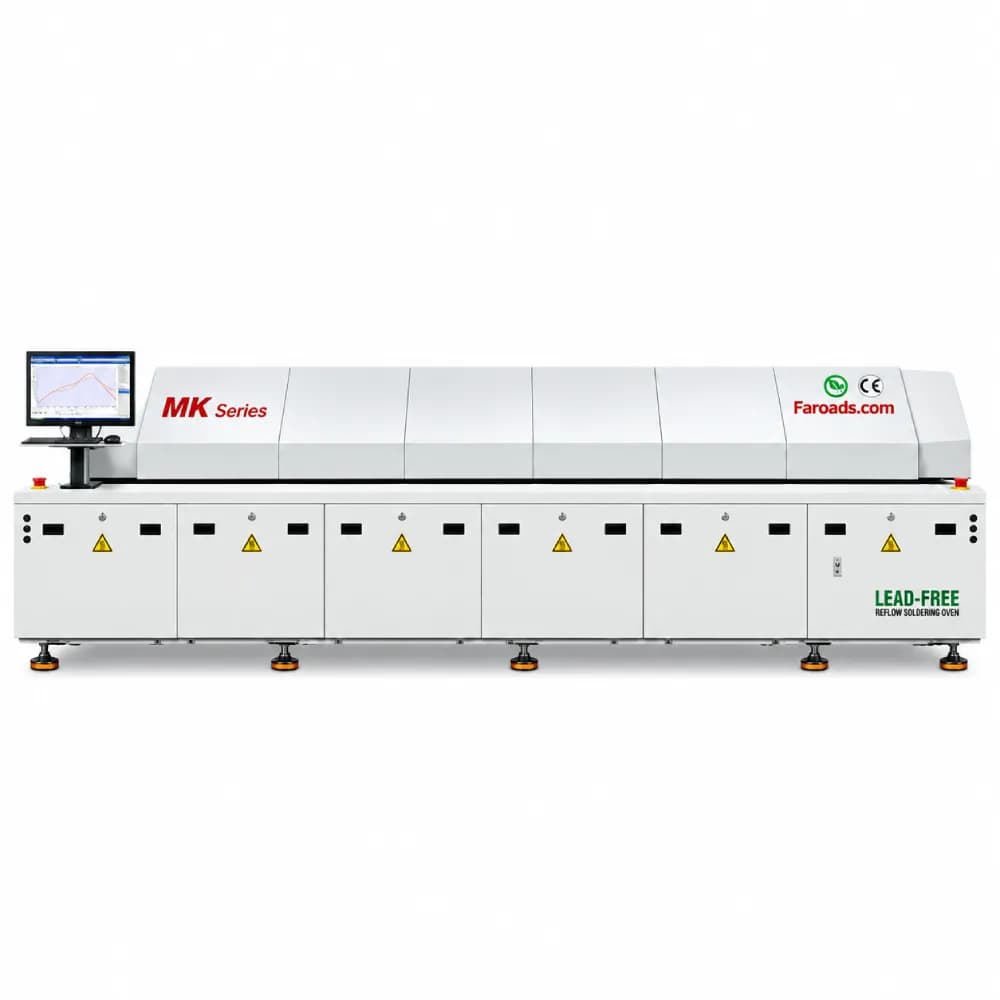
Choose a rail oven when your lighting boards are narrow enough to run on edge support, when underside components rule out a mesh belt, or when the same oven must also run conventional SMT panels that travel better on rails. A dedicated LED reflow oven is a process decision, not a label you apply to every lighting product.
If you are still sizing zones, cooling or the profile window, use the oven-profile and long-board guides rather than repeating that work here.
Frequently asked questions
Is every LED board a candidate for a mesh-belt oven? No. Wide, long or poorly supported lighting panels often are. Narrow control boards that travel well on rails may not need a dedicated mesh-belt machine.
Can I assume the MK-10MAX and MK-12MAX have a 700 mm belt? No. That width is clearly listed on the MK-8MAX page. Confirm belt width and upper clearance on the quoted model.
Does an LED oven require nitrogen? Not automatically. If your paste or reliability requirement needs nitrogen, state that reason and ask for the atmosphere configuration. Do not infer it from the LED label.
Will a mesh belt handle double-sided lighting boards? Treat underside components as a risk. If parts on the bottom side would contact the belt, a rail conveyor is usually the safer choice.
Request an LED reflow oven review
Send FAROAD your panel width and length, component height, whether the board is single- or double-sided, the paste window and the throughput you need. We will recommend a mesh-belt MK-MAX configuration or a rail production oven, and a loaded profile trial. Request a quote to start that review.