Energy-Saving or High-End Reflow? How to Choose Between MK and MS Ovens
How to choose between FAROAD's energy-saving MK and high-end MS reflow oven series: listed process features, nitrogen and MES options, and when an LED MK-MAX oven is the better class.
6 min read
This article is about choosing a FAROAD reflow oven series: the energy-saving MK line, the high-end lead-free MS line, or, for lighting and long boards, the mesh-belt MK-MAX line. It does not retell how many zones you need, how to compare energy use, or what a lead-free oven must handle. Energy use and lead-free capability are covered in energy-efficient reflow ovens and lead-free reflow ovens.
This is a series choice, not a zone-count choice
Zone count still matters, but it does not tell you which family to buy. FAROAD lists MK ovens in 8, 10 and 12 heating-zone versions, and MS ovens in 8, 10, 12 and 14 zone versions, including dual-track D models. You can arrive at a similar zone count in either series. The series decision is about the process features, options and utilities that come with that count.
Start with the boards and the process window: peak temperature, atmosphere, data you must collect, board width, and whether underside parts or long lighting panels change the conveyor. Then shortlist a series. Only after that should you choose 8, 10, 12 or 14 zones and a single- or dual-track layout. A general capacity and fit checklist still belongs in the existing reflow oven buying guide.
What the MS series is built to offer
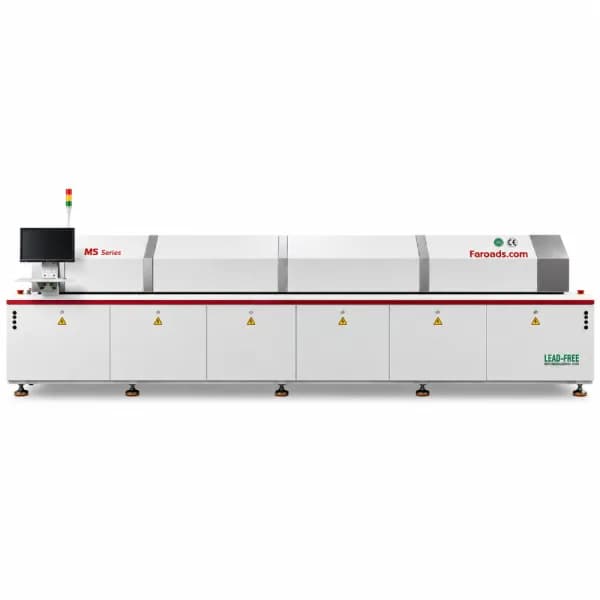
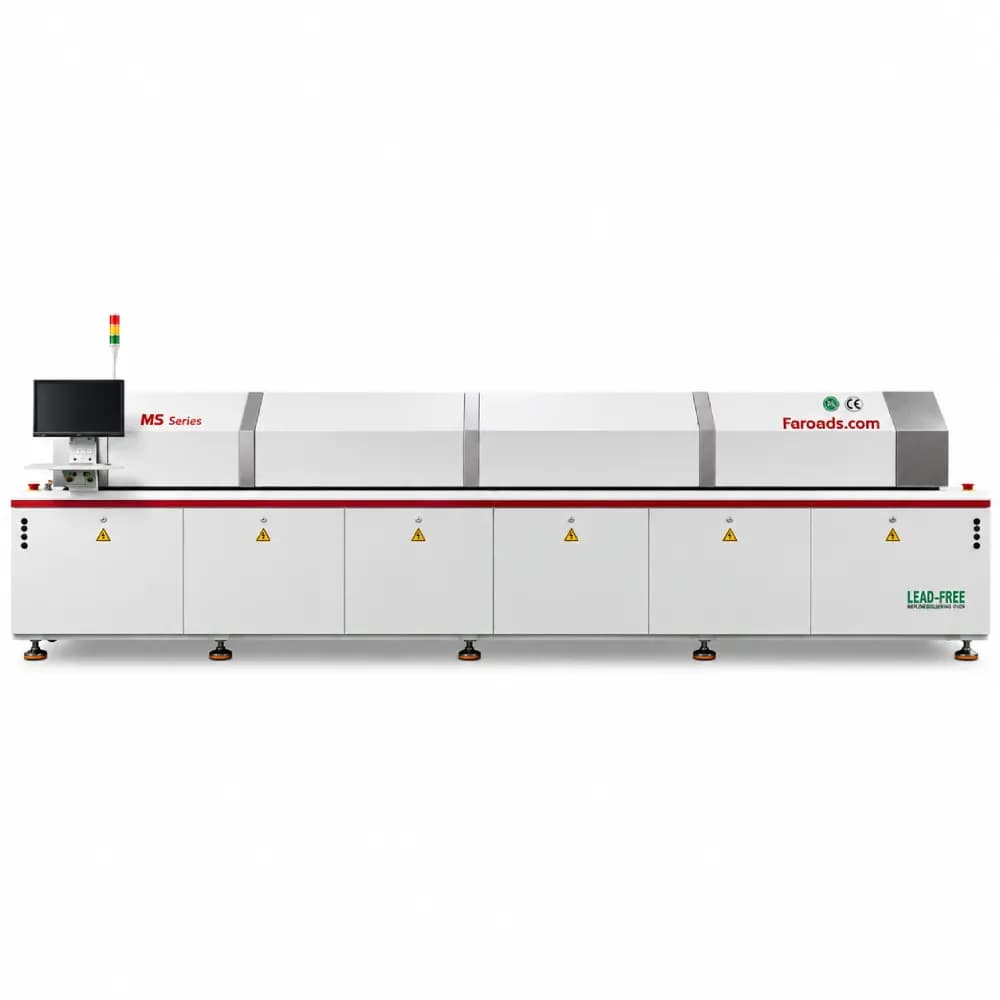
The MS series is listed as FAROAD's high-end lead-free convection range. On the MS-10, the published table includes a temperature control range from room temperature to 350 °C, PID closed-loop control, ±1 °C temperature-control precision and ±1 °C PCB temperature distribution, three internal-circulation cooling zones, and an air volume of 25 m³/min. Single-track transport width is published as 50–490 mm, with a belt height of 900 ± 20 mm and a transport speed of 300–2,000 mm/min. Upper and lower PCB clearance is listed as 30 mm above and 20 mm below. The page also lists MES data collection and upload via TCP/IP, using QR or barcode recognition for the upload, and a nitrogen package on the MS-10N that includes an oxygen analyser, a nitrogen flowmeter, and a water cooler outside the oven. Related dual-track and longer models are described with nitrogen-saving rosin recovery.
Those listed features are the reason to consider MS when the process needs a documented atmosphere, a data connection, or the tighter control and cooling arrangement published on the table. They are not a reason to assume every MS option is included in a base machine. Nitrogen is listed on the N models. Dual-track width is listed as 50–275 mm on each track, which is a different envelope from the single-track 490 mm. Confirm the exact model, not the family name, in the quotation.
Power and size are also specific. The MS-10 lists 3-phase 380 V at 50 or 60 Hz, 32 kW starting power, 9 kW normal operating power, overall dimensions of 6136 × 1450 × 1540 mm, and a weight of about 3,050 kg. Use those figures in the facility brief, and do not substitute another model's numbers.
What the energy-saving MK series is built to offer
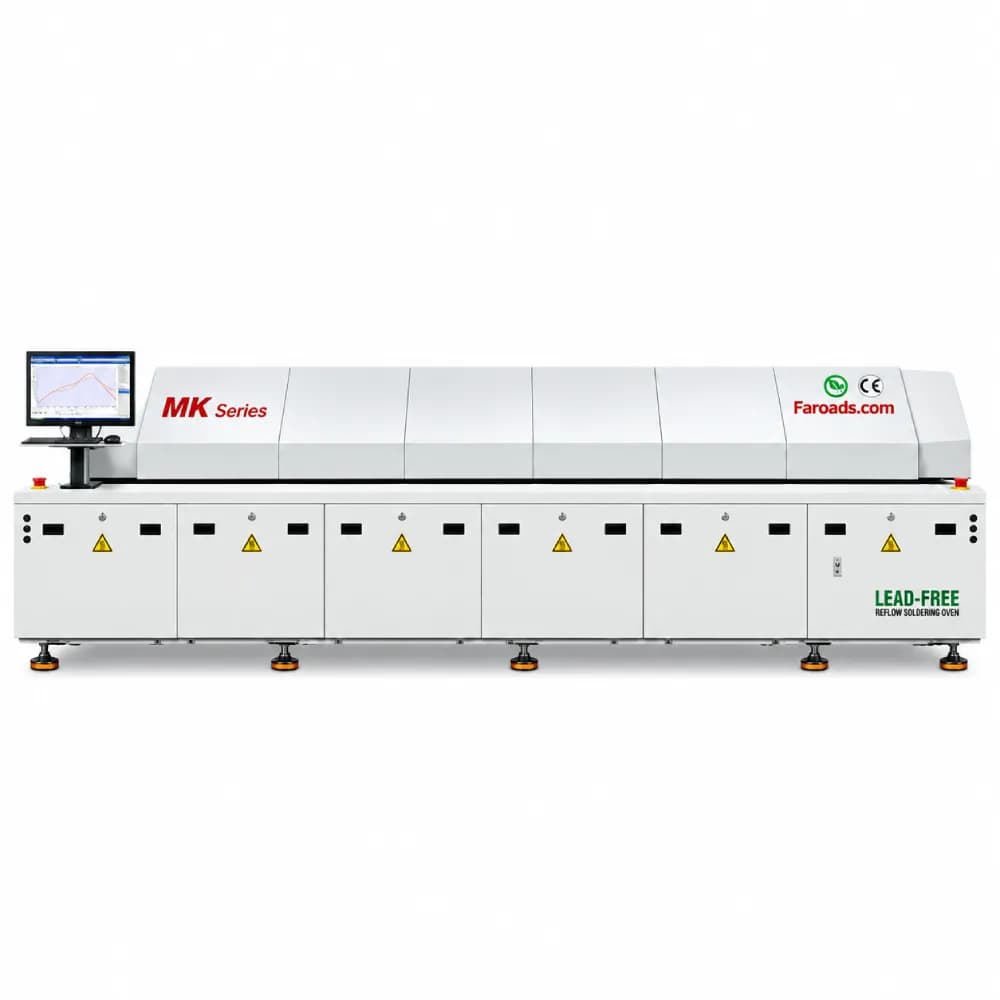
The MK series is listed as FAROAD's energy-saving lead-free range, in 8, 10 and 12 zone rail machines. The MK-10 table lists upper and lower 10 heating zones, a heated length of 3,670 mm, a cooling length of 1,440 mm, about 20 minutes to heat up, 30 kW starting power, 9 kW normal operating power, and overall dimensions of 5,990 × 1,420 × 1,490 mm for the single-track machine (5,990 × 1,630 × 1,490 mm dual track). The page states that other specifications are the same as the MK-8 series according to the manufacturer brochure. The MK-8 table lists a 50–490 mm single-track width, 350 °C range, ±1 °C control and distribution figures, 900 ± 20 mm belt height, and 7 kW normal operating power on that 8-zone model.
What the MK-10 page itself does not list is as important as what it does. MES collection, barcode and a nitrogen device are not listed on the MK and MK-MAX pages used for this article. If you need those functions, either specify an MS configuration that lists them, or ask in writing whether they can be supplied on the MK model you are buying. Do not infer them from the MS table, and do not infer MK-8 width, clearance or nitrogen from a MAX-series lighting oven.
The MK series can be the right buy when the process window is already served by a rail convection oven, the listed power and length fit the room, and you do not need the MS nitrogen or MES options. Energy comparisons across ovens still belong in the energy-efficient oven article; this article only places the MK family in that choice.
LED MK-MAX is a third class
If the product is a long lighting board that needs a mesh-belt oven, you are not choosing between a standard MK and an MS rail machine. You are choosing a different class. The MK-MAX models are listed as LED-specific mesh-belt ovens with an air extraction system described as preventing oil dripping or leakage. A 700 mm board width is published on the MK-8MAX page; do not assume the same width for the MK-10MAX or MK-12MAX unless those pages list it. Underside components remain a mesh-belt caveat. The class decision is covered in LED reflow ovens.
Choose from the process, then confirm on a profile
Use the process window to pick a series, then pick the zone count and track layout, then prove the oven on a profiled production board. If nitrogen is required, the trial should be the N configuration, and the generator or bulk supply should already be in the facility plan, as discussed in whether nitrogen reflow is worth the investment. If only rail convection and the listed MK utilities are required, an MS quotation may be more oven than the process needs. If MES upload or a listed nitrogen device is required, an MK quotation that does not list them is not a complete answer.
A series name on a proposal is not a specification. The quotation should name the model, track layout, nitrogen option, data interfaces and the board width and clearance that were used for the profile.
Frequently asked questions
Is an MS oven always the better lead-free choice? No. Both series are listed as lead-free convection ovens. Choose MS when you need listed features such as the MS-10N nitrogen device or MES upload, or the cooling and control arrangement published on the MS table. Otherwise an MK model may be sufficient. Confirm on a profile.
Can I assume the MK-10 has the same nitrogen and MES functions as the MS-10? No. Those functions are listed on the MS-10 and MS-10N pages. The MK and MK-MAX pages used for this article do not list MES, barcode or a nitrogen device. Ask in writing if you need them on an MK oven.
Do the MK-10 and MS-10 use the same amount of power in production? Both list 9 kW as normal operating power. Starting power is listed as 30 kW on the MK-10 and 32 kW on the MS-10. Compare energy on a common production profile, not on the family name, and size the electrical feeder from the starting figure as well.
When should I look at an MK-MAX instead of MK or MS? When the board and process need a dedicated LED mesh-belt oven, typically for long lighting panels. That is a different conveyor class, and it should be specified against the LED oven guide, not assumed from the rail MK or MS tables.
Request a reflow-series review
Send FAROAD your board width and clearance, the profile you must hold, whether nitrogen or process data is required, and the room length you can give the oven. We will propose an MK, MS or MK-MAX configuration from the listed models and confirm it on a profile of your boards. Request a quote to start that review.