Reflow Oven Profiles: What to Require Before You Buy
Before you buy a reflow oven, require loaded-board, multi-thermocouple profile evidence and the oven features that make ramp, soak, peak and cooling repeatable.
6 min read
A reflow oven is only as useful as the profile it can run, and repeat, on your boards. Capacity, zone count and energy use all matter, and we cover those in our reflow oven buying guide and in reflow oven zones. Before you buy, you also need profile evidence: what the process window is, how the supplier will demonstrate it on a loaded board, and which oven features make that result stable from one shift to the next.
FAROAD supplies convection reflow ovens. We do not sell thermal profilers. The notes below are about the oven and the proof you should require, not a buying guide for a particular profiler brand.
What a reflow profile is asking the oven to do
A profile is the temperature-versus-time path the assembly follows through the oven. In buyer language it has a few moving parts.
Ramp is how quickly the board and components heat as they enter the oven. Too steep a rise can stress parts or disturb the paste; too shallow a rise can use up tunnel length and still leave the board uneven.
Soak, sometimes called preheat, is the period used to even out temperatures across the assembly and to let the paste activate as the supplier intended. Heavy copper and large components lag behind small chip parts; the soak is where you try to close that gap.
Time above liquidus is how long the solder is molten. Too short, and joints may not wet fully. Too long, and you risk brittle joints, damaged parts or excess intermetallic growth.
Peak is the highest temperature the board actually reaches — not the setpoint on a zone controller. It must be high enough for the paste and low enough for the most delicate component.
Cooling is the path back down. A controlled cooldown helps form a sound joint; an uncontrolled one can leave stress or unexpected defects. None of these segments is a FAROAD-specific recipe. They are the shape of the process you are asking the oven to hold.
The window comes from the paste and the components
The acceptable window does not come from the oven brochure. It comes from the solder-paste datasheet and from the temperature limits of the components, often with industry profiling guidance such as IPC-7530A as a method, not as a FAROAD claim. Lead-free tin-silver-copper pastes, for example, typically have a narrower window than older tin-lead processes; we discuss that narrower window in our lead-free reflow oven article.
Your job as a buyer is to put those source documents on the table and ask the oven supplier to show a profile that stays inside them on your representative boards. If the paste supplier recommends a peak range and a time-above-liquidus band, those are the acceptance limits, unless you and your process engineer agree a tighter internal window.
Do not let a sample chart from an empty oven, or from a different board, stand in for that proof.
Demand loaded-board evidence, not empty-oven charts
An empty-oven or lightly loaded coupon chart can look tidy and still fail on the real product. Ask for profiles measured on a loaded production board, or on a clear equivalent, with several thermocouples. Place couples on the smallest and largest thermal masses, on opposite corners, and near any connector or shield that usually lags. One couple in the center of a blank board is not enough.
Then ask for the same profile more than once. A single pass can be luck. Repeated profiles, at the conveyor speed you intend to run, show whether the oven stays in the window when zones, loading and line pace are held constant. If you build mixed-mass or double-sided boards, include those conditions in the demonstration.
How you formally accept the machine is a wider topic; our SMT line integration and acceptance checklist covers factory and site acceptance practice. For the oven itself, write the profile evidence into that plan: which board, which paste, how many couples, how many repeats, and what "in window" means.
Oven features that make profiles repeatable
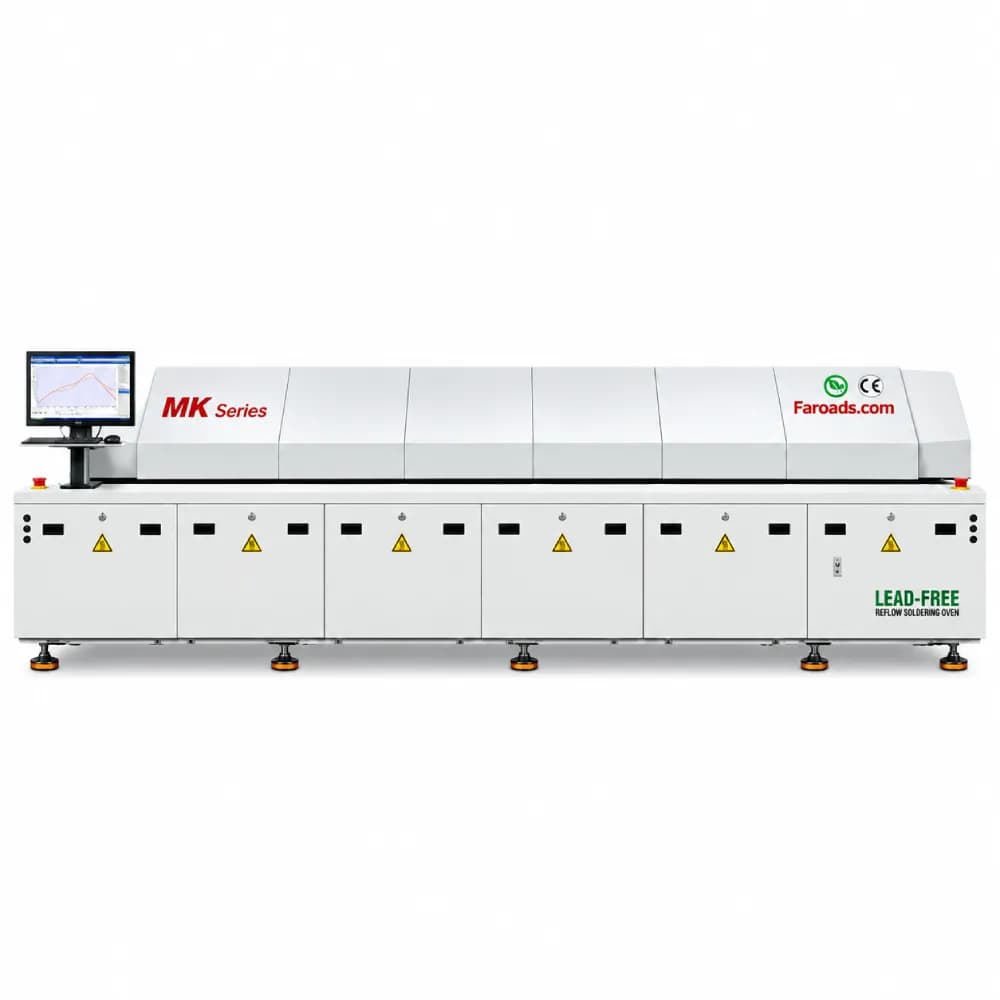
Evidence at purchase only helps if the oven can repeat it in production. Several published FAROAD features, re-checked on 17 November 2026, are relevant here. Confirm the exact figures on the model you quote.
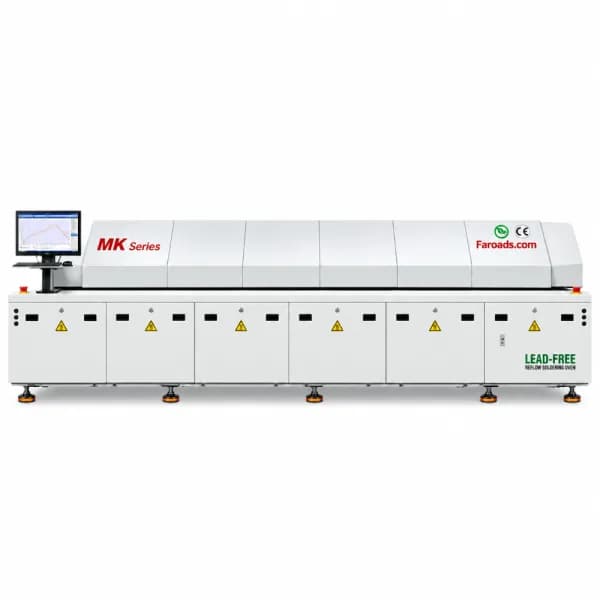
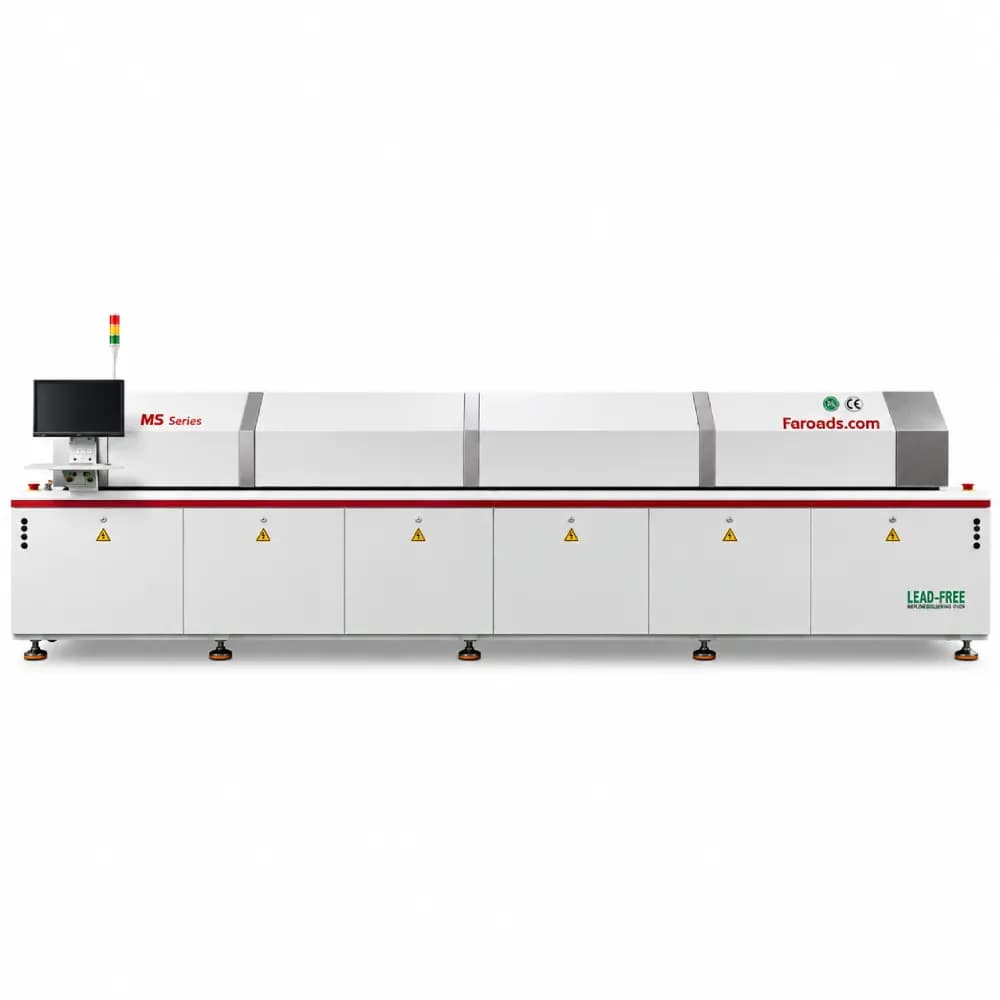
Control method and precision. The MS and MK pages list PID closed-loop zone control, using SSR drive, from room temperature to 350°C, with a stated control precision of ±1°C and a board-temperature distribution of ±1°C. The MS series also states that the spread across five test lines stays inside 1.0°C. Those figures describe control stability and uniformity. They are not a substitute for a loaded-board profile.
Heated length and cooling. A longer heated length and enough independently controlled zones give you room to shape ramp, soak and peak without running the conveyor so slowly that capacity collapses. How to size length from profile time is already covered in the buying guide, so do not reuse a generic length formula as if it were your product. Cooling matters as well: MS-8 lists two cooling zones, while MS-10, MS-12 and MS-14 list three, of the cold-air internal-circulation type. MK-8 lists two cooling zones and a 1065 mm cooling length. If your paste or components need a controlled cooldown, ask to see that part of the profile, not only the peak.
Recipe storage. A profile you cannot recall after a changeover will not stay in control. MS pages state that the oven can store multiple setting parameters; the MK-8 page lists setting-parameter storage as "multiple parameters." Ask how recipes are named, stored, protected and reloaded, and require a changeover demonstration between two of your products.
What to write into the purchase agreement
Keep the commercial list short and testable. Identify the representative boards and pastes. Require loaded-board, multi-thermocouple, repeated profiles at an agreed conveyor speed, judged against the paste and component window. Record the oven features that must be in the quoted configuration — zone count, heated length, cooling, atmosphere if you need it, and recipe storage. Leave formal acceptance steps to the integration checklist, and use a profile trial to reduce soldering defects rather than debating charts after the machine has landed.
If a claimed compatibility between the oven and a particular profiler brand is important to your plant, ask for that in writing. FAROAD does not sell profilers, and we will not invent a compatibility claim here.
Frequently asked questions
Can I accept an oven on an empty-tunnel temperature chart? You can use one as a setup check, but it should not be the acceptance proof. Ask for loaded-board profiles with several thermocouples, repeated at production speed.
How many thermocouples are enough? Enough to see the hottest and coldest parts of the assembly. A practical minimum is several couples on the real board, not a single couple on a test coupon.
Does tighter control precision guarantee a good profile? No. Precision and uniformity help the oven hold a setting. The profile still has to be developed for your paste, board mass and conveyor speed.
Do I need to buy a profiler from the oven supplier? No. FAROAD does not sell thermal profilers. Use a profiler your process team can support, and agree how the oven demonstration will be measured.
Request a profile-capable oven proposal
Send FAROAD your paste datasheet, component limits, heaviest board and the line speed you need to hold. We will propose a convection oven and a loaded-board profile demonstration you can measure. Request a quote to begin.