Pick-and-Place Machine Cost: How to Compare Price, Options and Payback
What drives the cost of a production pick-and-place machine, which options change the quote, and a simple, clearly illustrative method for judging payback before you buy.
5 min read
Ask three suppliers for a pick-and-place machine price and you may receive three numbers that are impossible to compare. One includes a full feeder set and installation; another quotes the bare machine; a third adds software licenses as a separate line. Before you can decide which machine is good value, you need the quotes on the same basis and a way to judge what the machine will return.
This guide explains what drives the cost of a production placement machine and how to estimate payback with your own figures. It does not publish prices: every number below is labeled as illustrative, and FAROAD prices depend on the configuration quoted.
Why a pick-and-place quote is hard to compare
A placement machine is a platform. The same model can be quoted with different heads, feeder quantities, nozzle sets, conveyors, software and service. Each choice changes the price, and some choices change what the machine can do.
The first step is to separate the quote into parts: the base machine, the options that change capability, the items that change productivity, and the services around the purchase. Once every quote is split the same way, the differences become clear.
What the base machine usually covers
The base price normally covers the frame, motion system, placement heads, vision system, conveyor and control software. Architecture has the largest influence at this level: single-arm or dual-arm, single-track or dual-track, and the type of placement head.
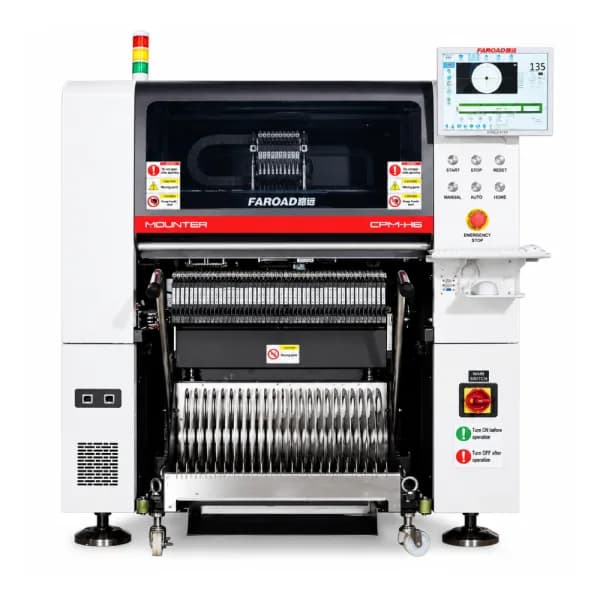
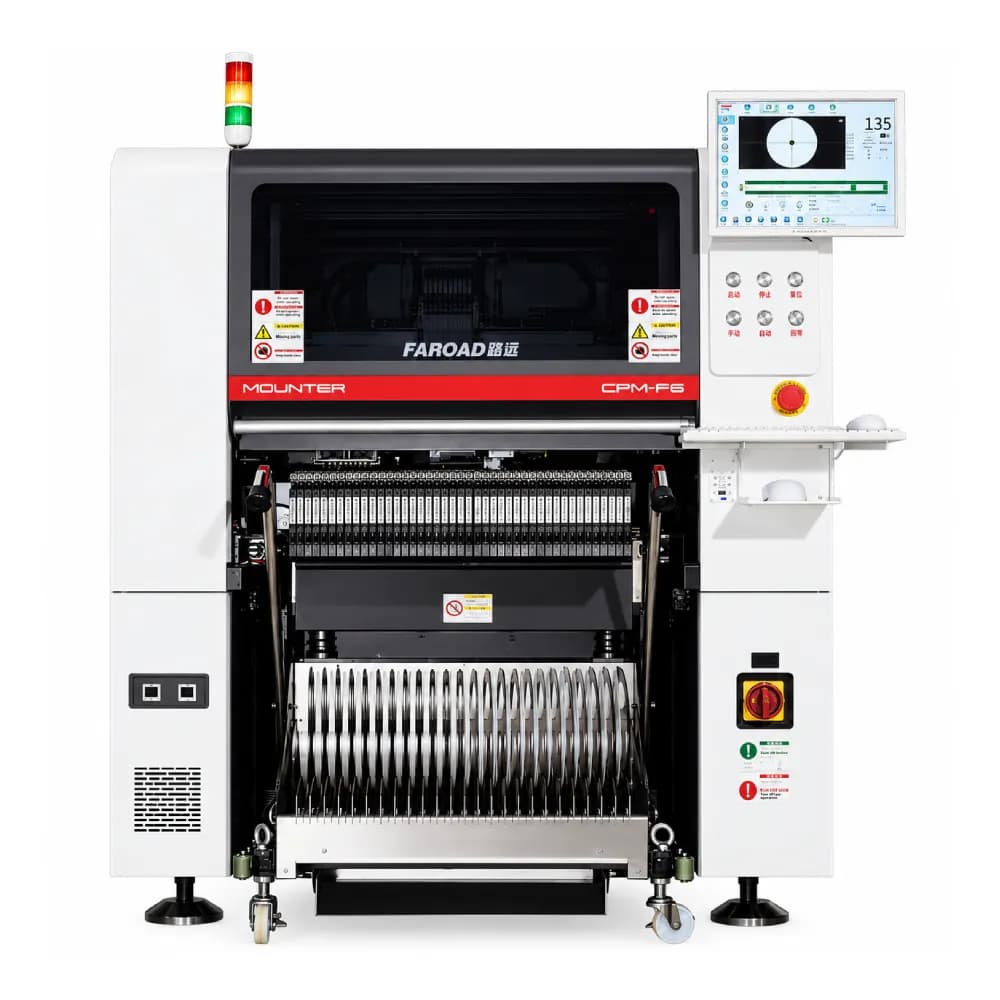
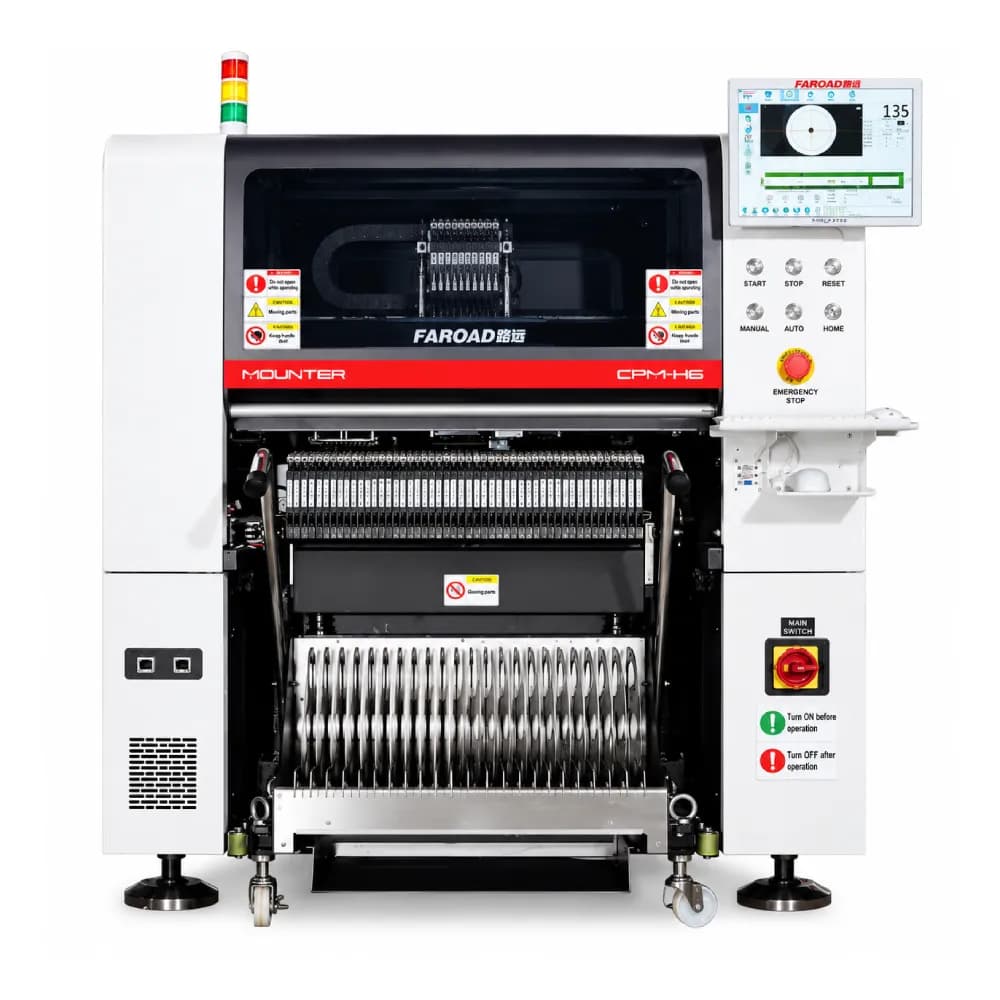
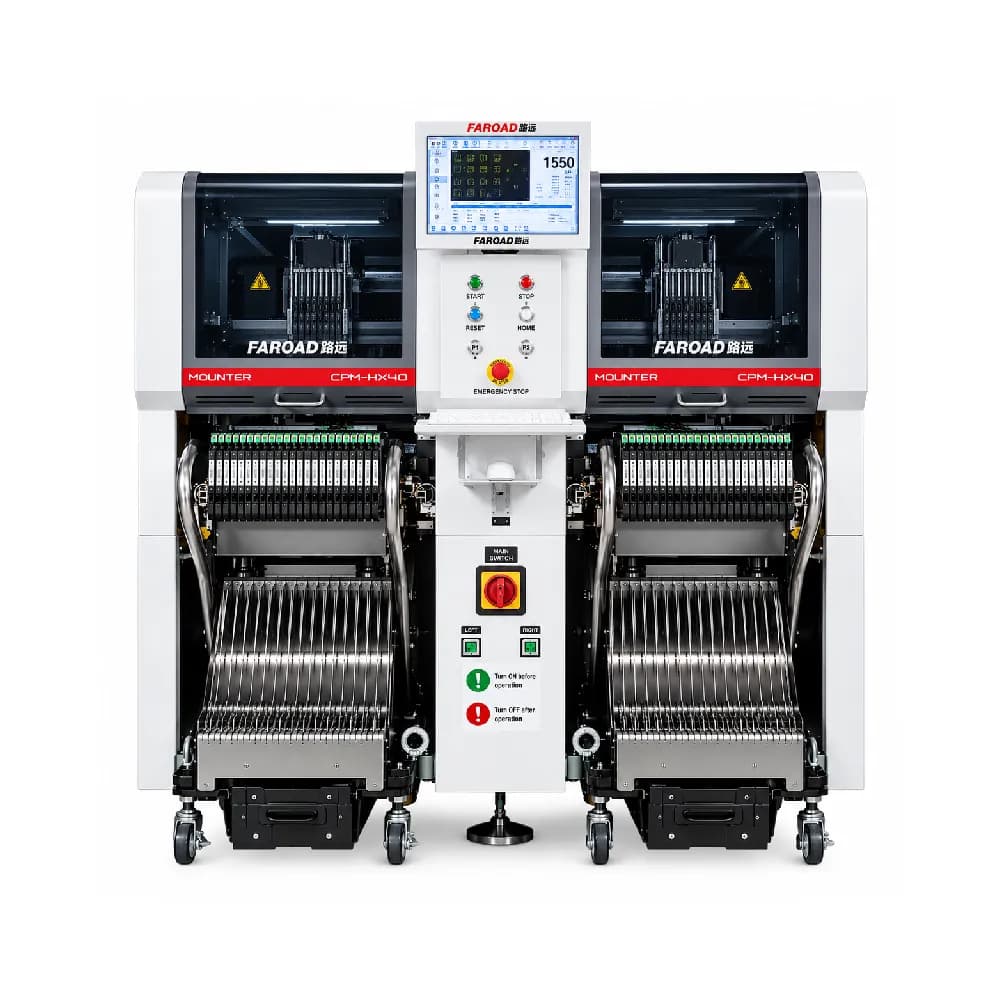
FAROAD's range shows how these choices differ. The CPM-F6 is a dual-arm, single-track modular machine whose heads can be configured as high-speed or multifunctional. The CPM-H6 is a dual-arm, dual-track machine that can run two different boards on its two tracks or work on one board with both heads. These are different investments built for different jobs; comparing their prices without comparing their roles tells you little.
Options that move the number
Options are where quotes diverge most. Look for each of these, by quantity, in every proposal:
- Feeders. The number and width of tape feeders, plus tube and tray handling. A full feeder set for a high-mix product range can be a large share of the total.
- Nozzles and nozzle changing. Standard nozzle sets versus an automatic nozzle exchange station. The CPM-H6 page lists an optional ATC station with 40 nozzle positions.
- Feeder carts. Dock carts allow a whole feeder bank to be swapped at changeover. The CPM-H6 and CPM-F6 pages list dock carts as options.
- Tray handling. The CPM-H6 page lists an optional tray feeding system with 20 tray slots; the CPM-F6 lists an optional tray cabinet.
- Process options. The CPM-F6 page lists force control management, substrate warping detection and quick model switching by QR code as options.
- Software and data. Offline programming, MES connection and line management software may be included or priced separately.
None of these options is necessary for every buyer. The point is to make sure two quotes include the same ones, or to price the missing items yourself before comparing.
Speed you pay for versus speed you use
Higher placement speed costs more. It only pays back if your line can use it.
Three things limit the value of extra speed. First, the rest of the line: if the printer or oven already sets the pace, a faster mounter waits. Second, your product mix: rated speeds are measured under optimal conditions, and boards with many large or odd-form parts place far more slowly. Third, utilization: a machine that runs one shift a day with frequent changeovers spends much of its time not placing parts.
Before paying for speed, estimate the placements per hour your products actually need, including changeover time. To convert an output target into placements per hour, use the method in our pick-and-place selection guide.
An illustrative payback calculation
The figures below are illustrative assumptions, not FAROAD prices or market data. Replace them with your own.
Suppose you are choosing between two configurations. Configuration B costs $80,000 more than Configuration A because of a faster head setup and more feeders. With A, your monthly demand needs two shifts. With B, the extra speed and fewer changeover stops let you meet the same demand in one shift plus some overtime.
If the second shift costs you two operators at an assumed fully loaded $35 per hour for 2,000 hours a year, removing it saves about $140,000 a year. Subtract an assumed $20,000 of overtime and extra running costs, and the annual net saving is about $120,000. The extra $80,000 would pay back in roughly eight months.
Now change one assumption. If the oven, not the mounter, is the bottleneck, B cannot remove the second shift, and the saving falls close to zero. The method matters more than the numbers: payback comes from a real change in how you run the line, not from the speed figure alone.
Running costs belong in the comparison
Running costs differ between machines. Compare power and compressed air from the published specifications: the CPM-F6 page lists 2 kW and 150 L/min of air, while the CPM-H6 lists 5 kW and 300 L/min. Add nozzles, feeder maintenance, spare parts and software updates. Our SMT line cost budgeting guide shows how to fold these into a whole-line budget.
How to ask for a quote you can compare
Send every supplier the same information: your BOM or component list, board sizes, target output, number of shifts, number of products and changeover frequency. Ask them to itemize the base machine, every option, the feeder list by width and quantity, software, installation, training and recommended spares.
When the quotes return, line them up item by item. Fill any gaps with your own estimates, then run the payback calculation for each configuration.
Frequently asked questions
Why doesn't FAROAD publish machine prices? Production machines are configured to each buyer's products. A price without the configuration behind it would be misleading.
What share of the cost is feeders? It varies widely with the number of products and parts. Ask for the feeder list separately so you can see its share.
Is a used machine a cheaper route? Sometimes, but check configuration fit, condition and parts support. Compare total cost, not purchase price alone.
How long should payback take? There is no standard figure. Calculate it from the specific change the machine makes to your labor, outsourcing or capacity.
Request a priced configuration
Send FAROAD your component list, boards and output targets, and we will prepare an itemized configuration you can compare line by line. Request a quote to start.