SMT Equipment for Consumer Electronics: What to Specify for High-Volume Lines
Consumer boards are small, dense and short-lived, and they are built in volume under constant cost pressure. Here is what to specify at each station of a consumer electronics SMT line.
4 min read
Consumer electronics put a particular mix of demands on an SMT line. Boards are small and densely populated, often on both sides. Components keep shrinking. Products have short lives, so new models arrive every few months and each one has to reach full volume quickly. And because the finished product competes on price, cost per board matters as much as capacity.
This guide walks through what those demands mean for each station when you specify a line for smartphone accessories, wearables, smart-home devices, audio products, chargers, small appliances and similar products.
Write the brief around volume and life cycle
Before comparing machines, describe the business pattern the line must support:
- Peak and average volume. Consumer demand is seasonal. Size the line for the realistic peak and know how it will run during quieter periods.
- Model turnover. Estimate how many new boards you will introduce each year and how quickly each must ramp.
- Smallest and finest parts. List the smallest passive size and the finest-pitch package now and on the next generation of products.
- Panel format. Note panel size, thickness and how many boards each panel carries, because that sets how many placements each cycle carries.
- Single or double-sided. Double-sided assemblies need two passes or a line arranged for both sides.
Printing: small apertures, tight control
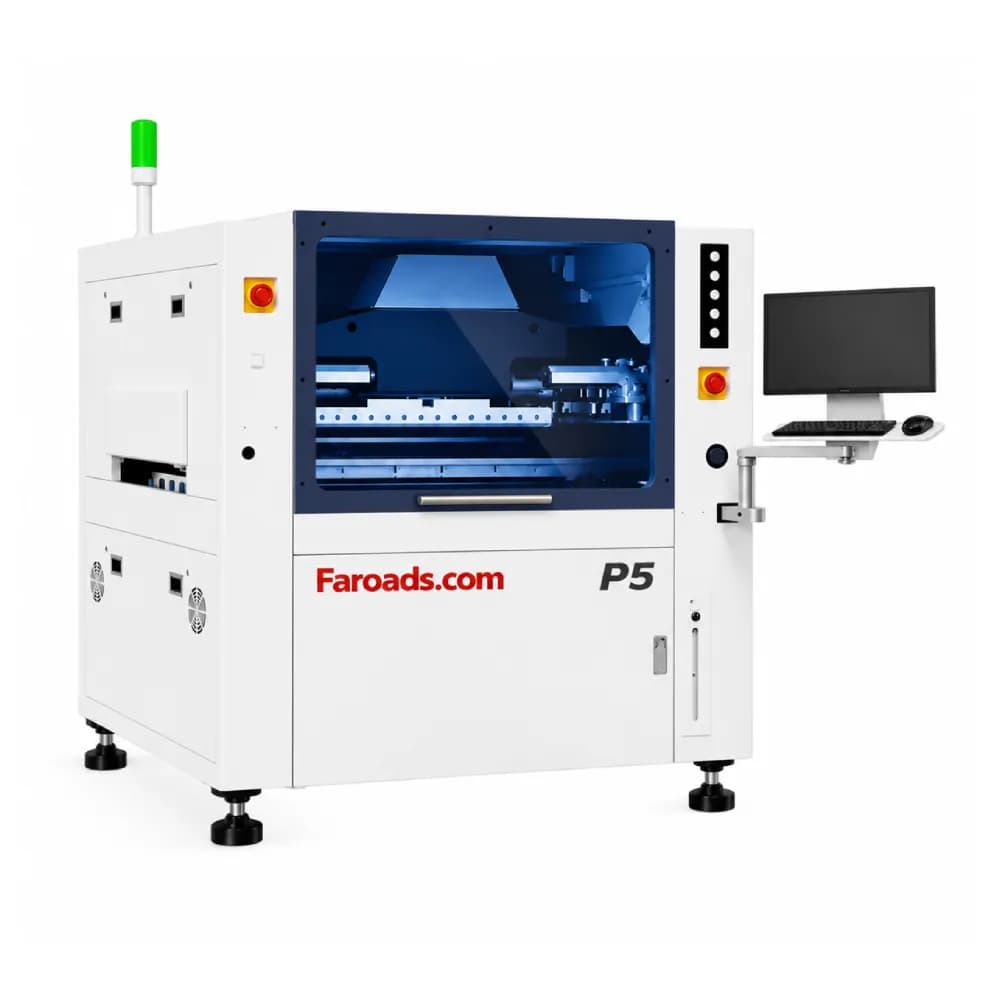
Most consumer boards use small pads and fine-pitch packages, so print quality sets the ceiling for yield. Look for automatic stencil alignment, consistent support for thin panels and dependable under-stencil cleaning. FAROAD's P5 solder paste printer lists a 7-second cycle time, automatic stencil positioning and repeat positioning accuracy of ±10 µm at 6σ.
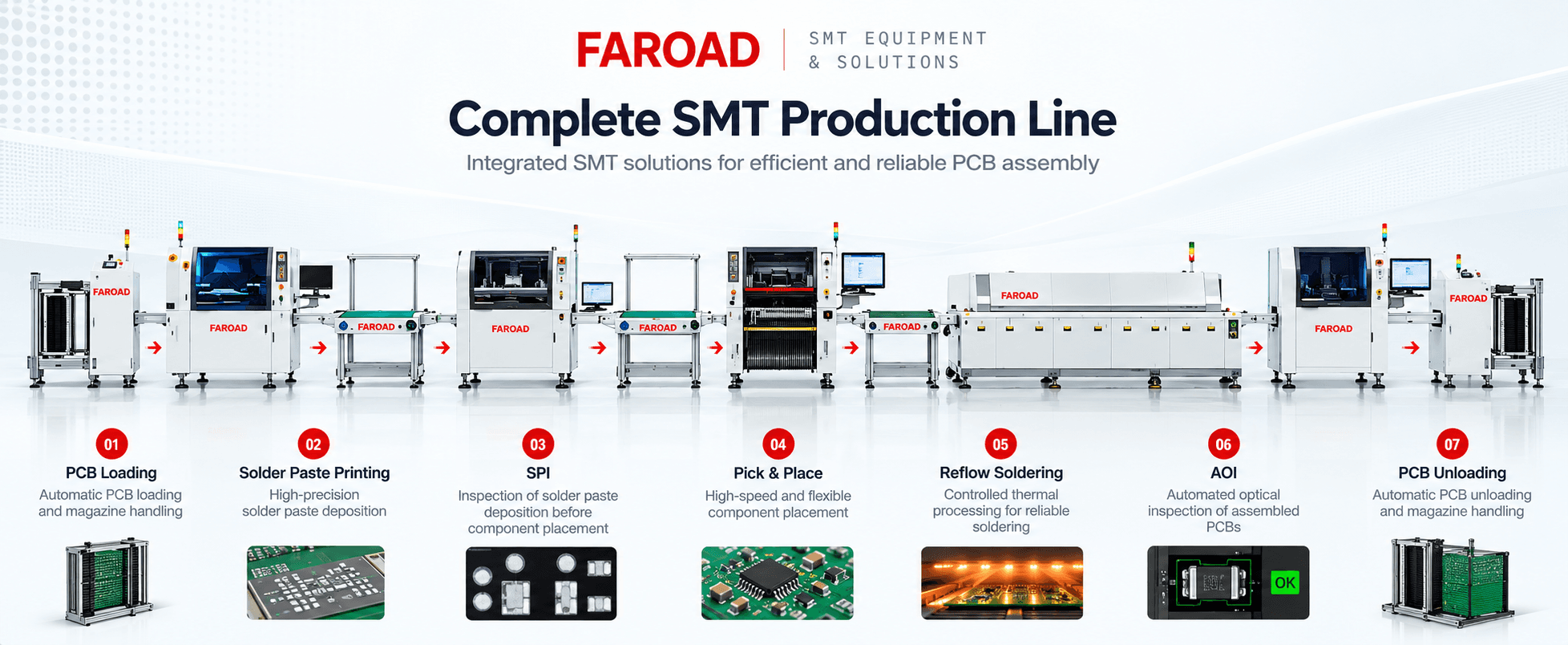
Pair the printer with 3D SPI. On dense boards, measuring paste volume and height before placement catches problems while the panel can still be cleaned and reprinted. FAROAD's 3D SPI page lists inspection of very small components, with 01005 and 03015 among its minimum component options.
Placement: speed for chips, precision for the rest
A consumer board typically carries a large number of small passives plus a smaller number of ICs, BGAs, connectors and shields. That mix favors a high-speed placement capability for chips and a precise, flexible head for larger and finer parts.
FAROAD's published specifications illustrate the options:
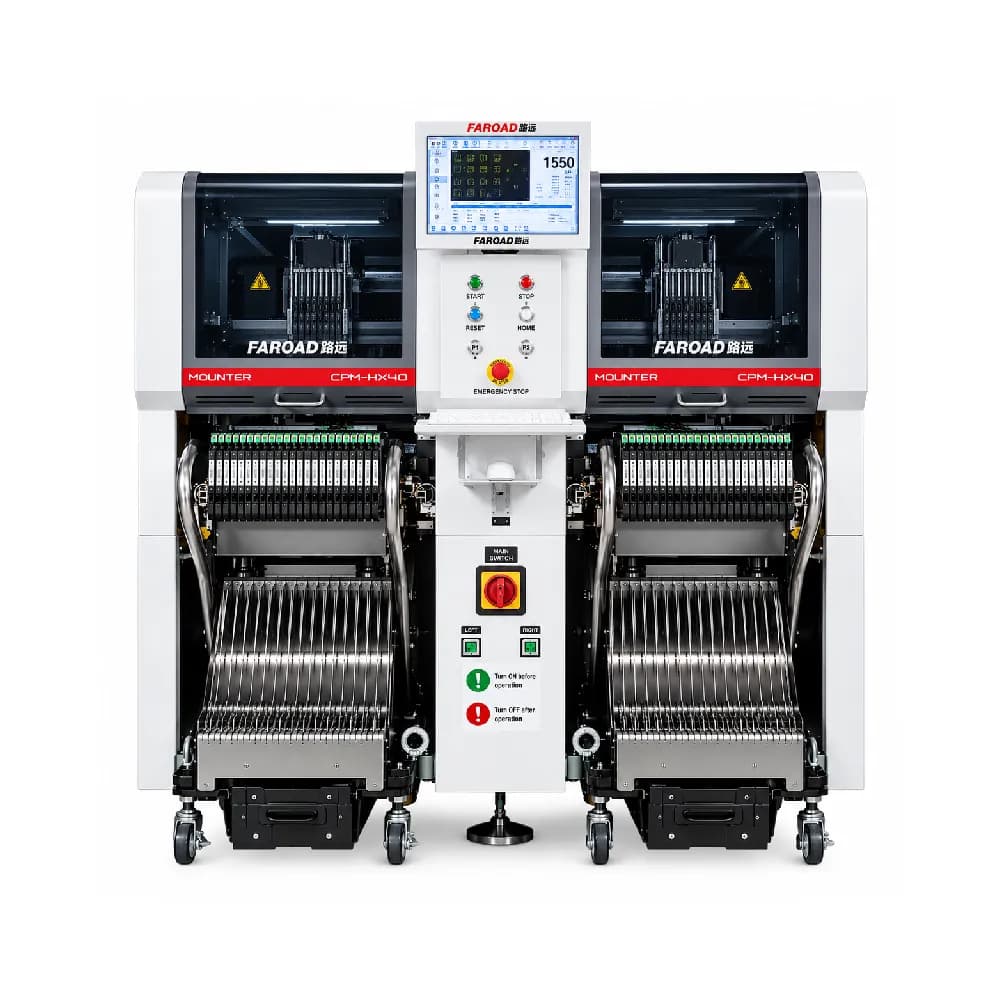
- The CPM-HX40 lists 80,000 CPH with rotary heads, ±0.025 mm accuracy at Cpk ≥ 1.0, and components from imperial 01005 to 6 × 6 × 3 mm. It suits the small-part end of the board.
- The CPM-H6 lists up to 90,000 CPH with high-speed heads and a multifunctional head configuration for components up to 55 × 55 × 25 mm, on single or dual tracks.
Combining a high-speed mounter with a more flexible one keeps fast placement and part coverage in balance. Ask the supplier to split your real program between machines and show the balanced cycle time.
Thin boards, panels and double-sided builds
Thin panels flex during printing and placement, which affects both accuracy and paste deposits. Check each machine's minimum board thickness and support method, and whether you will need dedicated support tooling or carriers.
For double-sided boards, decide how the second side will be built. Components already soldered on the first side must clear the board supports, the conveyor and the oven. Check the bottom-side clearance of every station against your tallest first-side part.
Reflow: consistent, not oversized
Many consumer boards are light, so reflow is usually about consistency and matching the oven length to line speed rather than heavy thermal mass. Shield cans, large connectors and battery contacts can still create local cold spots, so profile them early.
Nitrogen is sometimes added for fine-pitch joint quality or appearance; treat it as a decision to justify with trials. Our reflow oven buying guide explains how to match oven length to line output.
Inspection that keeps up with ramps
Because new products ramp quickly, inspection must be easy to program and fast enough to inspect every board. Plan 3D SPI after printing and inline AOI after reflow as a starting point. If bottom-side components need checking, FAROAD's Inpex M400 can image both the upper and lower sides of the board in a single pass.
Fast introductions and changeovers
With frequent model changes, the time from receiving a new design to stable production is a real cost. Ask how each machine takes in CAD or coordinate data, whether programs can be prepared offline, and how changeovers are handled.
For example, the CPM-F6 page describes importing placement coordinates from Excel or text files in one step, and the CPM-S5 page lists offline programming software for optimization.
Judge the line on cost per good board
Compare proposals on the cost of each good board, not just machine price and CPH. Include yield, changeover losses, labor per shift, energy and floor space. A line that is slightly slower on paper but changes over faster and runs with fewer defects can easily be cheaper per board over a product's life.
Frequently asked questions
Do we need 01005 capability now? Only if current or near-term designs use 01005 parts. If your roadmap points that way, specify placement and inspection for it now rather than replacing machines later.
Is a dual-track mounter worth it for consumer boards? Often, when boards are small and placement programs are short, because a second track hides board transfer time. Confirm with your own programs.
Should we buy one fast line or two smaller lines? Two lines give flexibility for overlapping product ramps and maintenance, while one line usually costs less per placement. Model both against your product plan.
How important is SPI for consumer boards? Very. Dense boards with small apertures are sensitive to paste variation, and SPI catches it before parts are placed.
Request a consumer line proposal
Tell FAROAD your products, volumes, smallest components and new-model plan. We will propose a line configuration and balanced cycle time. Learn more about our consumer electronics production solutions or Request a quote.