Industrial Electronics PCB Assembly: Planning the Right SMT Line
How control, automation and instrumentation boards differ from consumer products, and what that means for placement range, reflow of mixed boards, through-hole parts, coating and long product lifecycles when you plan an SMT line.
5 min read
Industrial electronics covers controllers, drives, sensors, instrumentation, communication gateways and the many boards inside automation equipment. These products are built in modest volumes, sold for years and expected to run for a long time in harsh conditions. They rarely look like phone boards. They mix tiny chips with large connectors, terminal blocks, relays and transformers, and many still carry through-hole parts. This guide explains how those traits should shape the SMT line you buy.
What industrial boards have in common
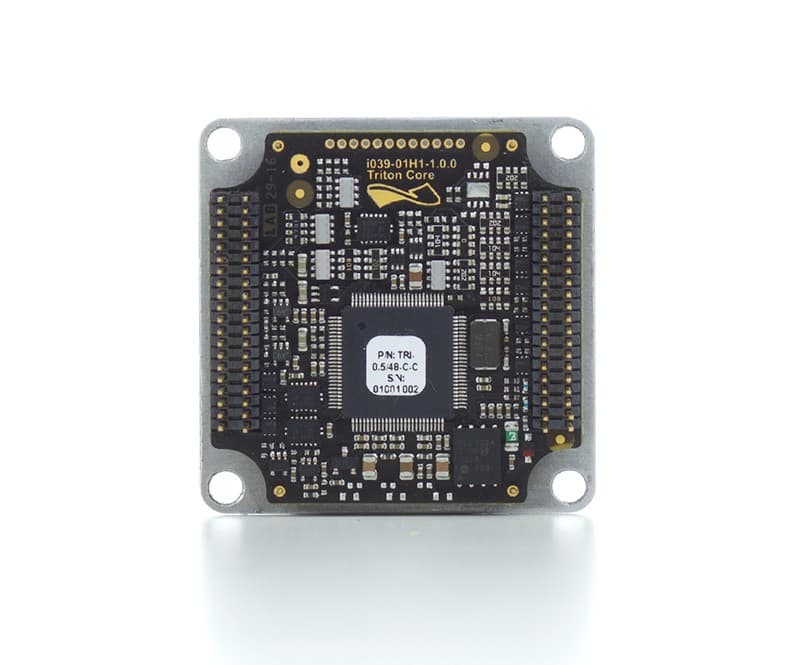
A modular plug-in servo drive with pin headers. Industrial control products like this often combine surface-mount electronics with large connectors and through-hole parts. Photo: INGENIA-CAT S.L. Source on Wikimedia Commons, CC BY-SA 4.0. Converted from PNG to JPEG for publication; not cropped or resized. This file is shared under the same license.
Several traits recur across the sector:
- High mix, modest volume: many product variants, each built in batches.
- Large and odd-form parts: connectors, terminal blocks, relays, inductors and shielded modules beside 0402 or 0201 chips.
- Mixed technology: surface-mount boards that still need some through-hole components.
- Thick or heavy boards: multilayer boards with copper planes that absorb heat.
- Long product lifecycles: the same board may be rebuilt for ten years or more, often with component substitutions along the way.
- Harsh environments: vibration, dust, moisture and temperature swings that call for robust joints and sometimes conformal coating.
FAROAD's industrial electronics page is the starting point for discussing these products with us.
Placement: range and flexibility before speed
For industrial work, the mounter's component range and feeder flexibility usually matter more than headline CPH. Check the largest and tallest parts you place, whether they come in tape, tray or tube, and the board thickness range.
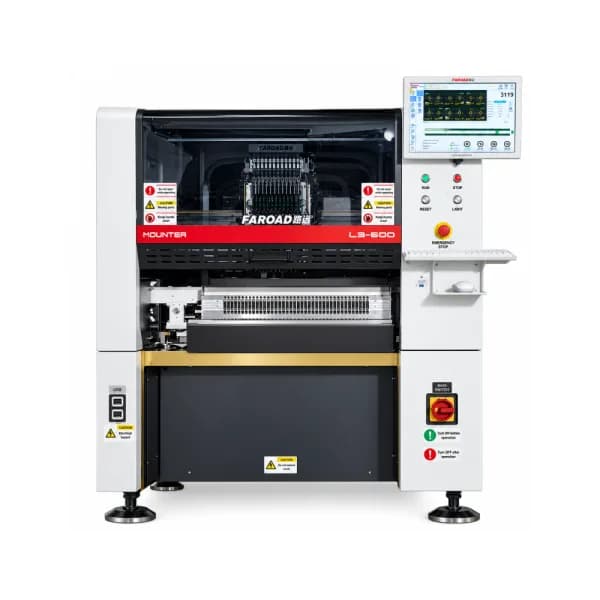
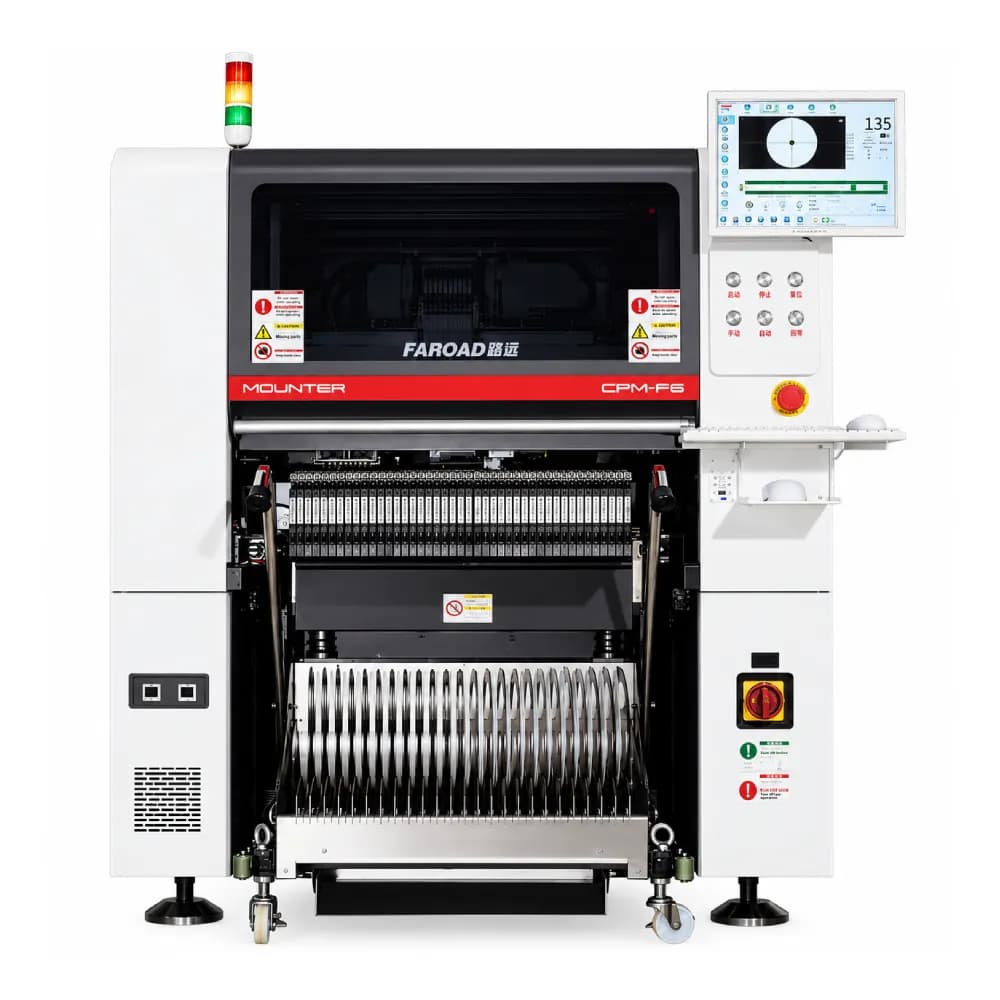
The CPM-F6 is a good example of the features to look for. Its high-speed head is rated at 42,000 CPH under optimal conditions, while the multi-functional head handles larger parts with a fixed camera, as big as 55 × 55 × 25 mm. The page lists boards up to 510 × 570 mm, a 0.5–9.0 mm thickness range, tape widths up to 88 mm for the multi-functional head, and tube feeders for stick-packed parts. Software support for importing coordinates from spreadsheets, defining unusual parts and sharing a component database across machines helps when many variants must be programmed and maintained.
Heavy connectors may need special nozzles, slower placement and good board support. Ask to see your largest parts placed during evaluation. Also check how long it takes to switch between two of your variants, because on a high-mix industrial line changeover time often limits output more than placement speed does.
Reflow: heavy boards and mixed thermal mass
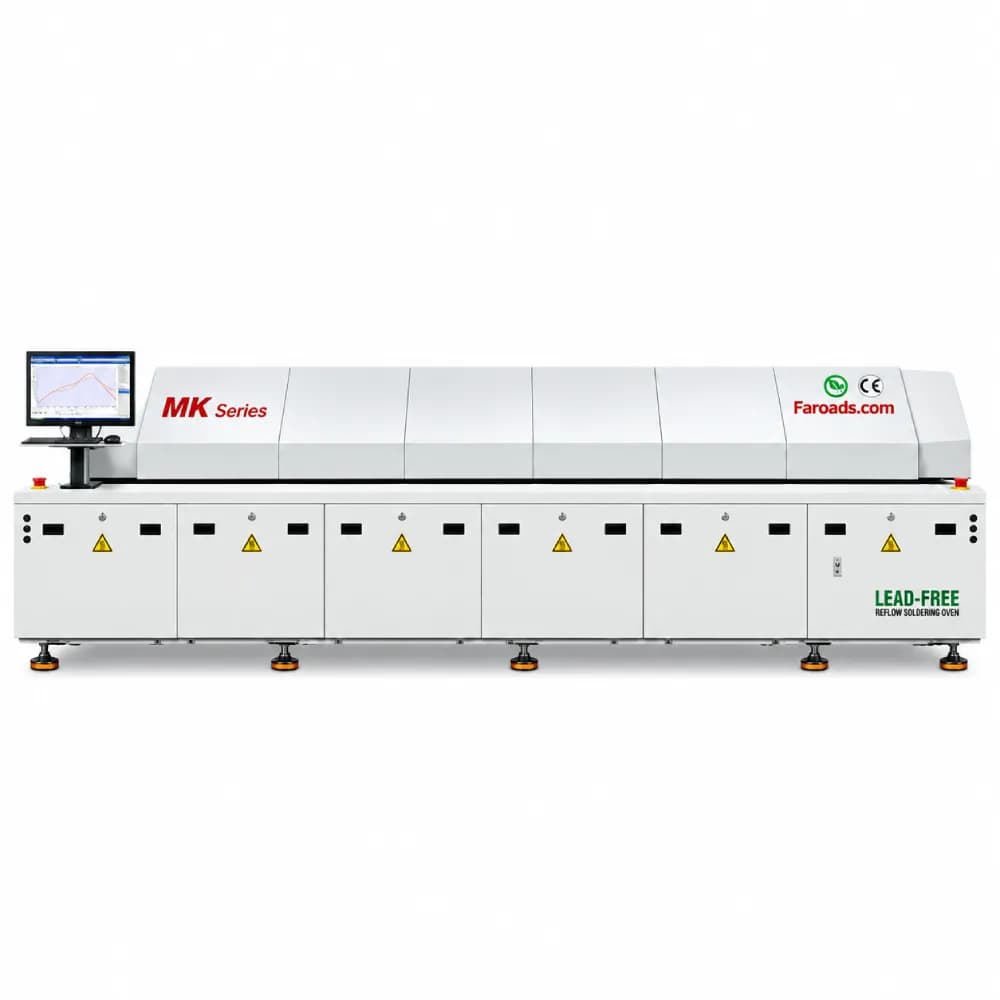
Thick boards with copper planes and large parts need more heat, while small chips on the same board must not overheat. The oven needs enough heating zones and good convection to bring the whole board into the process window. Profile with thermocouples on the heaviest connector, on a large inductor and on the smallest chip.
FAROAD's MK-8, MK-10 and MK-12 are energy-saving lead-free convection ovens with 8, 10 or 12 upper and lower heating zones, single- or dual-track options and PC+PLC control. The MK-10, for example, lists 10 + 10 zones over a 3,670 mm heated length. For a mixed industrial line, more zones give more room to shape the profile for heavy boards without slowing the conveyor too much.
Through-hole parts: plan the route early
Many industrial boards still carry through-hole connectors, terminal blocks and transformers. There are three common routes:
- Pin-in-paste: print paste into and around the holes and reflow through-hole parts with the SMT parts. Our guide to pin-in-paste reflow explains when it works.
- Wave or selective soldering: a separate process after reflow. Both are coming-soon categories at FAROAD, so plan them separately.
- Hand soldering: practical for a few parts in low volume, but slow and hard to control.
The choice affects stencil design, component selection and the line layout, so decide before buying equipment.
Inspection, coating and records
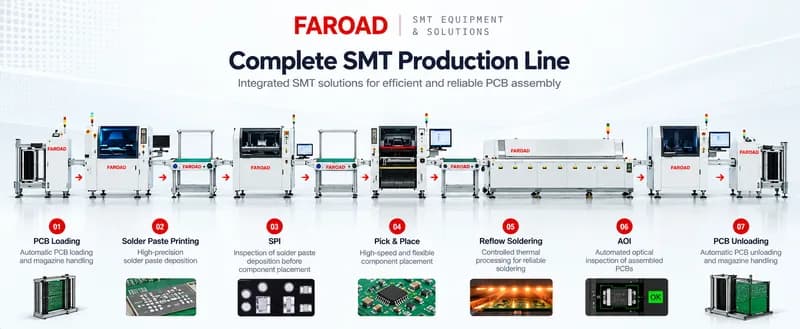
AOI after reflow checks visible joints and part presence. FAROAD's AOI machines are 2D inline systems with barcode recognition, SPC charts and full-board images. The S510 listing also mentions closed-loop data exchange between a coating AOI and coating or dispensing machines. Conformal coating equipment itself is a coming-soon category at FAROAD.
Because industrial products are rebuilt for years, keep each board's program, profile and inspection results under revision control. When a component is substituted, re-verify the library entry and profile rather than assuming the new part behaves the same way.
Questions to settle before you buy
Industrial buyers save the most time by answering a few questions before requesting proposals:
- What are the largest, tallest and heaviest parts, and how are they packaged?
- What is the thickest board, and how much copper do the inner layers carry?
- Which through-hole parts remain, and which route will solder them?
- How many active product variants are there, and how often does each run?
- Will boards be coated, and does coating need inspection?
- How long must programs, profiles and inspection records be kept?
Sending these answers with sample BOMs and board files lets a supplier propose a mounter, oven and inspection setup for your real products rather than a generic line. It also makes proposals from different suppliers easier to compare, because each one is answering the same detailed brief instead of making its own assumptions.
How this differs from power electronics
Power electronics lines focus on large power devices, heavy copper and thermal interfaces, as covered in our article on SMT lines for power electronics. Many industrial products include a power stage, but most of the board area is control and interface circuitry. The line needs to handle both, with the emphasis on mix, odd-form parts and long-term repeatability.
Frequently asked questions
What is the most important mounter feature for industrial boards? Component range and feeder flexibility, including trays and tubes for connectors and odd-form parts. Do industrial boards need nitrogen reflow? Not usually. Good convection and enough zones for heavy boards matter more. Test difficult products before deciding. Can one line handle both SMT and through-hole parts? Partly. Pin-in-paste handles some through-hole parts in reflow; others need wave, selective or hand soldering. How do I manage component substitutions over a long lifecycle? Control libraries and programs by revision, and re-verify placement and profile whenever a part changes.
Plan a line for industrial products
Share your board sizes, largest components, through-hole content and volumes with FAROAD, and we will propose placement, reflow and inspection equipment that fits your products. Request a quote to start planning.