SMT Line Traceability and MES: What to Require Before You Buy
What barcode, MES and line-communication capabilities to require on SMT equipment so boards can be identified and process data can be stored, and how to verify those claims in a trial.
6 min read
SMT line traceability is easy to write into a quotation and harder to prove on the floor. The buying task is to state what each machine must do with a board identity, which process data it must collect or upload, and how you will demonstrate that the handshake works before you accept the equipment. This is not a tutorial in MES software, and it is not a repeat of the mechanical and electrical acceptance work covered in the SMT line integration and acceptance checklist. Use that checklist for interfaces, FAT and SAT. Use this guide for the traceability requirements themselves.
The capabilities below are taken from live FAROAD product pages, re-checked on 18 November 2026. They are not the same on every family. Claim only what the page for that machine actually lists, and treat anything else as a question to ask in writing.
What traceability on an SMT line actually requires
At minimum you need a reliable board identity, a way to call the correct recipe or program, and a record of what happened at the stations that matter to you. Identity without data is only a serial number. Data without identity is only a batch log. Both have to travel with the board, or be joinable later, if a customer or auditor asks what was printed, placed, reflowed or inspected.
Do not assume that every machine talks to every other machine, or to your MES, in the same way. Conveyor interlocks and data upload are different layers. SMEMA, where it is listed, is a machine-to-machine handshake for board transfer. It does not, by itself, move barcodes or process records into a database.
Board identity and recipe call-up
Start with how the board will be identified at each station: a 1D barcode, a 2D code, or both, and whether the machine reads it itself or depends on an upstream scanner. Then ask what the read is allowed to do. The useful result is usually automatic program or recipe selection, and a record bound to that board ID.
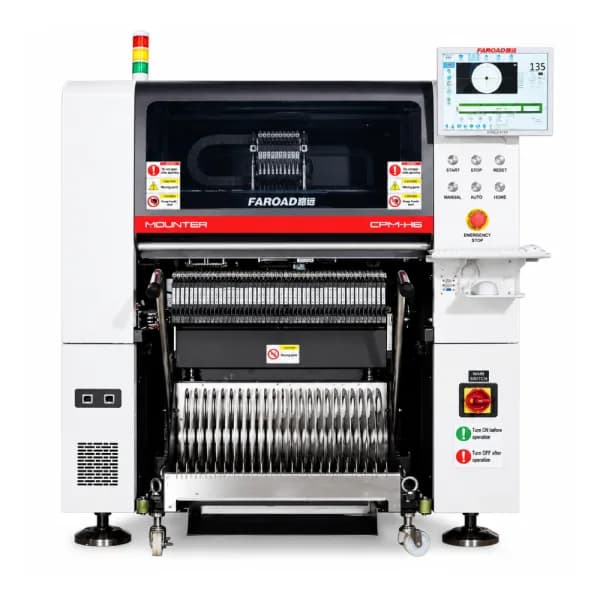
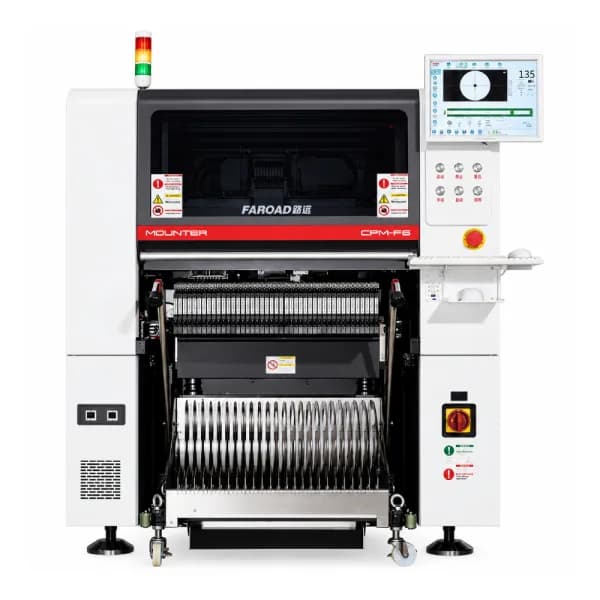
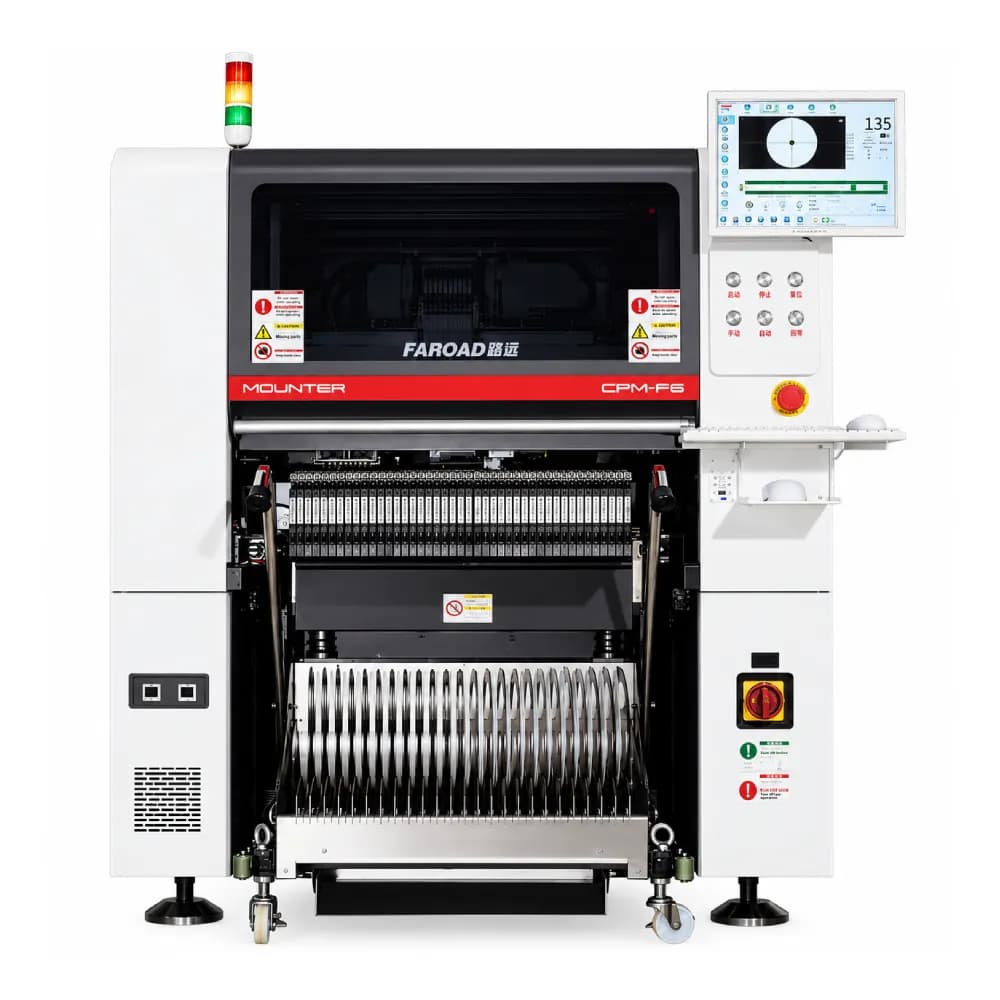
On the Inpex S510 and M400 pages, FAROAD lists 1D/2D barcode recognition, automatic width and program call-up from the PCB barcode, and support for MES instructions. On the CPM-F6 and the related CPM-F5, H6, HX40 and S5 pages, MES upload is listed as supporting QR code and barcode recognition and binding. The CPM-L3-600, L3-1200, L3F and L3T pages use the same idea: QR code or barcode recognition and binding for upload to MES. The MS-10 and the other MS and MS-D reflow pages list QR code or barcode recognition for MES upload.
If two adjacent machines cannot read the same code, or cannot call the right program from it, the line will depend on operators to close the gap. Make a sample of your actual board mark part of the trial.
What data is collected, and how it is sent
Ask each supplier to name the data, not just "MES compatible." Useful examples include the program or recipe used, cycle or process parameters, pass/fail results, and — at inspection — images or SPC summaries. Then ask how that data leaves the machine: the protocol, the format, and whether upload is tied to the board ID.
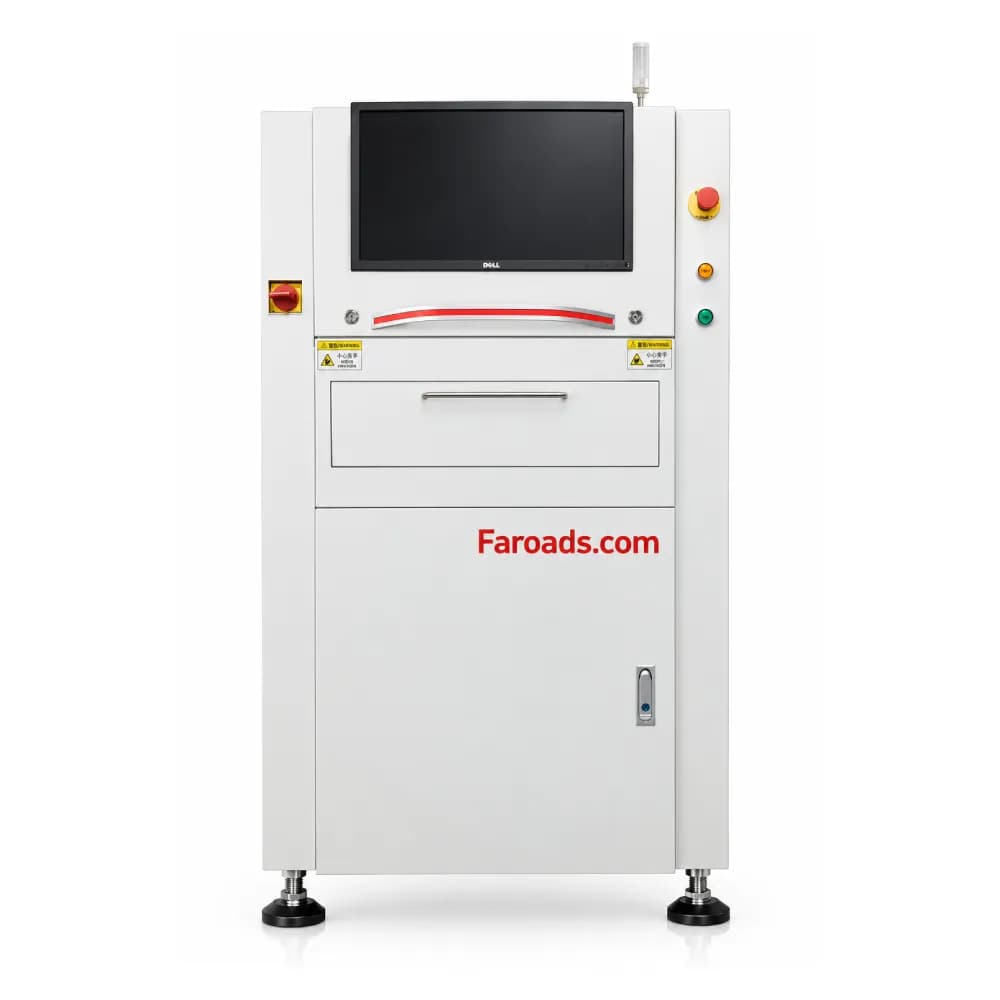
Where FAROAD pages name a protocol, they list TCP/IP. The CPM-F5, F6, H6, HX40 and S5 pages state that MES data collection supports the TCP/IP communication protocol. The CPM-L3 family uses the same wording. MS reflow pages state "MES Collection & Upload — Supports TCP/IP protocol." The Inpex AOI pages say the machines support MES instructions and can output a full-board image under different light sources for later quality traceability, together with SPC charts. The 3D SPI page lists MES integration with multiple data-format interfaces for transferring inspection data, and it lists a 1D/2D barcode scanner among the options. Do not treat that optional scanner as a substitute for the MES interface, and confirm whether the scanner is in the quoted configuration.
Do not invent HERMES or IPC-9852 support. Those terms do not appear on the FAROAD pages re-checked for this article. If you need a particular industry protocol, ask for it in the RFQ and require a demonstration.
Station-by-station: claim only what each machine lists
Coverage is uneven, and it should be quoted that way.
- Pick-and-place (CPM-F5, F6, H6, HX40, S5 and the CPM-L3 family): MES collection and upload are listed, with TCP/IP and QR code or barcode binding as above.
- MS reflow (MS-8, 10, 12, 14 and the D variants): SMEMA interfaces are listed, together with MES collection and upload over TCP/IP and QR code or barcode recognition. SMEMA is listed on these ovens; do not extend that claim to families that do not mention it.
- MK energy-saving ovens and MK-MAX LED ovens: the 18 November 2026 text extracts do not list MES, SMEMA or barcode. If you need traceability on those ovens, ask for it in writing rather than assuming it is included.
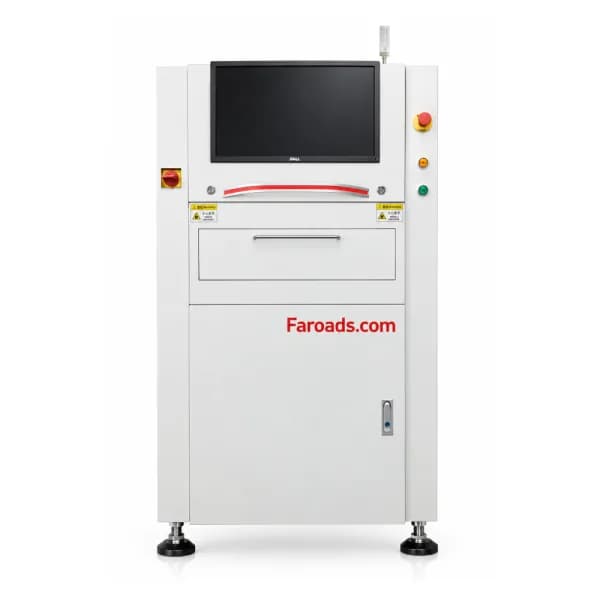
- Inpex S510 and M400: barcode, automatic program call-up, MES instructions, SPC and full-board image output, as above.
- 3D SPI: MES data interfaces are listed; a 1D/2D barcode scanner is listed as an option.
- P5, P6 and P20 printers: no MES or barcode function is listed in the 18 November 2026 extracts. If you need print-program traceability, ask whether it can be provided and how it will be shown.
- Magazine loaders, unloaders and the mini loader: the pages describe connection to conveyors and other SMT equipment. They do not list MES, SMEMA or barcode. Do not invent a loader identity step; ask if you need one.
The Inpex pages also mention possible closed-loop communication with coating or dispensing machines. Those categories are still marked Coming soon in FAROAD's equipment list. If that loop matters, put the request in the RFQ; do not treat it as a standard, currently sold cell.
Prove it in a connected trial
Write a short verification plan before the order. Use your real board mark, your real programs and, if you already have a MES or quality database, the actual destination system. The trial should show that the code is read, the correct recipe is called, the agreed data is stored or uploaded, and that a missing or unreadable code produces a defined response rather than a silent pass.
SMEMA transfer, where it applies, can be proven in the same run, but it does not replace the data checks. If one station cannot participate, record that as a gap with an owner, not as an assumption that the rest of the line will cover it.
Frequently asked questions
Does SMEMA give me MES traceability? No. SMEMA is a transfer handshake. It keeps boards moving between machines. It does not, by itself, record a board ID or upload process data.
Can I assume every FAROAD machine has the same MES functions? No. Pick-and-place, MS reflow, AOI and SPI pages list MES-related functions. MK, MK-MAX, the P5/P6/P20 printers and the loaders do not in the current page text. Ask where it is missing.
Do I need HERMES to buy a FAROAD line? Only if your plant standard requires it. FAROAD pages re-checked for this article do not list HERMES. If you need it, make it a written requirement and a trial item.
Is a barcode scanner on the SPI enough for inspection traceability? Not by itself. The SPI page lists MES data interfaces separately from an optional 1D/2D barcode scanner. Confirm both the identifier and the data upload in the quoted configuration.
Request a traceability-capable line review
Send FAROAD the board identifier you use, the stations that must record data, and any MES or quality system the equipment must talk to. We will map what is listed on each machine and propose a connected trial. Request a quote to start that review.