PCB Warpage on the SMT Line: Which Equipment Features Help
Thin, large or already-bowed boards are hard to print, inspect and place. Here are the equipment features that help — and what to ask for where a specification is not published.
5 min read
Thin boards, large panels and boards that already arrive bowed are difficult to print, inspect and place. Heat in reflow can add more distortion. This article is about the equipment features that help you keep those boards in process — and about the evidence you should ask for where a feature is not published.
It is not a guide to choosing a rail or a mesh conveyor; that comparison is in our reflow oven rail vs mesh belt article. It is also not a promise that any one machine will flatten a badly warped panel.
Why thin or large boards warp on an SMT line
Boards warp because copper, laminate and residual stress do not expand equally, and because thin or large panels sag under their own weight when they are poorly supported. Some warp is already in the bare board. Some appears when the stencil leaves the panel, when a placement clamp presses a bow, or when the assembly is heated.
The practical effect is the same: the stencil does not seal, paste height is mis-read, a nozzle places into a valley or onto a peak, or a board sags in the oven. You cannot inspect that risk at only one station.
Printing: support the board so the stencil can seal
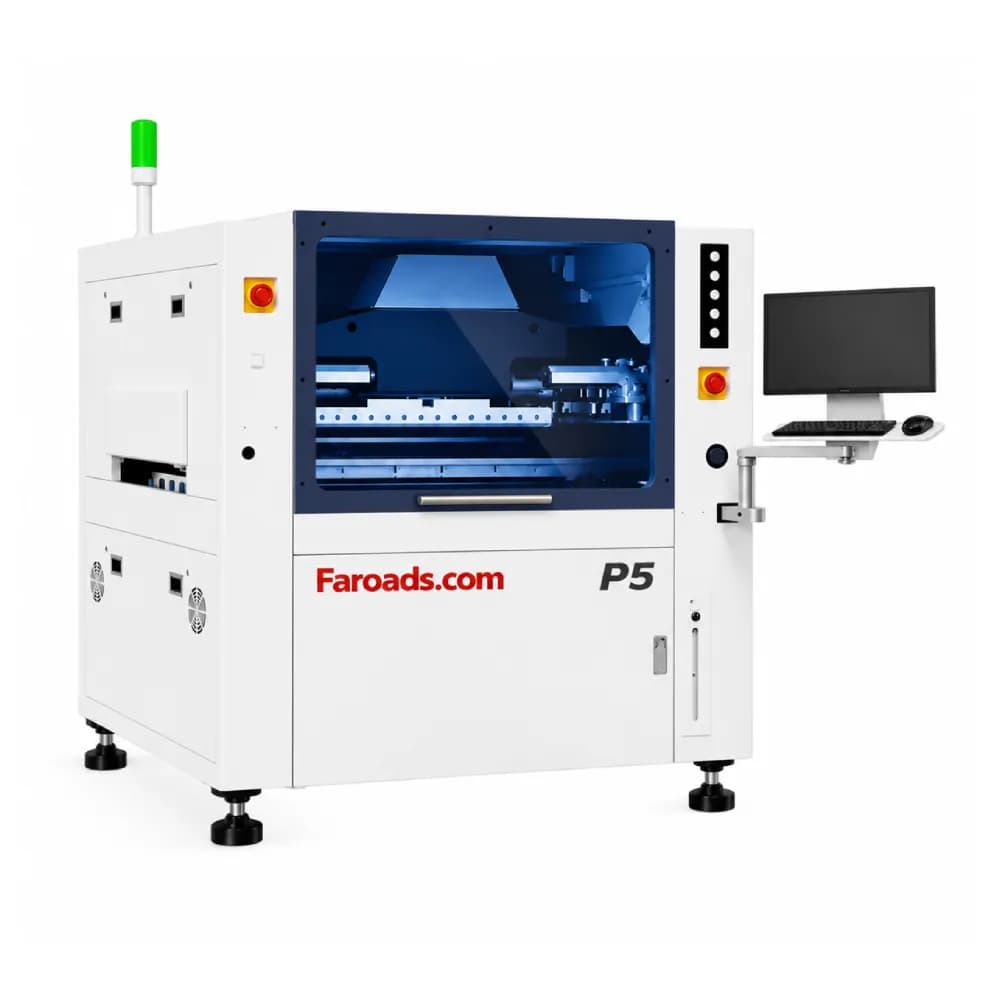
At the printer, warp becomes a gasket problem. If the panel is only held at the edges, the center can drop or rise relative to the stencil. The result is smear, bleed, incomplete transfer or a print that looks shifted because the board moved.
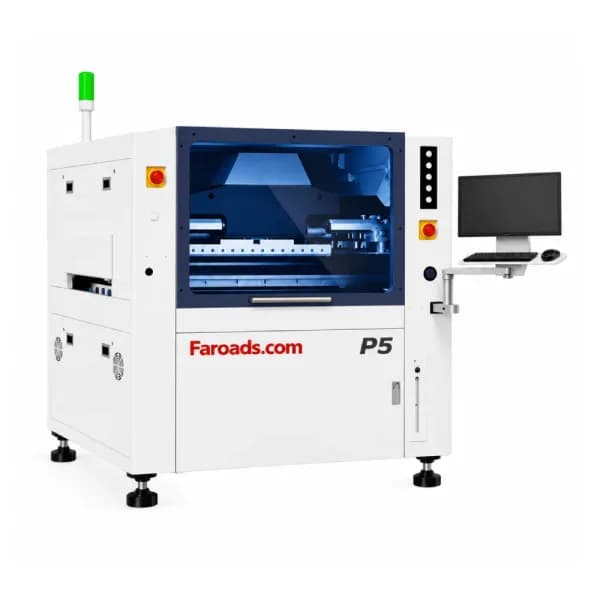
The live P6 and P5 pages describe a tooling set that holds the panel from underneath and at the edge: blocks, pins, and a vacuum cavity that can be assembled to suit the board, plus a flexible edge clamp and a platen that retracts in the Z direction. Blocks and pins give you local support under heavy or open areas. Vacuum helps hold thin or flexible regions flat during the stroke. Those pages also list automatic platform-height calibration to board thickness, which helps the stencil meet the board rather than assuming every panel is the same.
In a trial, print your thinnest and largest production boards, not only a stiff coupon. Look at paste release in the center of the panel as well as at the edges.
Inspection: compensate for warp instead of mis-measuring paste
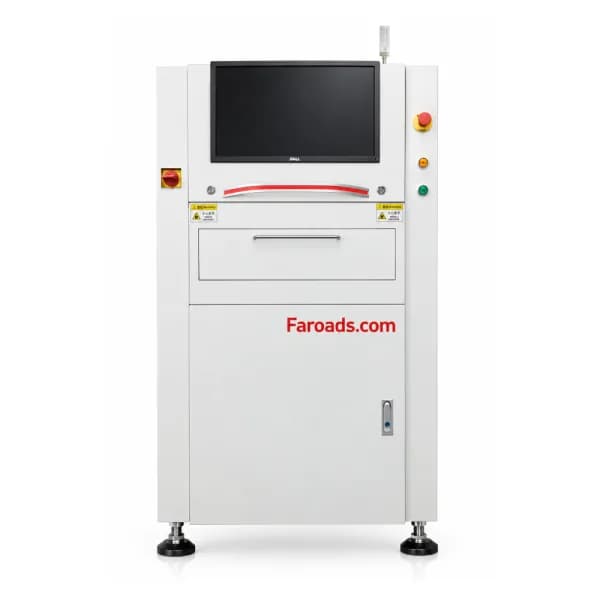
A warped board can fool solder paste inspection. If the reference plane is wrong, a good deposit can be called short or tall, and a real defect can be missed. The feature to ask for is warpage compensation, plus a published measuring range that covers the bow you actually see.
The FAROAD 3D SPI inspection machine page publishes a warp-correction method for flexible boards (a live Z adjustment plus a static correction in the telecentric lens) and states that it can measure a bowed PCB up to ±5 mm. Use that ±5 mm limit as a check against your worst production bow. If a panel exceeds it, do not assume the machine will still measure correctly — raise it in the quotation and in the trial.
This is an inspection capability, not a cure for the warp itself. The board still has to be printable and placeable.
Placement: detect warp before parts are committed
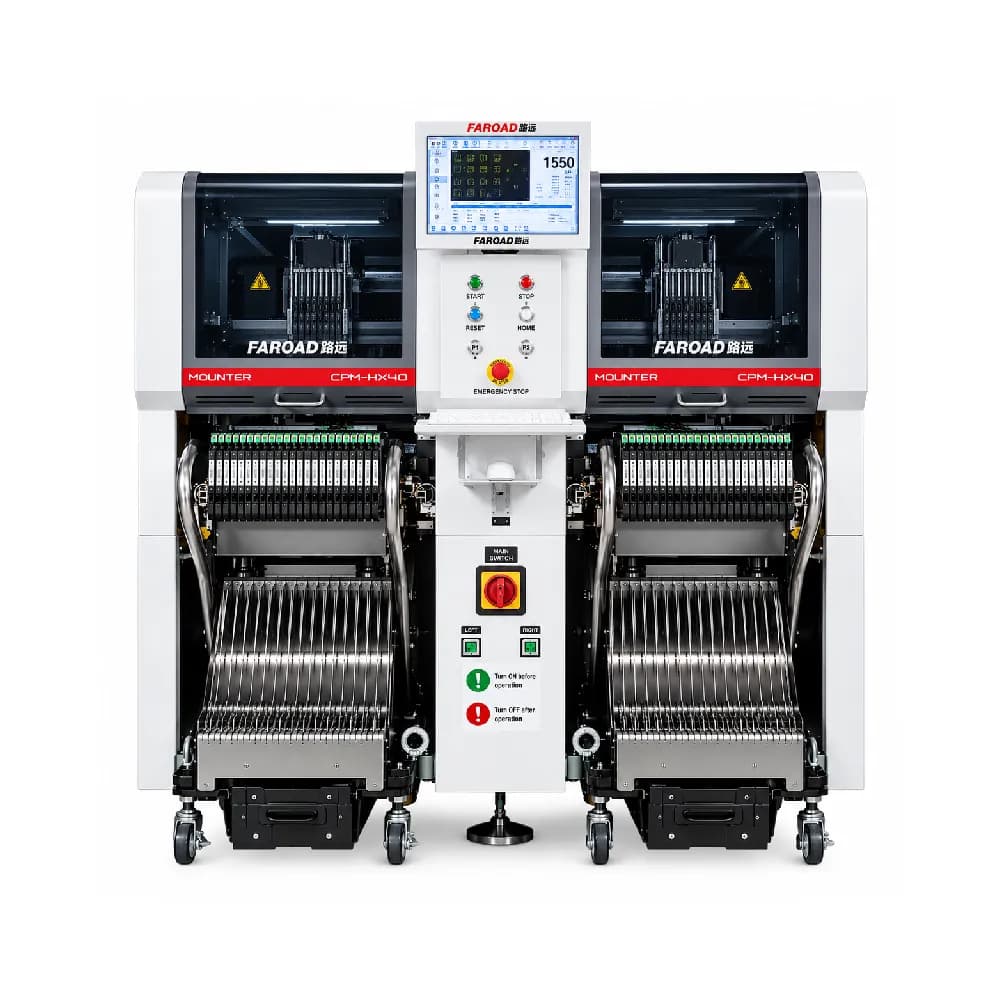
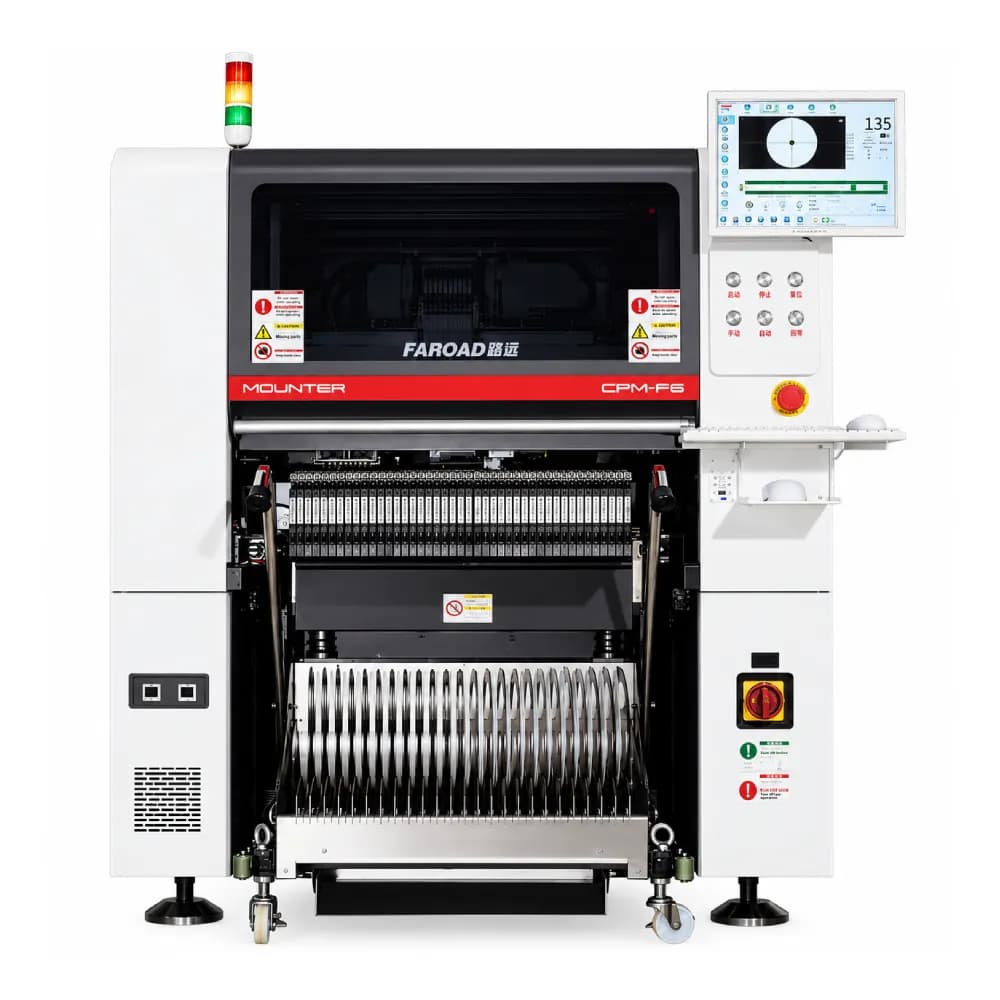
On the mounter, a bowed board changes the true height of the pad. Parts can be placed long, short, or with poorly seated leads. Two published FAROAD features are relevant, and both are options — they are not assumed to be in every machine.
The CPM-F6, CPM-H6 and CPM-HX40 pages list optional substrate warping detection. The H6 and HX40 pages describe that option as laser-based; the F6 page lists the option without a sensing method, so confirm the method in the quotation. The F6 page also lists optional force control management, which can help when a part is being placed onto a surface that is not perfectly flat. F6 and H6 also list board fixing with a lifting platform and upper and lower clamps (pneumatic on F6, electric on H6), which is the mechanical side of keeping a panel still.
If you buy the option, the trial should include your most bowed board and a check of what the machine does when warp is detected — skip, alarm, or height compensation. A detection feature with no agreed reaction is only a log entry.
Reflow: ask for support-at-temperature evidence
Reflow is where remaining bow often gets worse, especially on large, thin, or unevenly coppered boards. Some ovens offer a center support or similar hold-down through the heated tunnel. As of the product pages checked on 17 November 2026, FAROAD MS and MK reflow oven specifications do not clearly list a center-support device. We will not invent that specification.
What you should do is ask for evidence: how the quoted oven will support your thinnest and widest boards at temperature, whether a center support or equivalent can be offered, and how that arrangement is demonstrated on a loaded board. Conveyor choice also affects how a board is carried; use the rail-versus-mesh article for that decision rather than treating support-at-temperature as a belt-type issue alone.
If the board is already badly warped before reflow, fix print and handling first. An oven cannot reliably recover a panel that entered the tunnel out of specification.
Frequently asked questions
Can equipment remove warp that is already in the bare board? It can reduce the effect — better support, compensation and detection — but it will not make a badly manufactured panel flat. Set an incoming-board limit as well as machine features.
Is vacuum support always required in the printer? No. Many rigid boards run on blocks and pins. Thin, large or flexible panels are the cases where a vacuum cavity is worth specifying and testing.
Does SPI warpage compensation replace a flatter board? No. Compensation helps the measurement stay valid on a bowed panel, within the published ±5 mm range. It does not correct the print or the placement.
Why is a FAROAD oven center-support not listed here? Because it is not clearly published on the current MS and MK product pages. Ask for support-at-temperature evidence on your boards when you request a quote.
Request a warpage-capable line review
Send FAROAD your thinnest and largest panels, any known bow, and the stations where warpage already costs you yield. We will review printer support, SPI compensation, placement options and the oven evidence you should require. Request a quote to start that review.